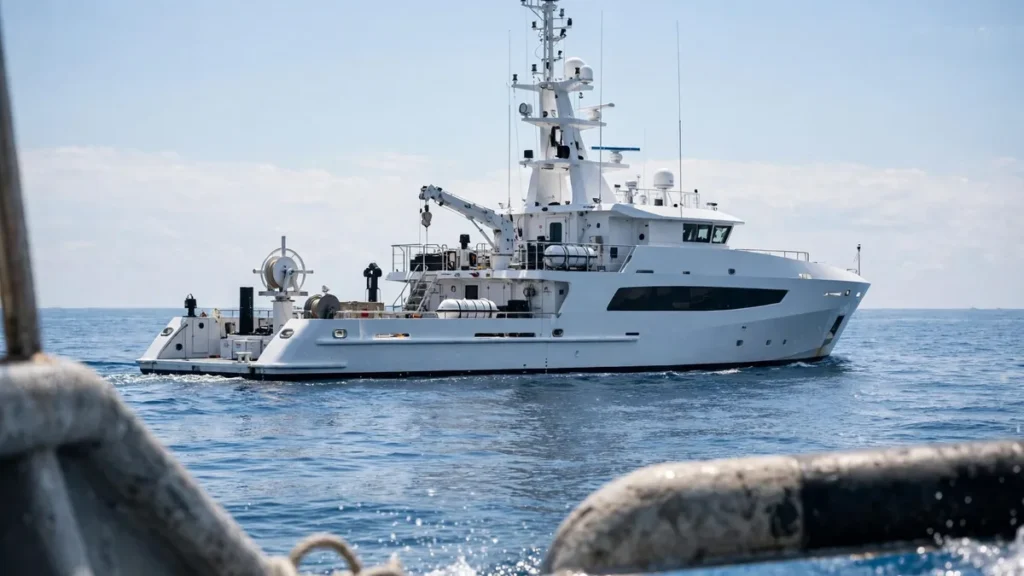
The marina was packed tight and the wind was pushing sideways across the fairway. The captain of the white yacht at the end of the row did not call for a tug or shout for extra hands. He tapped a small joystick on the flybridge, and the bow of his yacht slid sideways, smooth and unhurried, into a gap that looked too small for it. To everyone watching, it looked like nothing at all — which is exactly the point.
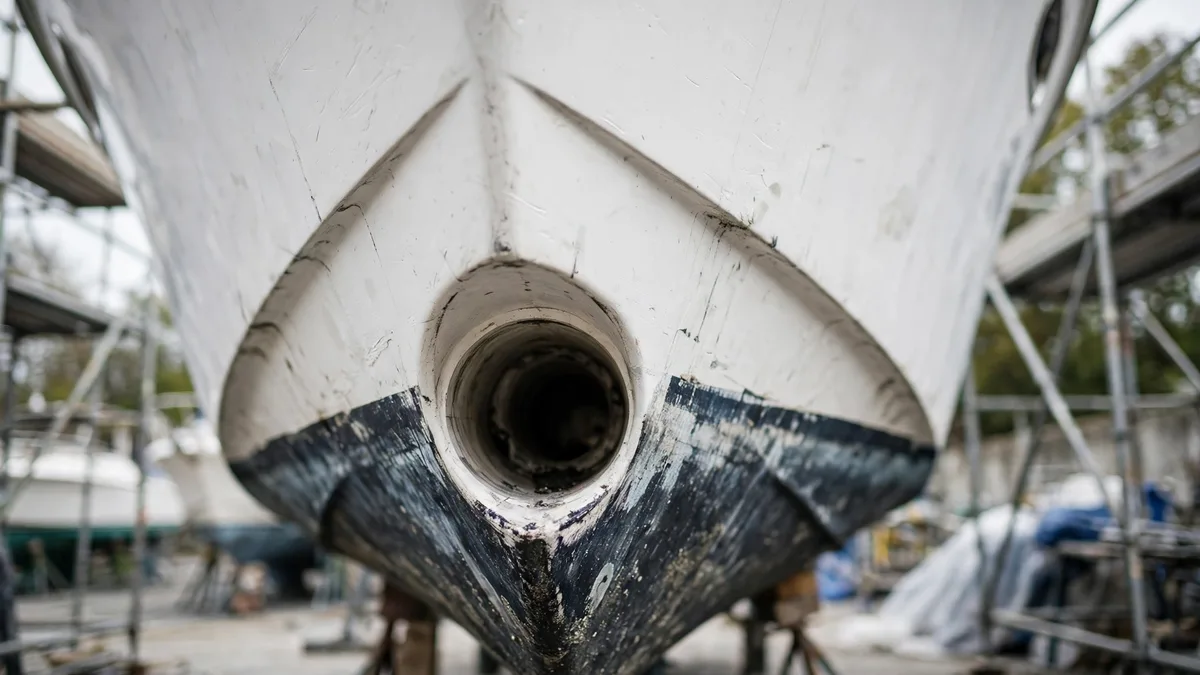
What moved that bow was a tunnel thruster: a propeller set sideways inside a tube through the hull near the bow, pushing water from one side to the other. It is a small piece of machinery doing a very hard job in a very hostile place, and one of the most expensive pieces of equipment per kilo on the whole yacht.
A bow thruster lives underwater, in salt water, expected to work instantly after months of sitting still. It must be powerful enough to push tonnes of hull sideways against the wind, quiet enough not to disturb the owner, and reliable enough that it never fails when it is needed most. Here is where the money goes.
Why the Yacht Bow Thruster Costs So Much
1. A propeller that must push sideways, not forward
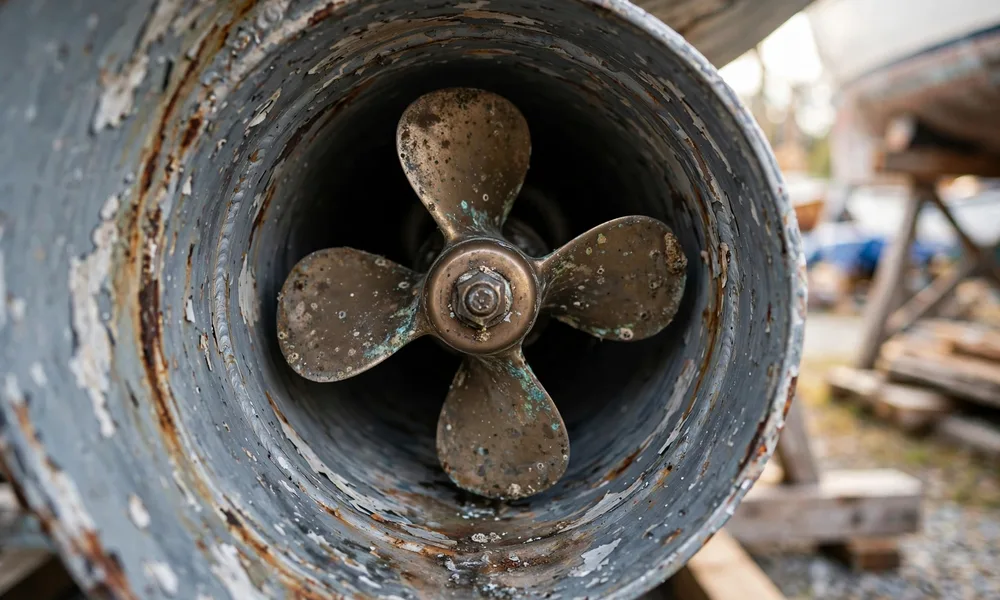
A normal propeller pushes a boat forward, in clean water, with the whole hull helping it. A bow thruster propeller does the opposite: it sits inside a short tunnel, pushes water sideways, and fights the shape of the hull itself. The blades are short, wide and heavily loaded, and must produce a huge sideways force from a very small diameter. Designing blades that grip the water without cavitating — without the water boiling into bubbles that eat the metal — takes careful testing. A thruster that cavitates is loud, weak and short-lived, so the propeller alone is a precision part, often cast in bronze and finished by hand.
2. A tunnel cut through a structural hull
The tunnel is a tube set into the bow, one of the most heavily loaded parts of the hull, built in without weakening the structure around it. On a fibreglass yacht it is laminated in with extra glass and resin; on a steel or aluminium yacht it is welded in and faired smooth. The inside must be perfectly round and smooth, because any roughness costs thrust and makes noise. The work is done by hand, in a cramped space, and a badly fitted tunnel can hum, vibrate, or crack the hull around it.
3. A motor sealed against salt water forever
The thruster motor sits in the worst place on the boat: low down, near the bow, where any leak arrives first. It is usually an electric or hydraulic motor, sealed to keep salt water out for years. The seals, bearings and windings are all marine grade, and the motor must survive being dunked, left idle for months, then asked for full power without warning. A motor built for a factory floor would die in a season. A marine thruster motor is built like a submarine part, and priced like one.
4. Power that arrives in a violent burst
A bow thruster does not sip power. A large yacht thruster can draw hundreds of amps in a few seconds, more than everything else on the boat combined. That means heavy copper cables run the length of the yacht, a dedicated battery bank or hydraulic power unit, and controls that switch that load safely. The installation is not just the thruster: it is the power supply, the breakers, the wiring and the cooling that support it, and on many yachts it costs as much as the thruster itself.
5. Controls that must be simple and instant
When a captain needs the bow to move, he needs it now, in exactly the direction he expects, with no delay and no surprise. Thruster controls are therefore built to be foolproof: a joystick or a pair of buttons, a proportional response, and a system that stops the instant the hand comes off. Behind that simplicity is a control unit that watches motor temperature, battery voltage and run time, and shuts the thruster down before it overheats — because a thruster is only rated for short bursts, typically a few minutes at a time.
6. Silence, smoothness and no vibration
A superyacht owner does not expect to hear the machinery. A bow thruster that rattles, hums or shakes the bow is a failure, even if it pushes the boat well. So thrusters sit on flexible mounts, the tunnel is faired to reduce noise, and the propeller is balanced to a fine tolerance. Some yachts fit a retractable thruster that folds away when not in use, adding no drag and no noise underway — but that adds a hydraulic lifting mechanism, more seals and more cost.
7. A tiny market and a long service life
Only a few thousand large yachts are built each year, and each needs at most one or two bow thrusters. The makers of the best thrusters are small specialist firms, building in small batches, with no mass-market volume to spread the cost of design, testing and certification. Every unit is expected to last twenty years or more, with spare parts available for decades — and that long support tail is priced into every thruster.
Yacht Bow Thruster Specifications
| Specification | Typical figure |
|---|---|
| Thrust | 40 to 500 kgf, depending on yacht size |
| Tunnel diameter | 185 to 300 mm on large yachts |
| Propeller | Bronze alloy, 4 to 5 blades |
| Motor | Electric DC or hydraulic, 4 to 30 kW |
| Power draw | Up to several hundred amps at full thrust |
| Run time | Short bursts, typically 2 to 4 minutes |
| Service life | 20 years or more with maintenance |
What a Yacht Bow Thruster Costs
Prices are estimates and vary widely with size, brand and installation. A small electric thruster for a 12-metre yacht can cost around $3,000 to $6,000 for the unit alone, while a large hydraulic thruster for a 40-metre superyacht can cost $30,000 to $80,000 before installation. Fitting, cabling, batteries and controls often add 50 to 100 percent on top. A full installation on a large yacht can pass $150,000 — a lot of money for a propeller in a tube, until the wind picks up in a crowded marina and the bow slides sideways exactly where the captain wants it.

A Rare Fact About Bow Thrusters
Some of the largest superyachts carry thrusters so powerful that they can hold the whole vessel in place against a strong wind without any anchor at all, a trick called dynamic positioning. The system reads the wind and the current, fires the thrusters in tiny bursts, and keeps the yacht hovering over one spot — the same idea that keeps offshore drilling ships in place over a wellhead, scaled down and silenced inside a pleasure yacht.
The bow thruster is easy to overlook because its whole job is to make hard things look easy: a propeller, a tunnel, a motor and a control system, built to survive salt water and neglect, hidden behind a round hole in the bow most people never notice. That invisibility is the achievement — and the reason it costs what it does. For the wider story of how a yacht moves, see how a yacht bow thruster is made, the numbers behind yacht propeller specifications, and how a yacht rudder works.