Watch a large yacht slide sideways into a tight marina berth, moving perfectly parallel to the dock without a tugboat in sight, and you are watching a bow thruster at work. It is a propeller hidden inside a tunnel through the bow of the boat, and it pushes water sideways to swing the front of the yacht left or right. Without it, a captain would need the main engines, the rudder, and a good deal of luck to dock a fifty-metre yacht in a crosswind. With it, the same manoeuvre looks effortless, and the yacht glides in as if it were on rails.
A bow thruster is a simple idea wrapped in hard engineering. The tunnel weakens the hull, the propeller lives in the dirtiest water a yacht meets, and the motor must deliver enormous thrust in short bursts without overheating. Building one means balancing all three problems at once.

How It’s Made
Step 1: Designing the tunnel
Everything starts with the tunnel: a tube through the bow, below the waterline, usually near the front third of the hull. Engineers choose its diameter from the size of the yacht — a small yacht might use a 185 mm tunnel, while a large superyacht can need one of 500 mm or more — and its position from the shape of the bow, because a tunnel too far forward sits in thin water and loses thrust. The tunnel weakens the hull where it passes through, so the surrounding structure is reinforced, and the tunnel is faired smoothly into the hull so water flows past it cleanly under way. Cutting a hole through a yacht’s bow is not something you do twice, so the design is settled long before the hull is built, in the same careful planning that shapes the hull itself, as our look at superyacht hull construction explains.
Step 2: Casting the propeller
The propeller is the heart of the thruster, and it is cast from bronze, usually a nickel-aluminium bronze that resists corrosion in seawater. The blades are cast as a single piece, then machined on a five-axis mill that shapes each blade to a precise curved profile, because a blade that is even slightly wrong will vibrate, cavitate, and eat itself alive in the tunnel. The finished propeller is balanced on a machine that spins it at high speed and measures any wobble, and blades that fail are re-machined or scrapped. Most bow thrusters use a propeller with four or five blades, chosen to give smooth thrust in both directions, which is why its blades are symmetrical in a way a normal propeller’s are not.
Step 3: Building the gearbox and motor
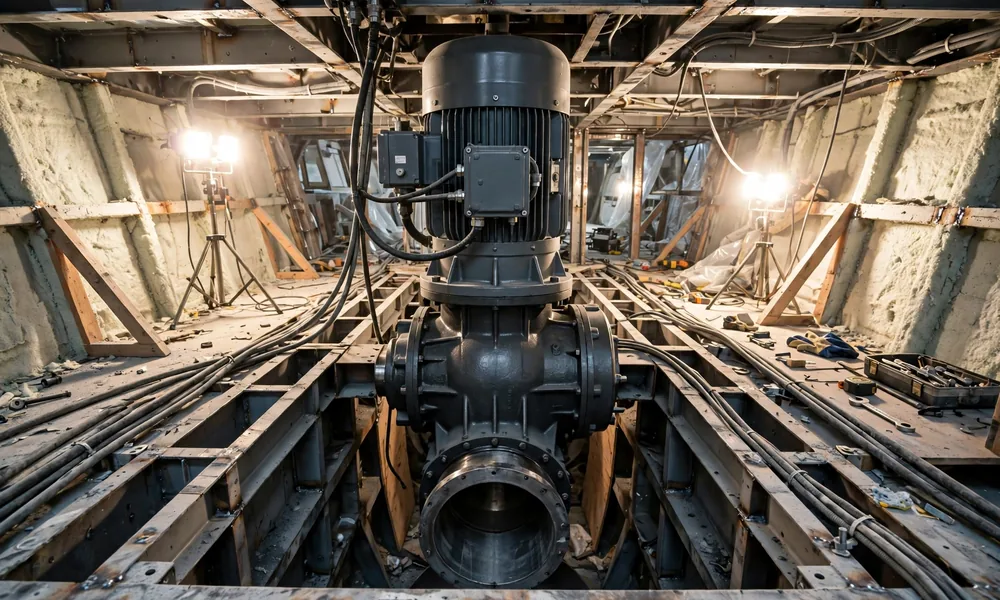
The propeller is driven by an electric motor or a hydraulic motor, mounted vertically above the tunnel and connected to the propeller by a gearbox with a pair of bevel gears that turn the drive through ninety degrees. The gears are cut from hardened steel, ground to a fine finish, and run in oil inside a sealed housing, because salt water in a gearbox is a death sentence. The whole drive unit is assembled on a bench, tested under load, and only then lowered into the hull.
Step 4: Fitting the tunnel and drive
Installation is a shipyard job. The tunnel tube is welded or laminated into the hull while the yacht is still under construction, and its ends are faired and painted with antifouling paint to keep marine growth out. The drive unit is bolted to a flange on top of the tunnel, the propeller is fitted onto its shaft from below, and the shaft seals are tested under pressure to make sure no water can leak into the boat. Then the motor is wired to the yacht’s electrical system, often through a dedicated battery bank or a generator, because a thruster’s appetite for power is far too large for the yacht’s ordinary house batteries. Keeping a yacht steady in a crosswind is a team effort between several systems, and the thruster works alongside the stabilisers that keep the boat level at anchor, as our look at yacht gyroscopic stabilizers explains.

Step 5: Testing in the water
A thruster is not properly tested until the yacht is afloat. In the yard, the motor is run in both directions while engineers listen for vibration and check the current draw. Then, on sea trials, the captain uses the thruster to hold the yacht against a wind, to turn it in its own length, and to slide it sideways into a berth, while the engineers measure how much thrust it actually delivers and how quickly the motor heats up. Only when the boat can be parked sideways in a breeze is the system signed off.
Step 6: Controls and safety
The last step is the part the captain touches: the controls. A bow thruster is driven from a joystick or a pair of buttons on the helm, and modern systems link it to the yacht’s joystick docking system, which combines the thruster, the main engines, and the stern thruster into a single control that moves the boat in any direction. The system is also linked to the yacht’s anchor handling, because the same crew that docks the boat must also hold it in place, as our look at how a yacht anchor system works shows.
Specs
| Specification | Detail |
|---|---|
| Type | Tunnel bow thruster, electric or hydraulic drive |
| Tunnel diameter | Typically 185 to 500 mm, depending on yacht size |
| Propeller | Four or five blades, nickel-aluminium bronze, symmetrical for equal thrust both ways |
| Thrust | Typically 40 to 500 kgf, depending on model and yacht size |
| Motor power | Typically 3 to 30 kW electric, or hydraulic equivalent |
| Drive | Vertical motor with 90-degree bevel gearbox, sealed oil-filled housing |
| Controls | Helm joystick or buttons; often integrated with joystick docking |
| Duty cycle | Short bursts, typically a few minutes at a time, with thermal cut-out |
Price
A bow thruster is one of the more expensive single systems on a yacht to buy and install. A complete unit for a mid-size yacht costs roughly $5,000 to $15,000 (estimate), including the tunnel, propeller, motor, and controls, while a large superyacht thruster can cost $50,000 or more (estimate); retrofitting one into an existing yacht can add thousands more in yard labour. It is a lot of money for a machine used only a few minutes a day, but owners who have docked a large yacht in a crosswind without one rarely argue about the price.
Rare Fact
A bow thruster can move a yacht sideways, but it cannot move it forwards — and that is the point. By pushing water sideways through the tunnel, it turns the bow into a steering wheel of its own, letting a captain spin a yacht almost in its own length. The fastest yachts in the world, in other words, hide their parking aid — and the slowest manoeuvre a yacht ever makes is the one that needs the most engineering.


