Stand on the deck of a yacht in a rolling sea and you expect to be thrown from side to side. Instead the deck stays almost level, the coffee stays in its cup, and the horizon tilts only a little. Below the waterline, out of sight, two fins are working like aeroplane wings turned on their side, pushing the hull back upright every time a wave tries to roll it.
Those fins live in one of the harshest places on a boat: underwater, under load, and under constant attack from salt. Everything about them is a compromise between strength and weight, and between moving fast enough to catch a wave and lasting long enough to be worth the price. The materials do most of the work.
Here is what those materials are, and why each one earned its place.

The Materials Behind the Yacht Stabilizer Fins
1. The fin itself, a wing that lives underwater
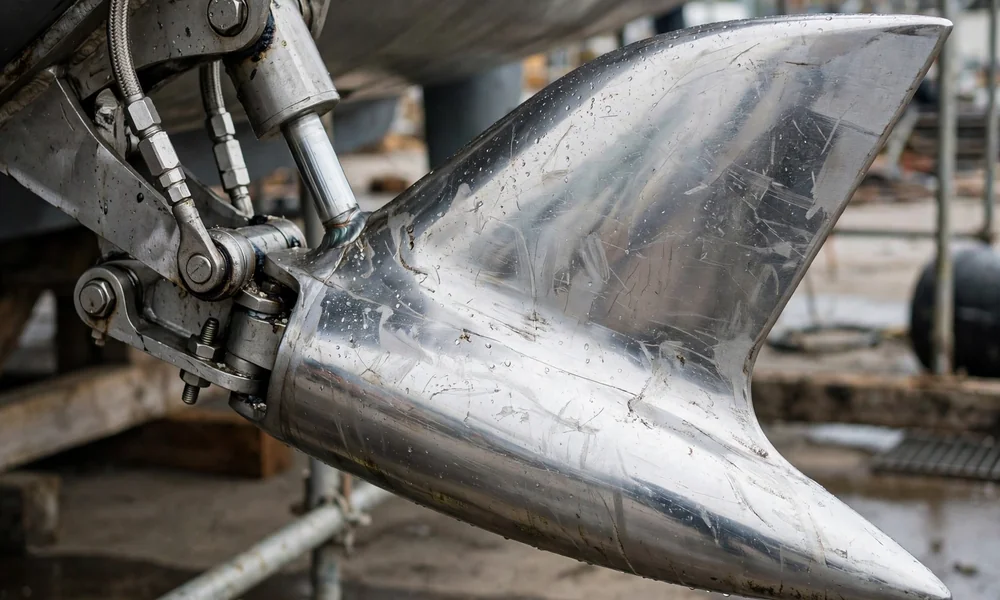
The fin is shaped like a small aircraft wing, and it is built like one too. Most modern fins are stainless steel or nickel-aluminium bronze, both strong in salt water and resistant to pitting. Some builders use a fibreglass composite fin with a steel core, which is lighter and can be moulded into a finer shape. The fin has to be stiff enough not to flex under load, because a flexing fin responds late, and a late fin is worse than no fin at all. Making one is a precise job, and how yacht stabilizer fins are made follows the process from the first casting to the final polish.
2. Hydraulic cylinders, the muscle behind the fin
The fin does not move on its own. It is driven by hydraulic cylinders, steel rams that push and pull the fin through its arc many times a minute. The cylinders are honed steel tube with chrome-plated piston rods, built to survive the oil pressure inside and the salt water outside. The seals are the weak point: a single failed seal lets seawater into the oil, and contaminated oil can destroy a pump worth more than a small car. The seals are tough polyurethane and Viton rubber, inspected at every haul-out. The fin’s speed and range are listed in the yacht stabilizer fins specs explained.
3. Shaft, bearings and seals, where the fin meets the hull
The fin is fixed to a shaft that passes through the hull, and that shaft is one of the most stressed parts of the whole system. It is usually a large stainless steel forging, machined smooth so the seals can ride on it without wearing. The bearings are heavy-duty, a roller bearing for the load and a plain bearing for guidance, lubricated and sealed against the sea. Where the shaft enters the hull there is a stuffing box or a mechanical face seal, the last line of defence against a leak. A failure here lets the sea into the boat, which is why this joint gets more attention at survey time than almost anything else below the waterline.
4. The hull mounting, steel that spreads the load
A fin pushing against the sea pushes back against the hull with tonnes of force, and that force has to go somewhere. Inside the hull, the stabilizer is bolted to a reinforced foundation of welded steel plate, tied into the frames and floors of the hull structure. The foundation is often the heaviest part of the installation, and it is designed into the yacht from the start. The keel below takes the same kind of load in a different way, and how a yacht keel is made shows how ballast and structure are combined to keep a sailing yacht upright.
5. Coatings and anodes, the fight against corrosion
Everything below the waterline is coated, and the fin is no exception. It is primed with epoxy, painted with antifouling paint that slowly releases biocides to stop weed and barnacles growing, and protected by sacrificial zinc anodes bolted nearby. The anodes are made from zinc because zinc corrodes first, giving up its own metal so the steel and bronze of the fin survive. When the anodes are eaten away they are replaced, usually at each haul-out. Divers clean fins between haul-outs on yachts that stay in the water all year.
6. Sensors and control housings, the brains in a waterproof box
The fin is only as good as the system that tells it when to move. Gyroscopes and accelerometers measure the roll of the yacht, and a control unit calculates the fin angle needed to cancel it, many times a second. The sensors sit in sealed housings, usually stainless steel or anodised aluminium, rated to keep water out even when the compartment floods. The cables run through watertight glands, and the connectors are gold-plated to resist corrosion. The software is built to spot a bad reading and centre the fins rather than trust it. The electronics are the cheapest part of the installation, but they decide whether the steel below does anything useful.
Yacht Stabilizer Fins Materials
| Material | Where it is used | Why it is chosen |
|---|---|---|
| Stainless steel or nickel-aluminium bronze | Fin itself | Strong in salt water, resists pitting and corrosion |
| Honed steel with chrome-plated rods | Hydraulic cylinders | Survives high pressure inside and salt water outside |
| Forged stainless steel shaft | Fin shaft and bearings | Carries tonnes of load, smooth enough to seal |
| Welded steel plate | Hull mounting foundation | Spreads the fin’s force into the hull structure |
| Epoxy, antifouling paint, zinc anodes | Coatings and protection | Stops fouling and sacrifices itself to save the fin |
| Anodised aluminium and stainless housings | Sensors and controls | Keeps water out of the electronics that steer the fins |
What Do Yacht Stabilizer Fins Cost?
A pair of stabilizer fins is estimated at roughly $100,000 to $500,000 installed, depending on the size of the yacht and whether the fins retract into the hull. The fins themselves are only part of the bill: the hydraulics, the hull reinforcement and the control system cost as much again. Running costs are lower but never zero, with seals, anodes and antifouling to renew at every haul-out. Owners usually call them the most expensive comfort on the boat, and the one they would never give up.
A Rare Fact
Fin stabilizers were first fitted to ships in the 1930s, and the early Denny-Brown system used fins driven by a gyroscope, with no electronics at all. The idea was the same as today: a fin angled into the water produces lift, and lift on one side of the hull cancels the roll of a wave. Modern systems can cut roll by up to 90 percent, which is why they are now standard on almost every large yacht.
Yacht stabilizer fins look simple from the dock, a pair of metal wings tucked against the hull, but they are a system where every material covers a weakness in the one next to it. The bronze takes the salt, the steel takes the load, the seals take the pressure, and the zinc takes the corrosion. Keep them working together and the sea feels flatter than it is.


