In a wooden boatyard the first thing you notice is the smell. It is cedar and teak and fresh varnish, mixed with sawdust that hangs in the light coming through the shed doors. A hull stands upside down on stocks in the middle of the floor, its ribs curving like the bones of some great animal, and a shipwright in a dusty apron is running his hand along a plank, feeling for a hollow the eye cannot see.
Wooden yachts are still built this way because no other material does quite what wood does. Timber is warm underfoot, quiet in a seaway, and easy to repair in a remote port with hand tools. This is how a luxury wooden yacht is made.

Step 1: Choosing and seasoning the timber
Every wooden yacht starts in the timber store, not on the drawing board. The hull planking is usually mahogany or teak, the frames are oak, and the deck is teak over a plywood or planked base. Each species is chosen for a job: oak for strength where the frames take the load, mahogany for planks that must bend in a fair curve, teak for decks that will be walked on barefoot in the sun and hosed down every evening.
Good timber is seasoned for years, not months. Planks are stacked with spacers so air can move between them, and the moisture is checked again and again until it settles near the level the finished boat will live at. Wood that is still drying will shrink after it is fitted, opening seams along the hull. Wood that is too dry will swell when it first meets the sea.
Step 2: Lofting the lines and raising the frames
Before any wood is cut, the yacht’s lines are drawn full size on the loft floor, a smooth expanse of boards painted pale so the curves show clearly. Long flexible battens are bent through marked points to fair the shape of the hull, and every frame station, waterline, and deck edge is lifted from those drawings.
The keel is laid first, a heavy backbone of oak or laminated mahogany, bolted to a building jig so it cannot move. Then the frames go up one by one, each steamed until it bends without breaking and clamped to the keel while it cools into shape. From Steel Plate to Superyacht Hull shows the same moment in steel, where plates are cut and welded instead of bent, but the logic is identical: the backbone first, then the shape, then the skin.
Step 3: Planking the hull
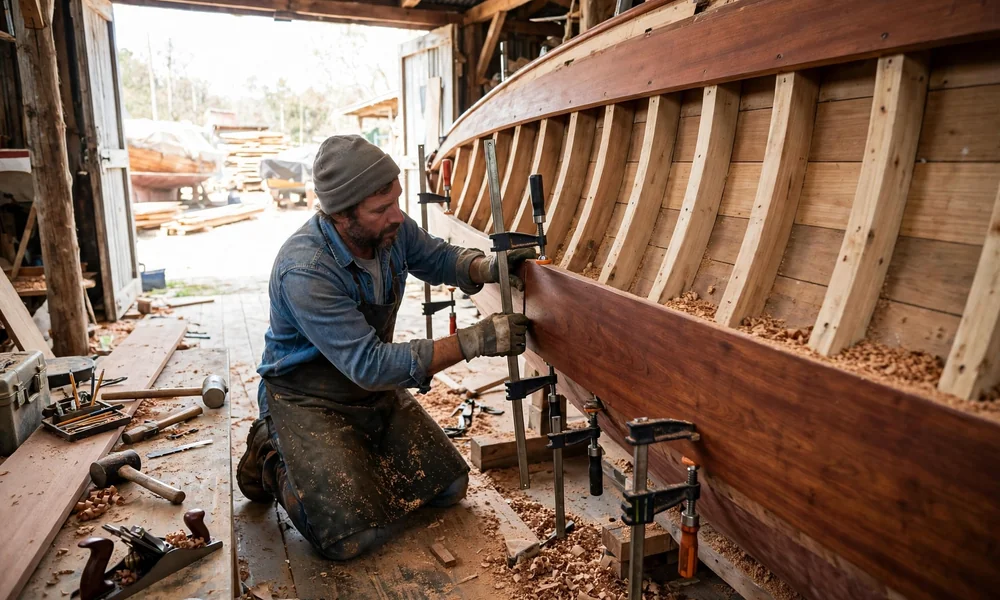
Planking is the slowest part of the build and the one that decides how the yacht will look for the next fifty years. Each plank is spiled, which means its shape is taken from the hull with a thin batten and transferred to the timber, then cut, planed, and steamed so it can be bent into place without splitting.
The seams are caulked with cotton and oakum, hammered in with a caulking iron and then payed with a seam compound that stays flexible as the wood moves. The fastenings are bronze or copper, never ordinary steel, because steel rusts, stains the wood, and swells until it splits the plank around it.
Step 4: Decks and the superstructure
Once the hull is planked and faired smooth, the deck goes on. On a luxury wooden yacht the deck is almost always teak, laid in narrow strips with dark seams, over a watertight sub-deck. Each strip is bedded, screwed, and plugged with a teak bung cut from the same plank, so the fastenings disappear and the deck reads as one unbroken surface. Teak Decks, Laid One Plank at a Time follows this work in detail, from the first king plank down the centreline to the last margin board at the edge.
The deckhouses and skylights are built next, framed in mahogany and glazed with thick glass or acrylic. The bulwarks and the cap rail, the heavy timber that runs around the edge of the deck, are shaped by hand and varnished until they shine like furniture.
Step 5: The interior joinery
The inside of a wooden yacht is where the luxury shows. Joiners fit bulkheads, berths, lockers, and a galley into a space that curves in every direction, and almost nothing is square.
Varnish is applied coat after coat, rubbed down between coats until the surface is deep and glassy. The Best Luxury Yacht Interiors, Ranked shows what this craft earns at the top of the market, where the difference between a good interior and a great one is measured in the grain of a single panel and the feel of a handrail.
Step 6: Launch, trials, and handover
A wooden yacht is launched with more ceremony than most boats, because the moment it touches water is also a test. The planks take up, swelling as they absorb water and closing the seams tight. The yard expects this and plans for it, with the pumps checked and the crew aboard.
Sea trials follow, with the engine run through its range, the sails set and trimmed, and the rig tuned until the mast stands straight under load. When the owner steps aboard for handover, the yacht is not merely finished; it has already proved itself in the water it was built for.
Specifications
| Detail | Specification |
|---|---|
| Hull material | Mahogany or teak planking on oak frames |
| Length overall | Around 15 to 30 metres |
| Planking method | Carvel, edge to edge with caulked seams |
| Fastenings | Bronze or copper screws and bolts |
| Deck | Teak laid over a watertight sub-deck |
| Engine | Single or twin marine diesel |
| Top speed under power | Around 10 to 14 knots |
| Timber seasoning | Usually two to five years |
| Build time | Around 18 to 36 months |
| Crew | Usually two to four |
Price
The estimated price of a new luxury wooden yacht is around 2,000,000 to 6,000,000 dollars, and that figure is an estimate only, because the cost depends on length, the species of timber, and the standard of the interior joinery. The timber itself is a modest share; the labour is the real cost, since a wooden hull is shaped by hand in a way no moulded hull can match. A buyer is paying for a boat that will be maintained, not replaced, and that can be repaired plank by plank for decades.
A rare fact
Few people know that a wooden hull is designed to leak a little when it is first launched. The planks are fitted dry with small gaps at the seams, and it is the seawater itself that swells the timber shut. Shipwrights call this taking up, and a hull that is caulked too tight before launch can actually push its own planks out of shape as the wood swells. The leak is not a fault; it is the boat finishing its own build.
When the varnish is polished and the sails are bent on, a wooden yacht looks like it grew that way, every curve following the grain.