The harbour master at a small marina on the south coast still remembers the first electric yacht that tied up overnight and asked for a charging point. It was a handsome 40-footer, silent as it slid into its berth, and its owner was grinning like a man who had just discovered a secret. By morning the grin had faded. The boat had taken on barely half a charge from a domestic socket, the owner had spent the night doing maths on the back of an envelope, and the harbour master had learned his first lesson about electric yachts: the battery is not a detail, it is the whole boat.
That is why electric yacht batteries deserve a proper reading, not a glance. A yacht is not a car with a bigger battery. It pushes a heavy hull through water, which takes far more energy than rolling along a road, and it has no charging station waiting around the next headland. The battery has to carry the boat, run the galley and the lights, survive salt air and damp, and still be worth something in ten years.

Capacity: How Far the Boat Can Actually Go
The headline number is capacity, quoted in kilowatt-hours, and most electric yachts carry somewhere between 40 and 200 kilowatt-hours. A typical family electric car holds about 75, so a yacht with a 100 kilowatt-hour pack carries roughly the same energy as a car, yet it weighs many times more. That is the first hard truth of electric boating: the energy budget is tight.
Range follows from capacity and speed, and speed is where the maths gets cruel. Pushing a displacement hull through water takes power that rises roughly with the cube of speed, so doubling your speed can demand eight times the power. A yacht that cruises happily for six hours at five knots might manage barely an hour at nine. This is why electric yacht makers quote range at slow cruising speeds, and why honest owners learn to love five knots.
The usable capacity matters as much as the headline figure. Most marine batteries are kept between about 10 and 90 percent charge to protect their lifespan, so a 100 kilowatt-hour pack may offer only 80 kilowatt-hours of real sailing. Ask how much is usable, not just how much is installed.
Chemistry, Voltage and Charging: The Numbers Behind the Range
Nearly every electric yacht today uses lithium iron phosphate, known as LFP. It stores less energy per kilogram than the nickel-rich chemistry in a sports car, but it is far harder to set alight, it tolerates thousands of charge cycles, and it does not mind sitting at full charge in a damp locker. On a boat, where a fire at sea is the nightmare scenario, that safety margin is worth more than a few extra miles of range.
Voltage is the next number to decode, and most electric yachts run at 48 volts, 400 volts, or something in between. A 48-volt system is simple and safe to work on, but it needs very thick cables to carry serious power. A 400-volt system, borrowed from electric cars, can deliver far more power through thinner cables and charge much faster, but it needs specialist installers. Neither is wrong; the voltage tells you what kind of boat you are looking at.
Charging power decides how the boat fits into real life. A yacht that charges at 3 kilowatts from a marina socket takes more than a day to refill a large pack; one that accepts 22 kilowatts from a three-phase supply can do it overnight. But fast chargers are rare on the water, and most marinas offer little more than a standard socket. The honest question is not how fast the boat can charge, but how fast it can charge where you actually sail. The wider shift towards hybrid power is already changing how big boats are built, and the case for why superyachts should go hybrid first explains why many large yachts pair a battery with a diesel generator rather than going fully electric.
Weight, Lifespan and What the Battery Costs
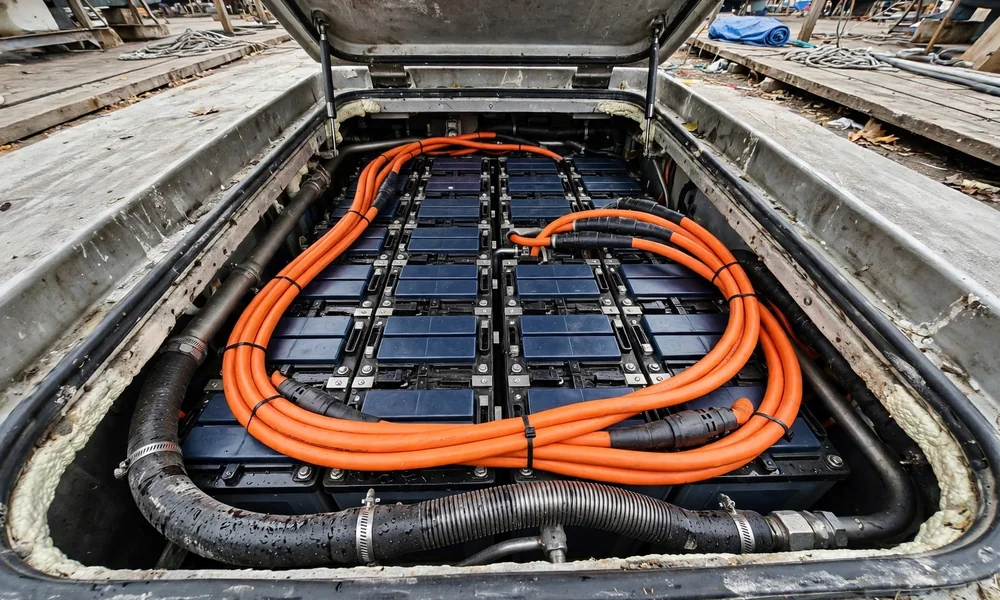
Weight is the spec that owners feel every time the boat moves. A 100 kilowatt-hour LFP pack weighs roughly 700 to 900 kilograms, about the weight of a small car, and it has to sit low in the hull where it affects trim and stability. Designers who get the placement right gain a boat that sits steady in a chop; designers who bolt the pack in wherever it fits end up with a boat that trims by the bow and hobby-horses in a swell.
Lifespan is usually quoted in cycles, and a good LFP marine pack is rated for 3,000 to 5,000 full cycles before its capacity falls to about 80 percent of new. A weekend sailor might manage 100 cycles a year, which suggests decades of use, but calendar ageing, heat, and time spent sitting at full charge all eat into that figure too. The warranty is the honest version of the lifespan claim: a ten-year warranty with a clear capacity guarantee is worth more than a cycle count quoted in a brochure.
Price is the number that stops most conversations, and a full electric yacht battery system — pack, management electronics, motor, charger and installation — typically adds an estimated $30,000 to $120,000 to the cost of a comparable diesel boat, depending on size. The battery alone often accounts for half of that. Running costs are lower, with electricity far cheaper than diesel per mile and far fewer moving parts to service, but the payback takes years of regular use. The comparison with larger vessels is instructive, and the diesel versus hybrid ship propulsion comparison shows the same trade-off playing out at a much bigger scale.
The Numbers That Matter
| Specification | Typical Value | What It Means |
|---|---|---|
| Battery capacity | 40–200 kWh | Total energy stored; bigger means more range |
| Usable capacity | About 80% of total | The energy you can actually sail on |
| Chemistry | LFP most common | Safer, longer-lived, slightly heavier |
| System voltage | 48 V or 400 V | Decides power, cable size and servicing |
| Charging power | 3–50 kW | How fast the pack refills at the marina |
| Cycle life | 3,000–5,000 cycles | How long before capacity fades to 80% |
| Pack weight | 700–900 kg per 100 kWh | Affects trim, stability and performance |
There is a rare fact tucked into this story that surprises even experienced sailors: the first practical electric boats appeared in the 1880s, and by the early 1900s electric launches were carrying passengers on the Thames and across lakes in America, decades before the diesel engine took over. They lost out not because the idea was bad, but because petrol was cheap and batteries were heavy. A century later the same idea is back, with batteries a hundred times better. The same battery thinking that powers a yacht also powers a car, and the electric car battery pack specs explained shows how the same cells, voltages and cooling ideas are shared between the two worlds.

So read the spec sheet slowly, and read it in order: capacity at a stated speed, usable energy, chemistry, voltage, charging power, weight and warranty. A boat that is honest about all seven will tell you the truth about where you can sail and how long it will take to get home.


