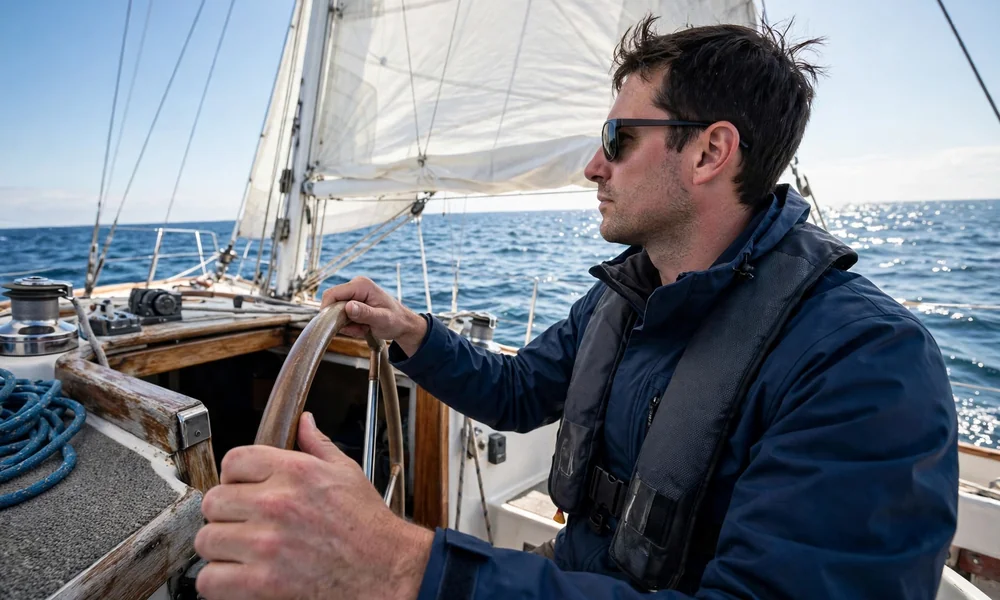
The yacht is running downwind in a rising sea, surfing down the face of each wave at twelve knots. The helm is light in the helmsman’s hands — almost too light. Then a wave catches the stern at an angle, the boat slews sideways, and for a second nothing the helm does seems to matter. The rudder, a flat blade hanging below the stern, has lost its grip on the water. When it bites again, the boat straightens with a shudder. The helmsman has just been reminded that the smallest-looking part of the boat is the one that keeps it pointing the right way.
The rudder is the yacht’s steering device, and it is also its most vulnerable one. It hangs below the hull, exposed to floating debris, grounding and the full force of the sea, and if it fails, the yacht cannot be steered at all. Yet most sailors barely think about it until something goes wrong. The rudder’s size, shape, angle and construction decide how the boat handles: whether the helm feels light or heavy, whether the boat tracks straight or wanders, and whether it stays controllable when the wind rises and the waves grow.
This guide explains the rudder’s numbers in plain English — blade area, stock diameter, rudder angle, balance and the materials that hold it all together — and why a part you never see matters more than almost anything else on the boat.

How a Yacht Rudder Works
Step 1: The blade
The rudder blade is a flat, streamlined foil — like a small wing turned on its side — that hangs below the stern. When the helmsman turns the wheel, the blade angles into the water flow, and the water pressure on one side of the blade pushes the stern sideways, swinging the bow in the opposite direction. The blade’s area is the key number: too small, and the yacht will not turn in a strong wind or at low speed; too large, and it creates drag that slows the boat down. On a typical 12-metre cruising yacht, the blade area is about 0.5 to 0.7 square metres.
Step 2: The stock and bearings
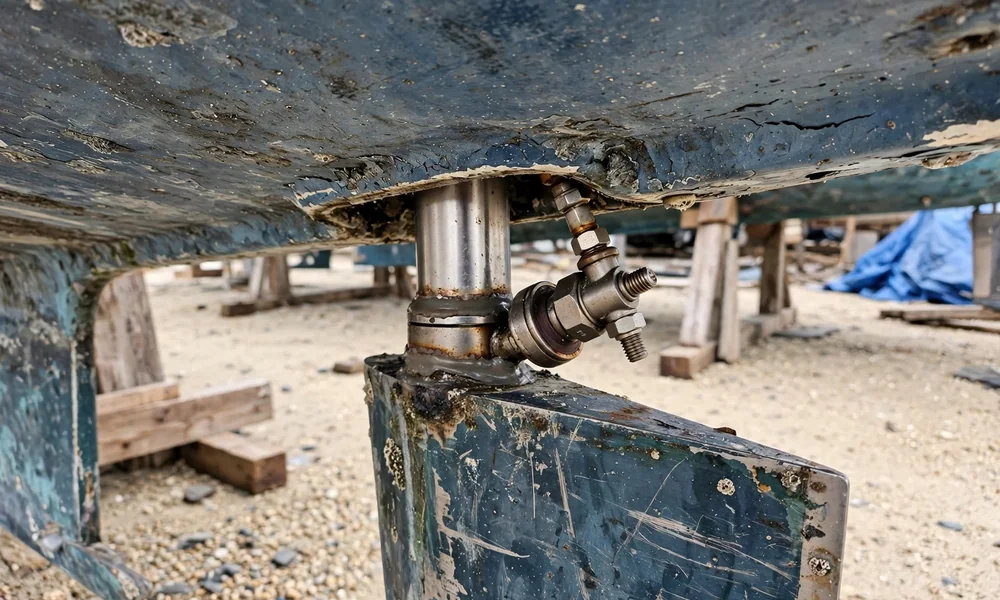
The blade is attached to a vertical shaft called the stock, which runs up through the hull to the steering mechanism. The stock is usually stainless steel, about 60 to 80 millimetres in diameter on a mid-sized yacht, and it carries the full twisting force of the water on the blade. It turns in bearings — one near the hull, one higher up — that must be strong, watertight and smooth, because a stiff bearing makes the helm heavy and a worn one makes it vague. The stock is sized with a large safety margin: a stock that bends or breaks leaves the yacht with no steering at all.
Step 3: Balance — spade, skeg and transom-hung
Rudders come in three main types. A spade rudder hangs freely below the stern, supported only by its stock, and it is the most efficient shape — but also the most exposed. A skeg rudder has a fixed fin, called a skeg, in front of the blade, which protects the blade and supports it, at the cost of some drag. A transom-hung rudder is bolted to the back of the hull on older or smaller boats, simple and easy to inspect. The choice is a trade-off between performance and protection. The keel that works alongside the rudder is explained in our guide to yacht keel specs.
Step 4: Rudder angle and helm feel
A rudder is most effective at angles of up to about 35 degrees from the centreline. Beyond that, the water flow breaks away from the blade — a stall, like an aircraft wing at too steep an angle — and the rudder stops working properly while creating huge drag. Helm feel comes from the balance of the blade: if a small part of the blade sits ahead of the stock, water pressure helps turn it, lightening the helm. The right balance makes the helm feel alive without ever feeling out of control.
Step 5: Steering linkage
Above the stock, the steering system takes over. On most yachts, cables or a hydraulic ram connect the stock to the wheel in the cockpit, with a quadrant — a curved metal arm — turning the stock as the wheel turns. Larger yachts use hydraulic steering, where the wheel drives a pump that pushes a ram, giving smooth, powerful control with little effort. Some yachts have a tiller instead of a wheel: a simple arm attached directly to the top of the stock, which gives the helmsman an immediate, physical feel for the water.
Step 6: Emergency steering
Because a rudder failure leaves a yacht helpless, every offshore yacht carries an emergency steering plan. The simplest is an emergency tiller: a metal bar that fits directly onto the top of the rudder stock if the wheel steering fails. Some yachts carry a spare rudder blade that can be mounted on the transom. Others can be steered by adjusting the sails alone, balancing the boat so it holds a course without a rudder — a slow, skilled technique that works only in moderate conditions. How the keel is built to survive the same waters is covered in our guide to how a yacht keel is made.
Yacht Rudder Specs
| Specification | Typical range |
|---|---|
| Blade area | About 0.5 to 0.7 square metres on a 12-metre yacht |
| Maximum rudder angle | About 35 degrees each way from the centreline |
| Stock diameter | About 60 to 80 millimetres, stainless steel |
| Blade material | Fibreglass, foam core, or stainless steel |
| Rudder type | Spade, skeg-hung, or transom-hung |
| Bearings | Two or more, self-aligning and watertight |
| Steering type | Cable, hydraulic, or direct tiller |
| Balance | About 15 to 25 percent of blade area ahead of the stock |
What Does a Yacht Rudder Cost?
A replacement rudder for a 12-metre cruising yacht is estimated to cost roughly $5,000 to $20,000, including the blade, stock and bearings, while a custom rudder for a larger or racing yacht is estimated at $20,000 to $60,000 or more. Prices are estimates only and vary by size, material and builder. Repairs after a grounding are usually cheaper than replacement, but the bearings and stock must be inspected, since hidden damage can fail later at sea. The steering system that connects to it is explained in our guide to how a yacht rudder works.
A Rare Fact
In 2020, a group of orcas off the coasts of Spain and Portugal began interacting with sailing yachts in a way nobody had seen before: approaching from behind, they targeted the rudders, pushing and biting them until the blades were damaged or broken. Dozens of yachts were disabled, and several had to be towed to port. Scientists still debate why the orcas do it — play, curiosity or a learned behaviour passed between pods — but the effect on sailors was immediate. Rudder inspections, emergency tillers and insurance claims all became part of everyday conversation in the region.
The rudder is the least glamorous part of a yacht and one of the most important. But every time the wind gusts and the stern starts to swing, it is the rudder — its area, its angle and its strength — that decides whether the yacht keeps its course or loses it. Its numbers are small and its job is enormous.


