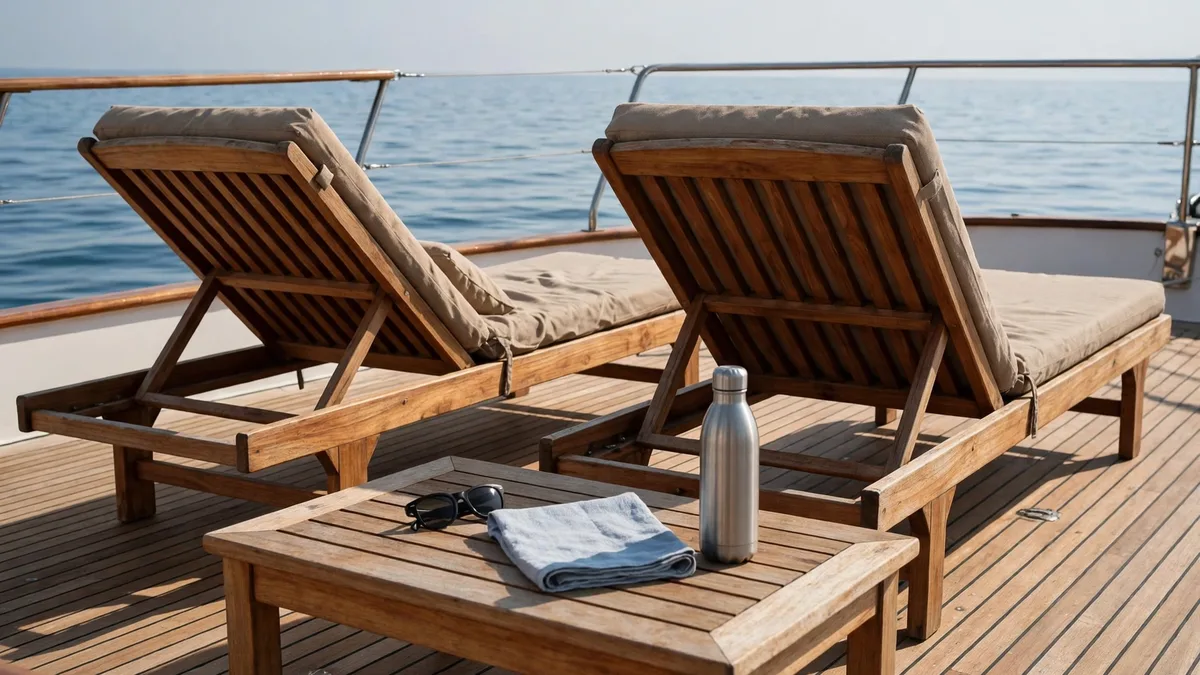
Step aboard a yacht at anchor on a still evening and the first thing you notice is not the size of the boat or the shine of the hull. It is the furniture on the deck: a low teak table worn smooth by salt air, deep lounge chairs with cushions that have survived a hundred rainstorms, a dining set that looks as if it grew there rather than being bolted down. Out on open water, furniture is not decoration. It is equipment, and it has to survive sun, spray, and storms while still looking like it belongs on a floating home.
Yacht deck furniture lives a harder life than almost any furniture on land. It is soaked in salt, bleached by ultraviolet light, and thrown around by waves, yet it is expected to stay beautiful for decades. The makers who build it are part boatbuilder, part cabinetmaker, and part sailor, and they choose every material with the sea in mind. This is how a piece of yacht deck furniture is made, from a plank of timber to a chair that can face down an ocean.
How It’s Made
Step 1: Choosing the timber
Almost every piece starts with teak. Teak is naturally oily, which makes it resist rot and repel water without paint, and it contains silica, which makes it hard-wearing under bare feet. The best marine teak comes from mature trees, quarter-sawn so the grain runs straight and the boards stay stable as they dry. Each board is inspected for knots, splits, and sapwood, and only the clean heartwood makes the cut. Cheaper pieces may use iroko or mahogany, but teak remains the standard, and its care is closely tied to the deck beneath it, as our guide to yacht teak deck materials explains.
Step 2: Seasoning and cutting
Fresh teak is too wet to build with, so the boards are seasoned for months, sometimes years, until their moisture content drops to a level that will not move once the furniture is at sea. Then the maker draws the design full-size on paper or directly onto the wood, and cuts the parts: legs, rails, slats, and armrests, each one a little oversize so it can be shaped by hand. Curved parts are bent by steaming the wood until it is pliable, then clamping it to a form until it cools into its new shape. A chair back that fits the human spine is not cut from a straight board; it is coaxed into a curve.
Step 3: Joining without nails
Good yacht furniture is held together with joints, not screws. Mortise and tenon joints, dovetails, and scarph joints lock the parts together, and marine epoxy fills any gap the wood cannot close on its own. Metal fasteners are used sparingly, and when they are, they are silicon bronze or stainless steel, because ordinary steel rusts in salt air and stains the timber brown. The joints are glued, clamped, and left overnight, and a piece that creaks when it is flexed by hand goes back to the bench. A loose joint at sea only gets looser.

Step 4: Shaping and sanding
With the frame assembled, the maker shapes it. Edges are rounded so they do not catch clothing or skin, seat slats are spaced so rainwater drains through, and armrests are sculpted to fit a hand. Then comes the sanding, grit by grit, from coarse to fine, until the surface feels like silk. Teak is rarely varnished on a working yacht deck, because varnish peels in the sun; instead the wood is left to silver naturally or oiled lightly so it keeps its honey colour a little longer. The same eye for detail goes into every part of a yacht’s deck hardware, including the running gear described in our guide to yacht propeller materials.
Step 5: Fitting the hardware and cushions
Deck furniture must stay put in a seaway, so hinges, folding mechanisms, and mounting points are fitted next. Tables fold or telescope so they can be stowed in a blow; chairs stack or fold flat; loungers adjust through several positions. The hardware is marine-grade stainless steel, polished so it does not corrode. Cushions are cut from quick-dry foam that does not hold water, covered in solution-dyed acrylic fabric that resists fading and mildew, and fitted with ties or press studs so they do not slide off in a gust. A cushion that holds water becomes a sponge, and a sponge on a yacht becomes a problem.
Step 6: Finishing and sea trials
The finished piece is oiled, assembled, and checked one last time. Drawers and folding parts are worked until they move smoothly, every fastener is checked for tightness, and the furniture is weighed, because weight matters on a yacht and every kilogram counts. Then it goes aboard, is bolted or lashed to its deck fittings, and is used. The real test is the first season at sea: sun, salt, and spray will find any weakness the workshop missed. Pieces that survive that season with only a little silvering of the teak will last for decades, handed down with the boat itself. Keeping the furniture light matters for the same reason the hull below it is kept light, as our look at yacht keel specs shows.
Specs
| Specification | Detail |
|---|---|
| Main material | Marine-grade teak, sometimes iroko or mahogany |
| Fasteners | Silicon bronze or 316 stainless steel |
| Adhesive | Marine epoxy, waterproof and gap-filling |
| Finish | Natural oiled teak or left to weather silver |
| Cushion foam | Quick-dry reticulated foam |
| Cushion fabric | Solution-dyed acrylic, UV and mildew resistant |
| Typical weight | 8 to 25 kg per chair, 15 to 40 kg per table |
| Expected lifespan | 20 to 30 years with basic care |

Price
Yacht deck furniture is priced like the boats it serves. A single well-made teak deck chair typically costs $800 to $2,500 (estimate, based on typical marine furniture retail pricing), while a matching teak dining table can run $2,000 to $6,000 (estimate). A full set for a superyacht deck, including loungers, tables, and dining chairs, can easily reach $20,000 to $50,000 (estimate). Custom pieces built to fit a specific deck, with hand-shaped curves and matched grain, cost more still, and the price reflects months of seasoning, hand joinery, and materials chosen to survive decades of salt and sun.
Rare Fact
Teak’s secret weapon is not its strength but its oil. The wood is so rich in natural oils that it was once used to build the decks of warships and the hulls of clippers without any paint at all, and it is one of the few timbers that can be left bare in salt water and still outlast steel fittings. Those same oils make teak famously difficult to glue, because the oil repels most adhesives, which is why yacht builders wipe every joint with solvent moments before applying marine epoxy. A wood that resists water, rot, and glue in equal measure is a strange material to build with, and it is exactly why teak furniture can sit on a deck for thirty years and still be worth refinishing.