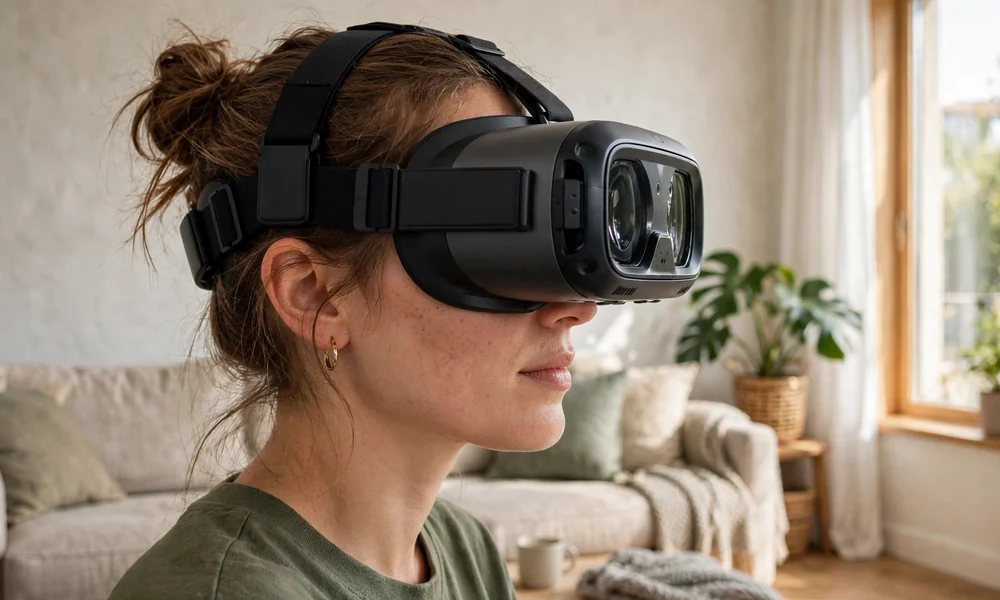
Put on a virtual reality headset and the world disappears. A beach at sunset, a cockpit at 30,000 feet, a workshop that exists nowhere at all — all of it appears a few centimetres from your eyes, bigger than the room you are standing in. Nothing about that should work. A flat screen that close to your face should look like a blurry television pressed against your nose. The reason it does not is a pair of lenses, each one smaller than a biscuit, doing one of the hardest optical jobs in consumer technology.
Those lenses are the unsung heroes of virtual reality. The display gets the attention and the processor gets the praise, but without the lenses, the headset is just a screen strapped to your face. They bend light, magnify the picture, and trick your brain into believing that a display the size of a playing card is a world stretching to the horizon.
The challenge is brutal. Human eyes are built to look at things far away; put a screen five centimetres in front of them and the eye muscles strain, the image blurs, and your head aches within minutes. The lenses must solve that, make a small screen fill your entire field of view, keep the edges as sharp as the centre, and do it in a device light enough to wear for hours — a problem that took optics engineers decades to crack.

How It Works
Step 1: The screen shows two pictures, not one
Everything starts with the display. A VR headset does not show you one image. It shows two — one for each eye, rendered from slightly different angles, exactly like your two eyes see the real world. Your brain fuses them into a single three-dimensional scene, and that difference is what gives virtual objects their depth. The lenses sit between your eyes and the display, and their first job is to deliver each picture to the right eye only, with nothing leaking across.
Step 2: The lenses push the screen far away
A VR lens is a magnifier with a very specific trick. It takes the display sitting a few centimetres from your face and bends its light so your eyes focus on it as if it were several metres away. Opticians call this a virtual image: the picture your brain perceives is much larger and further away than the physical screen. Without it, you would be trying to focus on something closer than your eyes can comfortably manage. The lens lets your eye muscles relax, as though you were looking across a room.
Step 3: Magnifying a small screen into a whole world
The same lenses also magnify. A typical VR display is only a few inches across, but the lenses stretch what you see until it fills more than a hundred degrees of your field of view. That is why the world inside feels enormous — and why the lenses must be so precisely made: magnify an image that much and every flaw in the glass, every speck of dust, and every tiny error in the curve gets magnified too. This is the same precision thinking behind stacked camera sensors, where layers of silicon are aligned to tolerances your eye cannot see.
Step 4: Flattening the picture so the edges stay sharp
A simple curved lens has a cruel weakness: it bends light more at the edges than in the centre, so the middle of the picture is sharp and the corners smear. Modern lenses fight back with clever shapes. Many use Fresnel lenses — a flat lens cut into fine concentric rings, each bending light by a slightly different amount, so the whole surface acts like a much thicker lens in a fraction of the space. Others use aspheric curves, where the surface changes its bend gradually from centre to edge. The newest headsets use pancake lenses, folding the light path through several thin elements so the headset becomes far slimmer. Whichever design is used, the goal is the same: a picture that stays sharp from edge to edge.

Step 5: Correcting colour and distortion
Bending light is never clean. A lens splits white light into its colours slightly, painting faint rainbow fringes around bright objects — an effect called chromatic aberration. It also warps straight lines, bowing them outward or inward. VR engineers correct both problems twice: once in the glass, by combining lens elements of different materials that cancel each other’s colour errors, and once in software, by deliberately distorting the image in the opposite direction, so that after the lens bends it, the picture arrives at your eye straight and true.
Step 6: Adjusting for every pair of eyes
No two people have the same eyes. The distance between your pupils — your interpupillary distance, or IPD — can vary by more than a centimetre from person to person, and if the lenses are not lined up with your pupils, the picture blurs and your head aches. Good headsets let you slide the lenses closer together or further apart, by hand or with a small motor, until each lens sits directly in front of its eye. Some also offer focus adjustment for glasses wearers. The eye box — the small zone where your eye must sit to see the full, sharp image — is only a few millimetres wide, so getting this right is the difference between a headset that disappears and one that constantly reminds you it is there. Keeping the headset comfortable is its own engineering battle, and the teams who design cooling for sustained performance in compact devices face the same enemy: a powerful machine in a tiny space, pressed against a human body, that must never get hot, heavy, or loud.
Specs
| Specification | Typical value |
|---|---|
| Lenses per headset | 2 (one per eye) |
| Common lens types | Fresnel, aspheric, pancake |
| Field of view | 90–120 degrees |
| Display distance from the eye | About 4–6 cm |
| Virtual image distance | Appears 1–2 metres away |
| IPD adjustment range | About 53–75 mm |
| Key optical problems corrected | Distortion, chromatic aberration, edge blur |
| Lens material | Optical plastic or glass, anti-reflective coated |
What Does It Cost?
You cannot buy VR headset lenses on their own — they are built into the headset, and their cost hides inside the price of the device. A standalone headset typically sells for around $500, while a flagship mixed-reality headset can cost around $3,500. Those are approximate retail prices, and the lenses are a meaningful share of them: each lens is moulded, polished, coated, and inspected to optical tolerances, and a single scratch or bubble means it is thrown away. Prescription inserts for glasses wearers are sold separately, typically for an estimated $50–$100 a pair — an estimate that varies by supplier.
A Rare Fact
Here is the detail most people miss: the Fresnel lens in a VR headset uses the same optical trick as a lighthouse. In the 1820s, Augustin-Jean Fresnel designed a lens of concentric rings so a lighthouse lamp could throw its light for miles without a lens weighing tons. Two centuries later, the same rings — shrunk to the size of a coin — let a headset stay light enough to wear while throwing an entire world into your eyes. The same obsession with tolerances that defines titanium machining challenges is what makes a lens you can barely feel capable of bending light exactly where it needs to go.


