Some of the strongest parts in a car, a plane, or a phone start their lives as a plain cylinder of aluminium, heated until it glows orange and then squeezed — violently, in a single blow — between two steel dies. That is forging, and it is one of the oldest ways of shaping metal, older than casting and older than machining. A forged part is stronger than a cast one, because the squeezing lines up the metal’s grain and closes the tiny voids that make castings weak.
Aluminium forging is used wherever a part must be light and strong at the same time: suspension arms, aircraft fittings, bicycle cranks, and the structural parts of electric cars. The forging plant is a loud, hot place, full of furnaces, presses, and the smell of hot oil — but the work itself is precise. The billet must be the right temperature, the dies must be the right shape, and the press must strike with the right force, or the part will be wrong.

Inside the Production
Step 1: Cutting and heating the billet
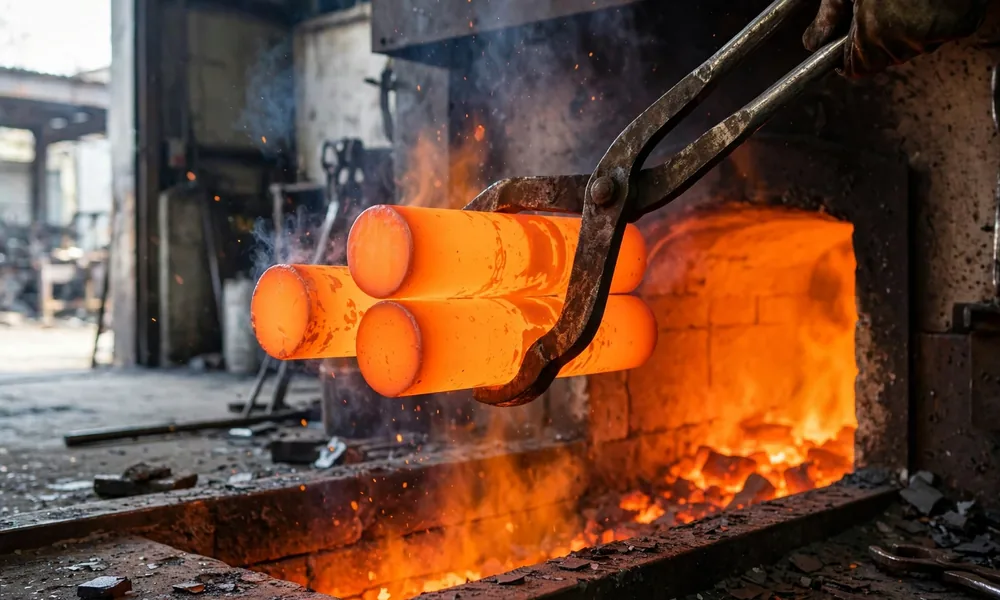
Production starts with the billet — a solid cylinder or bar of aluminium alloy, cut to a precise length and weight. The weight matters: too little metal and the dies will not fill, too much and the excess will squeeze out as flash that must be trimmed away. The billets are loaded into a furnace and heated to around 400 to 500 degrees Celsius, hot enough for the aluminium to flow under pressure but not so hot that it melts. The heating is timed carefully, so every billet reaches the same temperature all the way through.
Step 2: Forging in the press
The glowing billet is lifted from the furnace with long tongs — by hand in a small shop, by a robot in a large one — and placed in the bottom die of the press. The press closes, and in a fraction of a second, many tonnes of force squeeze the aluminium into the shape of the die cavity. Some parts are forged in a single blow; others need several blows, with the part moved between dies of different shapes, each one bringing it closer to its final form. The noise is tremendous, the floor shakes, and the part that comes out is hot, rough, and already recognisably the shape it will become.
Step 3: Trimming the flash
Forging always produces flash — a thin fin of excess metal that squeezes out between the two halves of the die. The hot forging is moved to a trimming press, where a sharp-edged die cuts the flash away, leaving the part close to its final shape. The flash is collected and sent for recycling, because it is clean aluminium alloy and worth recovering. The trimmed part is then checked: its shape is compared to a template, and any part that is under-filled — where the metal did not reach into a corner of the die — is rejected.
Step 4: Heat treatment
A freshly forged aluminium part is soft, so it is heat-treated to give it its strength. The part is heated again in a furnace, held at temperature, and then quenched — cooled quickly in water or air — which locks the alloying elements into the metal’s structure. It is then aged, held at a lower temperature for hours, which lets tiny strengthening particles form inside the metal. The way the part is shaped is part of what how aluminium forging is made explains, and the heat treatment is the step that turns a soft forging into a part that can carry real loads.
Step 5: Machining and finishing
After heat treatment, the forging is machined to its final dimensions. Forging gets the shape close, but the surfaces that matter — the holes, the bearing seats, the faces that bolt to other parts — are cut on milling machines and lathes to tolerances a forging press cannot reach. The part is then finished: sharp edges are removed, surfaces are blasted or polished, and any protective coating is applied. Some parts are anodised, which grows a hard oxide layer on the surface that resists corrosion and wear.
Step 6: Inspection and testing
Every forged part is inspected before it leaves the plant. Dimensions are checked against the drawing, surfaces are examined for cracks and laps — folds in the metal where it flowed wrongly in the die — and a sample of parts from each batch is tested destructively: cut open, or pulled apart in a tensile test, to prove the metal is sound all the way through. A part that fails any test is scrapped, and the forging programme is reviewed before more are made. Only the parts that pass are packed and shipped to the customer, where they will be bolted into a car, a plane, or a machine that depends on them not failing.

Specs
| Specification | Typical figure |
|---|---|
| Material | Aluminium alloys, commonly 6061 or 7075 |
| Billet temperature | About 400–500°C before forging |
| Press force | Hundreds to thousands of tonnes |
| Part weight | From a few grams to tens of kilograms |
| Strength gain | Forged parts stronger than cast equivalents |
| Heat treatment | Solution treatment, quench, and ageing |
| Finishing | Machined, then anodised or coated |
| Inspection | Dimensional, visual, and sample testing |
| Typical uses | Suspension arms, aircraft fittings, cranks |
Price
An aluminium forging is priced by the part, and the price depends on size, complexity, and volume. As an estimate, a small forged part costs roughly $5 to $50, while a large, complex forging — such as a car suspension arm — costs roughly $50 to $300. The tooling is the expensive part: a set of forging dies can cost tens of thousands of dollars to make, so forging only makes economic sense when hundreds or thousands of parts are needed.
A Rare Fact
The grain of a forged part follows its shape, like the grain of wood following the curve of a bent branch — and that is the whole secret of forging. When aluminium is cast, its grain is random; when it is forged, the squeezing lines the grain up along the shape of the part, so the metal is strongest exactly where the part needs to be strong. Engineers call this grain flow, and they design dies specifically to create it: a well-designed forging has grain that flows around a hole or a bend, rather than being cut through it by machining. It is why a forged bicycle crank can be lighter than a cast one and still survive years of a rider standing on the pedals — the metal itself is working with the shape, not against it.
Forging is one of the oldest metalworking crafts, and it still makes some of the strongest parts in the modern world. The way the forging process works is explained in how aluminium forging works, and the reason a forged part costs what it does is explored in why aluminium forging is so expensive. The next time you see a suspension arm, a bicycle crank, or an aircraft fitting, remember the glowing billet, the press, and the grain of the metal flowing around the shape it was made to hold.


