Put on a modern virtual reality headset and the world disappears. A flat screen a few centimetres from your eyes becomes a mountain valley, a cockpit, or a concert hall, and your brain accepts the trick without protest. The lenses are the reason it works. They are small, light, and curved in ways that would have been impossible to manufacture at scale twenty years ago, and they bend the light from the display so that it looks as though it is coming from far away.
The lens in a VR headset is not one piece of glass. It is a stack of materials, each doing a job the others cannot do: bending light, correcting colour, blocking reflections, and surviving the heat and sweat of being pressed against a human face for hours.
The materials inside those lenses are a quiet contest between optics, weight, and cost, and the winners are not always the materials that bend light best. Here is what they are, and why engineers chose them.

The Materials Behind VR Headset Lenses
1. Optical plastic, the lens that replaced glass
The first choice in a VR lens is the material it is made from, and for most headsets the answer is optical plastic, usually a polycarbonate or a cyclo-olefin polymer. Optical plastic is roughly half the weight of glass for the same lens, and it can be moulded into complex shapes, including the aspheric curves and the Fresnel ridges that modern lenses use, in a single step. The full process of shaping that plastic into a working lens is described in how VR headset lenses are made, from moulding the blank to polishing the finished optic.
2. Fresnel ridges, the rings that save weight
Look closely at a VR lens and you will see fine concentric rings, like the grooves on a vinyl record. Those are Fresnel ridges, and they are a material trick as much as an optical one. A conventional curved lens is thick in the middle and heavy, so a Fresnel lens replaces the smooth curve with a series of stepped ridges, each one bending the light by the same amount while the lens itself stays thin and flat. The cost is a faint scattering of light at the ridges, which shows up as a soft glow, sometimes called god rays, around bright objects on a dark background.
3. Anti-reflective coatings, the layers you cannot see
Every surface of a VR lens is coated, and the coatings are measured in nanometres. An anti-reflective coating is a stack of thin films, often magnesium fluoride or silicon dioxide, each a quarter of a wavelength thick, designed so that the reflections from each layer cancel each other out. The same chamber also applies a hard coat, usually a silicone-based polymer, that protects the soft plastic from scratches.
4. High-index resins, the material for pancake lenses
The newest headsets use pancake lenses, and they need a different material. A pancake lens folds the light back on itself with a polarising beam splitter, so the distance between the display and the lens can shrink from several centimetres to a few millimetres, which makes the headset far slimmer. That folding only works if the lens material has a high refractive index, bending light sharply in a thin piece, so manufacturers use high-index resins, sometimes with a refractive index above 1.6, compared with about 1.5 for ordinary optical plastic. The way the folded light path changes what the wearer actually sees is set out in how VR headset lenses work, including why the field of view and the sweet spot behave differently from older designs.
5. Polarising films, the light traffic controllers
Inside a pancake lens, and in some Fresnel designs too, sit polarising films, thin sheets of plastic that only let light vibrating in one direction through. The films are made from stretched polyvinyl alcohol, dyed with iodine, and laminated between protective layers. In a pancake lens, the light passes through a polariser, bounces off a mirror, passes through a quarter-wave plate that twists its polarisation, and then passes through a second polariser that lets it out towards the eye. But the films are what make the folding possible at all, and without them the headset would have to be twice as thick.
6. The housing and the face gasket, the materials that touch skin
The lens does not sit alone. It is held in a housing, usually moulded from polycarbonate or a glass-filled nylon, chosen because it is stiff enough to hold the lens alignment to a fraction of a millimetre and light enough to keep the headset balanced. Around the housing sits the face gasket, the foam or silicone pad that seals the headset against the wearer’s face. The foam is usually a soft polyurethane, sometimes with a silicone skin that can be wiped clean, and it has to seal out light without pressing hard enough to leave marks. The numbers behind all of this, from the field of view to the lens diameter, are explained in the VR headset lens specifications, where the trade between size, weight and image quality becomes clear.
VR Headset Lens Materials
| Material | Where it is used | Why it is chosen |
|---|---|---|
| Optical plastic, polycarbonate or cyclo-olefin | Lens body | Light, mouldable into complex curves |
| Fresnel ridges in the same plastic | Lens surface | Thin, light, wide field of view |
| Magnesium fluoride and silicon dioxide coatings | Lens surfaces | Cancel reflections, resist scratches |
| High-index resin | Pancake lenses | Bends light sharply in a thin lens |
| Stretched polyvinyl alcohol film | Polarisers | Controls light direction in folded optics |
| Polycarbonate housing, polyurethane foam | Mount and face gasket | Stiff, light, comfortable against skin |
What Do VR Headset Lenses Cost?
The lenses are a small part of a headset’s price, but they are not cheap to make well. A pair of moulded Fresnel lenses is estimated at roughly $10 to $25 in volume production, including the coatings, while a pair of pancake lenses with high-index resins and polarising films is estimated at roughly $30 to $60. A complete consumer headset sells for an estimated $300 to $1,000 depending on the displays and the tracking, and the lenses account for roughly five to ten per cent of that.
A Rare Fact
The Fresnel lens was invented for lighthouses, not for headsets. Augustin-Jean Fresnel designed it in 1822 to focus the light of a lighthouse lamp into a beam that could be seen twenty miles out to sea, using the same stepped ridges that VR lenses use today. Two centuries later the same idea is moulded into a piece of plastic the size of a coin, and it is what lets a headset show you a whole world from a screen an inch from your eyes.
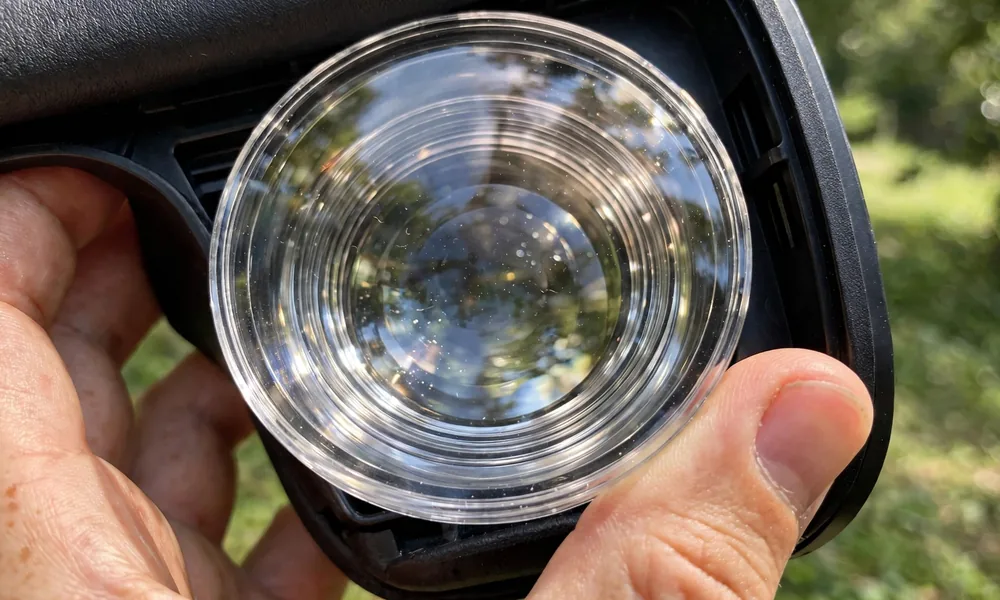

A VR lens looks like a simple piece of curved plastic, but it is a stack of compromises: plastic for weight, ridges for thinness, coatings for clarity, films for folding, and foam for comfort.