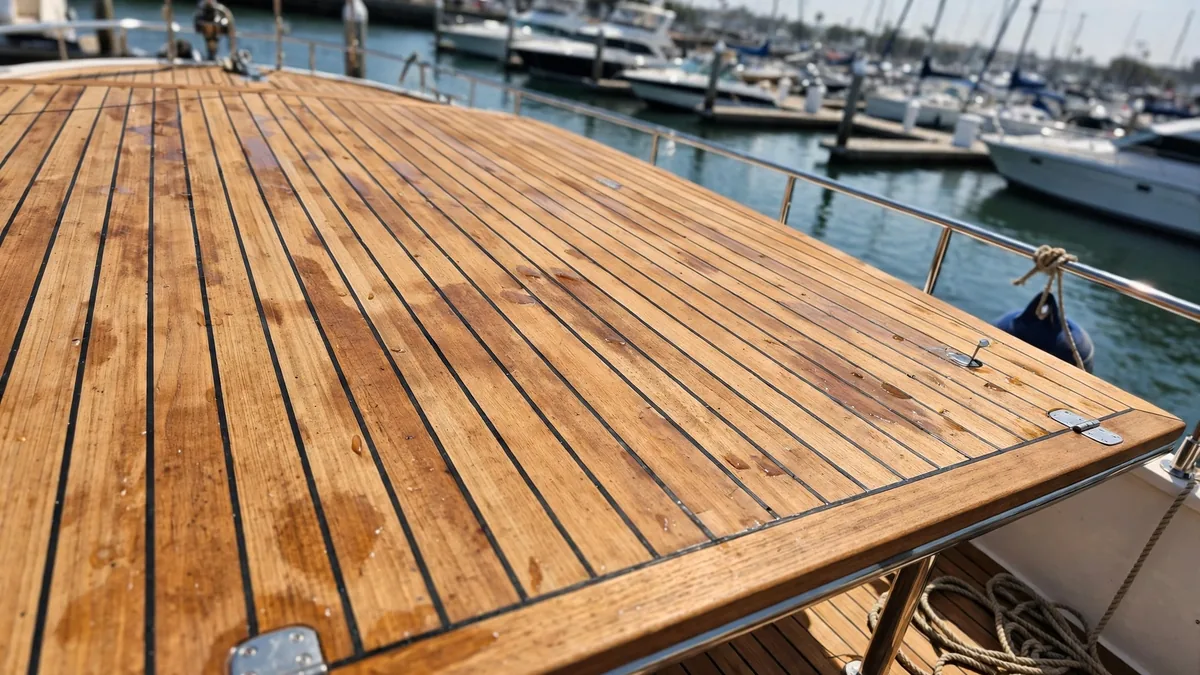
Step aboard a large yacht on a hot afternoon and the first thing your feet notice is the deck. It is warm but never scorching, grippy even when it is wet, and it smells faintly of wood and salt. The planks run in long, even lines from bow to stern, separated by thin black seams, and every plank looks as though it was cut for exactly the place it occupies. Nothing about it feels accidental.
That deck is not a single material. It is a system, and teak is only the visible layer. Underneath it sit a subdeck, adhesives, caulking, fasteners and finishes, each chosen because the sea punishes the wrong choice quickly.
Here is what those materials are, and why each one earned its place.
The Materials Behind the Yacht Teak Deck
1. Teak itself, the wood that barely moves
Teak is the obvious material, and it is chosen for reasons that have little to do with how it looks. The wood is dense, oily and naturally resistant to rot, and it contains silica, which makes it hard wearing underfoot. More important for a deck, teak moves very little as it takes up and gives off moisture, so the planks stay flat and the seams stay tight through wet winters and dry summers. The full process of turning that timber into a finished deck is described in how a yacht teak deck is made, from milling the planks to laying them out across the deck. Cheaper woods can imitate the colour for a year or two, but they swell, shrink and grey unevenly, and that is why builders keep coming back to teak despite its price.
2. The subdeck, the structure the teak protects
Under the teak sits the real deck, and on a modern yacht it is usually marine plywood, a fibreglass sandwich, or a steel or aluminium deck, depending on how the hull was built. The teak is a wearing surface, not the structure, and the subdeck carries the loads. Whichever material is used, it has to be fair and dry before the teak goes down, because any bump or hollow in the subdeck will show through the planks.
3. Caulking, the black seams that keep the sea out
The dark lines between the planks are caulking, and they are the most misunderstood part of the deck. They are not decoration. Each seam is filled with a flexible compound, usually a two-part polysulphide or a modern polyurethane sealant, that bonds to the sides of the planks and stays elastic as the wood swells and shrinks. When it is fresh the caulking is sanded flush with the planks, and as the teak wears down over the years the seams are left standing slightly proud, which is why an old deck feels ribbed underfoot. The way those seams work with the planks as the deck flexes is part of how a yacht teak deck works, including why the seams matter as much as the wood.
4. Epoxy adhesive, the bond that replaced thousands of screws
Older teak decks were screwed down, with every screw hidden under a wooden plug, and a large deck could hold thousands of them. Modern decks are mostly glued. A two-part epoxy adhesive bonds the teak directly to the subdeck, spreading the load across the whole plank instead of concentrating it at screw points, and it leaves no holes for water to follow into the structure. Screws are still used in some places, usually around the edges and at hatches, but the glue does most of the work.
5. Stainless steel fasteners, the metal that must not rust
Where fasteners are used, they are stainless steel, and the grade matters. The usual choice is 316 marine-grade stainless, which contains molybdenum and resists the pitting that salt water causes in lesser grades. Fasteners also appear in the deck hardware, the rails, cleats and hinges, and the same rule applies: anything that touches the teak has to survive salt without staining it.
6. Oils and sealers, the finish that is mostly left off
Many owners expect a teak deck to be oiled or varnished, but most builders leave it bare. Teak contains its own natural oils, and a bare deck weathers to a soft silver-grey that many owners prefer. What builders do use is a sealer on new decks, a thin treatment that slows the greying without building a film, and a mild cleaner for washing. The deck furniture that sits on the teak gets a different treatment, and how yacht deck furniture works shows how the chairs, tables and loungers are built to survive the same sun and salt. The rule for the deck itself is simple: let the wood be wood, keep it clean, and let the sun do the finishing.
Yacht Teak Deck Materials
| Material | Where it is used | Why it is chosen |
|---|---|---|
| Teak | Deck planks | Dense, oily, rot-resistant, barely moves when wet |
| Marine plywood or fibreglass sandwich | Subdeck | Light, stiff, carries the structural load |
| Polysulphide or polyurethane caulking | Seams between planks | Flexible, waterproof, resists sun and salt |
| Two-part epoxy adhesive | Bonding planks to the subdeck | Strong, gap-filling, heat-resistant bond |
| 316 stainless steel | Screws and deck hardware | Resists salt-water pitting and staining |
| Teak sealer | Surface treatment | Slows greying without building a film |
What Does a Teak Deck Cost?
A teak deck is one of the most expensive surfaces on a yacht, and the timber is only part of the bill. The wood itself is estimated at roughly $150 to $300 per square metre for good quality teak, depending on the grade and the length of the planks, and the labour to lay it is usually as much again. Replacing a worn deck costs almost as much as fitting the first one, because the old teak has to be removed and the subdeck repaired before the new planks go down. Synthetic teak, made from PVC, is estimated at roughly half the price of real teak and needs no oiling, which is why it has become common on smaller boats, although it can feel hotter underfoot and it never weathers like the real wood.
A Rare Fact
Teak is one of the few woods that was once controlled by law. In nineteenth-century Burma, where the finest teak grew, the British colonial government declared teak a royal tree, and cutting it without permission was a serious offence, because the timber was needed for shipbuilding. That same durability is why a teak deck laid today can still be in service fifty years from now, long after the yacht around it has been refitted twice over.

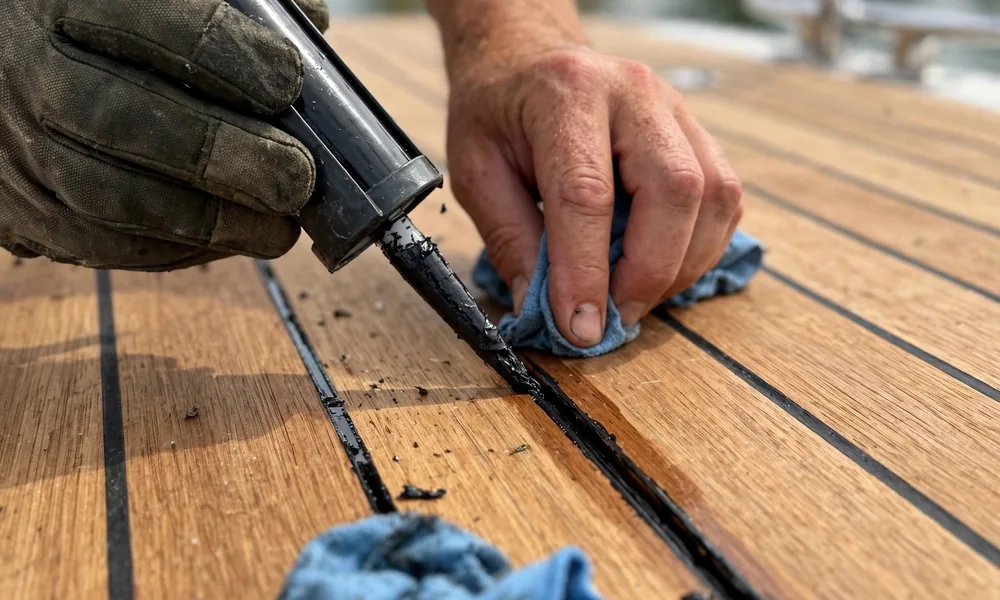
A teak deck looks simple from the dock, a pattern of wood and black lines, but it is a layered system where every material covers a weakness in the one next to it. The teak takes the wear, the caulking takes the movement, the epoxy takes the load, and the stainless steel takes the salt. Keep them all working together and the deck will outlast almost everything else on the boat.


