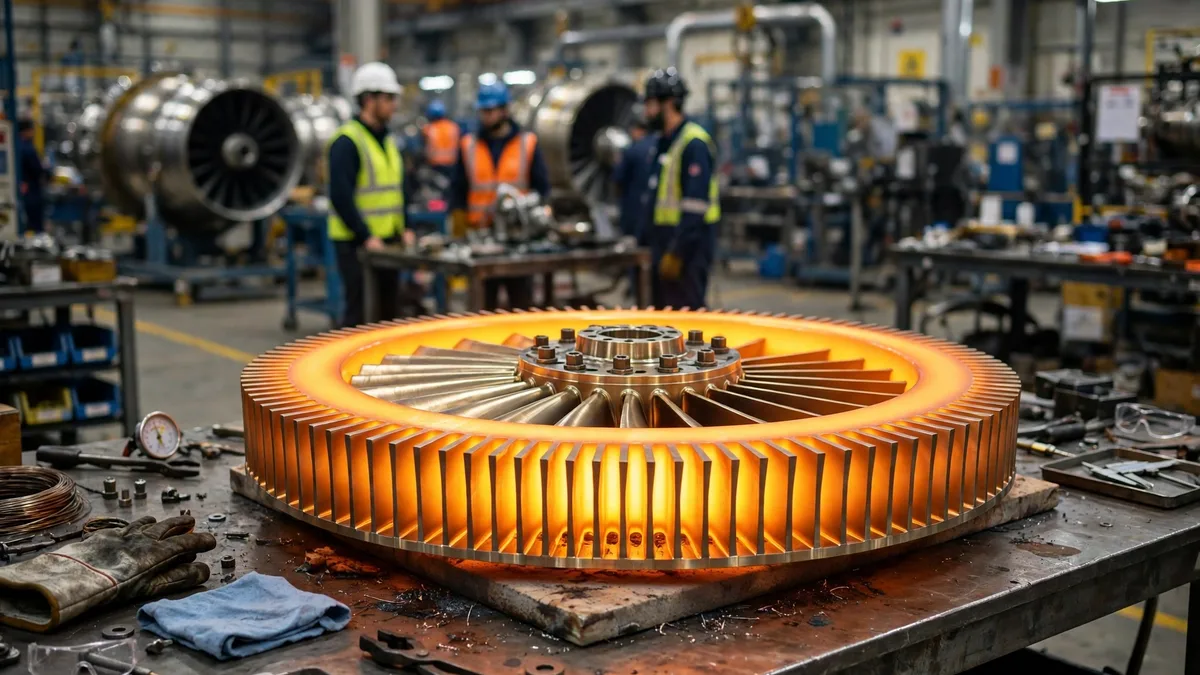
In a jet engine test cell in the desert, a turbine disc spins at twenty thousand revolutions a minute while hot gas at more than a thousand degrees washes over it. Any ordinary steel would soften, stretch and fail within seconds. The disc does not. It is made from Inconel, a family of nickel-chromium superalloys that keeps its strength where other metals give up, and it is one of the most expensive metals ever put into regular industrial use. A kilogram of Inconel can cost many times more than a kilogram of stainless steel, and a single finished part can cost more than a family car.
Inconel was born in the 1940s, when engineers needed a metal that could survive inside the first jet engines and, later, inside rocket motors and nuclear reactors. What they got was an alloy so stubborn that it resists heat, corrosion and fatigue all at once, and so difficult to work with that every step of making it adds to the price. This is why Inconel costs so much, and why, for the jobs that truly matter, nothing cheaper will do.
Why It Costs So Much
1. Nickel, chromium and the price of rare ingredients
Inconel is mostly nickel, often more than half its weight, with large amounts of chromium and smaller additions of molybdenum, niobium, iron and titanium. Nickel is a costly base metal, and its price swings with global mining and battery demand, while niobium and molybdenum are produced in only a handful of countries. Buying the raw ingredients for a batch of Inconel therefore costs far more than buying the iron and carbon that go into steel. A foundry cannot substitute cheaper metals without losing the very properties that make Inconel valuable, so the material bill is high before a single furnace is lit.
2. Melting it takes extraordinary heat and control
Inconel melts at around 1,300 to 1,400 degrees Celsius, and it must be melted under vacuum or in a carefully controlled atmosphere so that oxygen and nitrogen do not contaminate it. The industry standard is vacuum induction melting followed by vacuum arc remelting, a second pass that purifies the metal further. Each melt uses enormous amounts of energy and expensive crucibles and electrodes, and the whole process is monitored continuously. A single contaminated batch can be worth tens of thousands of dollars and must be scrapped, so the cost of perfection is built into every good batch.
3. It is famously hard to machine
Once cast or forged, Inconel must be cut, drilled and milled into its final shape, and here it earns its reputation as a machinist’s nightmare. The alloy work-hardens as it is cut, meaning the surface gets harder the more you work it, and it holds its strength even as the cutting tool heats up. Tools wear out quickly, sometimes after only a few parts, and cutting speeds must be kept slow to avoid destroying the workpiece. Shops that machine Inconel use rigid machines, flood coolant and expensive carbide or ceramic tooling, and they charge accordingly, because a single complex part can take many hours on a machine that could have finished a dozen steel parts in the same time.
4. Forging and heat treatment are slow, skilled work
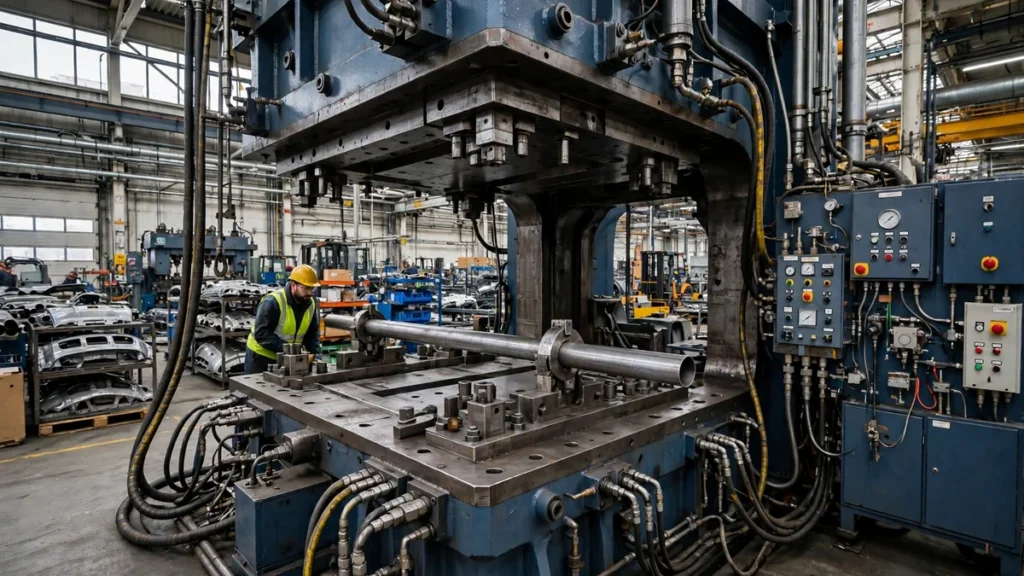
Many Inconel parts are forged rather than cast, squeezed into shape under huge presses while hot, and the forging window is narrow: too cold and the metal cracks, too hot and its grain structure is ruined. After forging comes a sequence of solution treatments and ageing cycles, heating and cooling the part over many hours to precipitate the tiny particles that give Inconel its strength. Each cycle is logged and tested, and the furnaces used are specialised and expensive to run. There is no shortcut. Rushing the heat treatment produces a part that looks right and fails early, which in a jet engine is not an option.
5. Testing and certification cost as much as making it
Because Inconel goes into aircraft engines, rockets, submarines and chemical plants, every batch must be proven, not just promised. Samples are pulled for chemical analysis, tensile testing, creep testing at high temperature and ultrasonic inspection for hidden flaws. Aerospace customers demand full traceability, so each part carries a paper trail from the mine to the finished component. The laboratories, the inspectors and the documentation all cost money, and a part that fails a test is rejected outright. Customers pay for that certainty, because the alternative is a failure nobody can afford.
6. Very few suppliers can make it at all
Only a small number of mills in the world produce aerospace-grade Inconel, and the expertise is concentrated in a few companies with decades of experience. That scarcity means long lead times, sometimes many months, and little room to negotiate on price. Buyers in aerospace and defence accept it because qualifying a new supplier takes years of testing. Scarcity also means that when demand spikes, for example when aircraft production rises, prices climb quickly and there is no cheap substitute waiting on the shelf.

Specifications
| Specification | Detail |
|---|---|
| Base metal | Nickel, typically 50 to 72 percent by weight |
| Main alloying elements | Chromium, molybdenum, niobium, iron, titanium |
| Melting range | Approximately 1,300 to 1,400 degrees Celsius |
| Density | About 8.2 to 8.5 grams per cubic centimetre |
| Maximum service temperature | Up to around 1,000 degrees Celsius for some grades |
| Tensile strength | Up to about 1,400 megapascals when aged |
| Key grades | Inconel 625, Inconel 718, Inconel 600 |
| Main uses | Jet engines, rockets, nuclear reactors, chemical plants |
Price
Inconel is sold by weight and by grade, and prices move with the nickel market, so any figure is an estimate. As a guide, raw Inconel bar and plate commonly costs several times the price of stainless steel per kilogram, and finished aerospace parts cost far more again once machining, heat treatment and certification are included. A single turbine disc or rocket component can cost thousands or tens of thousands of dollars. Buyers rarely haggle over the metal itself; they pay for the guarantee that it will not fail at a thousand degrees, and that guarantee is what the price really buys.

Rare Fact
Inconel 718, the most widely used grade, gets much of its strength from tiny particles of a compound called gamma double prime, which only form during a carefully timed ageing treatment. Skip or rush that treatment and the alloy is dramatically weaker, even though it looks identical. Engineers call it a precipitation-hardened alloy, and the difference between a correctly aged part and a rushed one can be hundreds of megapascals of strength.
That is the real story of Inconel: a metal whose value is not in its ingredients alone but in the patience, heat and precision that turn them into something that refuses to fail. It is expensive because every step, from the vacuum melt to the final ultrasonic test, is done to a standard that ordinary metals never need. And in the machines where it is used, that standard is the whole point.
For a sense of how hard such metals are to shape, our guide to titanium machining challenges covers a close cousin of the same problem, while how aluminium forging is made shows the forging craft behind high-strength parts, and the carbon fibre curing process explains another material that only gains its strength through careful heat treatment.