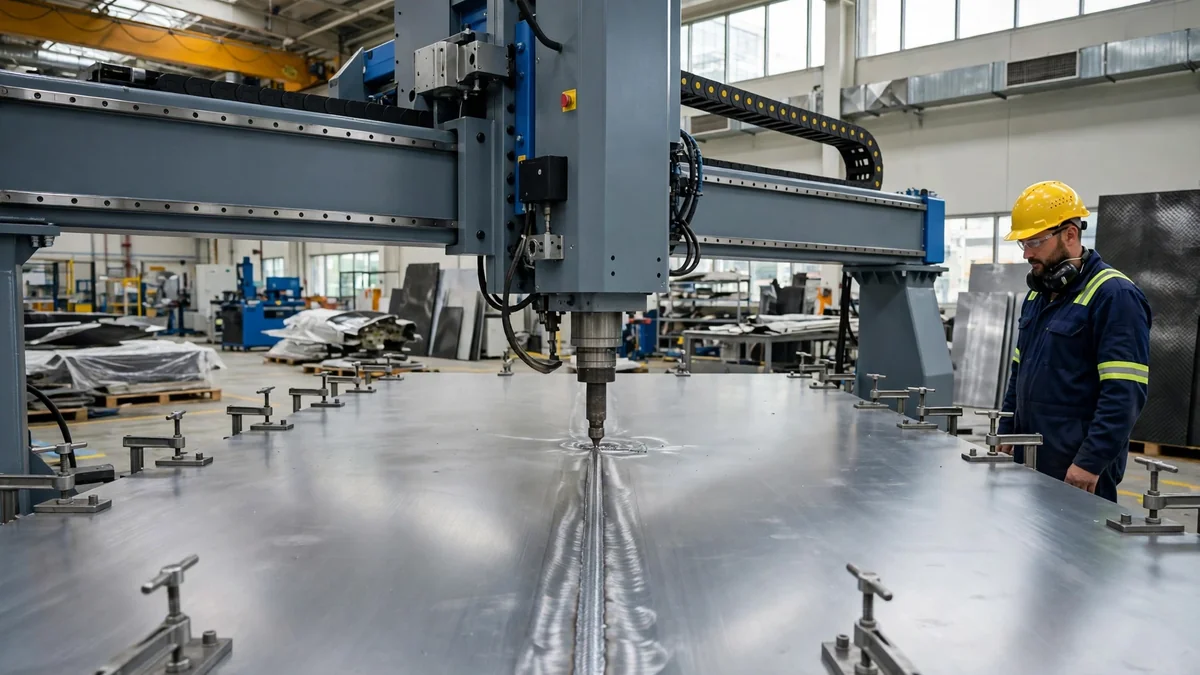
The strangest thing about the strongest weld in the factory is that nothing melts. Two aluminium panels lie side by side on a long bed, clamped flat by a row of steel toggles. Above them, a blunt steel tool spins at hundreds of revolutions per minute and plunges into the seam between the panels. There is no arc, no flash, no shower of sparks. There is only a low hum, a faint smell of hot metal, and a smooth, rippled seam trailing behind the tool like a wake.
Friction stir welding was invented in 1991 at The Welding Institute in Cambridge, and it solved a problem that had frustrated engineers for decades: aluminium and other light alloys are notoriously hard to weld with a flame, because they melt, oxidise and crack. Friction stir welding never lets the metal melt at all. It softens the metal with friction, stirs it together, and leaves a joint that is often stronger than the metal around it.
How Friction Stir Welding Is Made
Step 1: Preparing the joint
Everything starts with the fit-up, and in friction stir welding the fit-up has to be nearly perfect. The two pieces are machined so their edges meet with almost no gap, because the process adds no filler metal — the joint is made entirely from the parent material. The edges are cleaned to remove oxides, oils and dirt, and the panels are laid on a heavy steel backing plate that supports them against the enormous downward force of the tool.
Step 2: Clamping the work down
Once the panels are aligned, they are locked in place with a row of clamps spaced along the seam. The clamps have two jobs: they stop the panels from being pushed apart by the rotating tool, and they stop them from lifting off the backing plate as the metal softens. On a long weld — a rocket tank seam can run for metres — the clamping system is a machine in itself, with dozens of hydraulic or manual toggles.
Step 3: Choosing the tool
The tool is the heart of the process: a steel cylinder with a wide flat shoulder and a short pin sticking out of its centre, like a stubby mushroom. The pin plunges into the seam and stirs the softened metal, while the shoulder rides on the surface, pressing down and containing the plasticised material so it cannot escape. Tool shapes vary — threaded pins, fluted pins, scrolled shoulders — and each is tuned to a material and thickness.

Step 4: Plunging and stirring the seam
The weld itself begins when the spinning tool plunges into the start of the joint. Friction between the shoulder and the metal generates intense heat — enough to soften aluminium to a putty-like state at around 400 to 500 degrees Celsius, but never enough to melt it. The tool then travels along the seam, and the pin churns the softened metal from one side to the other, mixing the two panels together at a molecular level. It is a weld made by kneading, and the same patience that shapes other joining work — from steel welding to electron beam joints — is what keeps the seam sound.
Step 5: Controlling heat and speed
The operator’s real skill is in the balance of rotation speed, travel speed and downward force. Spin too fast and the metal overheats, leaving a rough, weakened seam; travel too fast and the pin leaves a tunnel of unmixed metal buried inside the joint. Modern machines control all three automatically, adjusting in real time as sensors watch the force on the tool. The result is a joint with almost no distortion — panels come out flat, where a conventional weld would have pulled them into a banana shape.
Step 6: Finishing the ends
Every friction stir weld has a weakness at its ends: the hole left where the tool plunges in, and the hole where it pulls out. Factories deal with this by starting and ending the weld on sacrificial run-off tabs — extra pieces of metal clamped beyond the real joint — so the holes land in scrap, not in the part. The tabs are cut off and the ends are trimmed flush.
Step 7: Inspecting the joint
A friction stir weld hides its defects inside, so inspection is done with ultrasound or X-rays rather than the eye. Inspectors scan the full length of the seam looking for voids, lack of mixing or cracks, and they cut test pieces from the ends of production runs to pull apart in a tensile machine. A good weld breaks in the parent metal, not in the joint — proof that the seam is stronger than the sheet around it. That test result is recorded for every batch, because on a rocket tank or a train body, the paperwork is part of the product. The same discipline that certifies a pressure hull, as in submarine pressure hulls, is what makes a stirred joint trusted at altitude and at sea.
Friction Stir Welding at a Glance
| Specification | Typical Value |
|---|---|
| Invented | 1991, The Welding Institute, Cambridge |
| Main materials | Aluminium, magnesium, copper, some steels |
| Peak temperature | About 400–500 °C for aluminium, below melting point |
| Tool rotation speed | Roughly 200–2,000 rpm |
| Travel speed | Roughly 50–1,500 mm per minute |
| Typical thickness | 1–75 mm, single or double sided |
| Key advantage | No melting, low distortion, joint stronger than parent metal |
What Does It Cost?
Friction stir welding is not cheap to set up, but it is cheap to run. A dedicated friction stir welding machine costs roughly $500,000 to several million dollars (estimates), depending on size and automation, and the tooling itself is inexpensive compared with a welding robot’s consumables. There is no filler wire, no shielding gas and almost no post-weld straightening, so the cost per metre of weld can be lower than conventional arc welding on long aluminium joints (estimates). For the customer, that shows up in the price of the finished structure: a friction stir welded train body or fuel tank costs more to design but less to build and finish. The economics are strongest where the welds are long, the metal is aluminium, and distortion would otherwise mean hours of rework.
A Rare Fact
The largest friction stir welds ever made hold together the fuel tanks of space rockets. The core stage of NASA’s Space Launch System is welded from aluminium panels more than eight metres across, and the friction stir welds that join them are the longest and thickest of their kind — joints so critical that the welding machine itself is one of the largest ever built. A process invented to fix a problem with aluminium window frames now holds together the machine that carries astronauts to the Moon. It is a remarkable journey for a weld that never melts, and it shares its roots with the most exacting joining work anywhere, from electron beam welding to the pressure hulls of submarines — different tools, same rule: the joint must never be the weakest part.