Hold your phone up to a sunset and tap the shutter. In less than a second, a lens smaller than a lentil has gathered the light, bent it, focused it, and handed it to a sensor that turns it into a photograph good enough to print. Nothing about that feels expensive. The lens is a speck of glass you could lose on a carpet. Yet the camera system in a flagship phone is one of the most costly pieces of engineering in the whole device, and the tiny lens at its heart is the reason why.
The surprise is not that the lens is small. It is that it has to do the work of a professional camera lens while fitting into a body a few millimetres thick. A full-size camera lens has room to breathe: big glass elements, wide barrels, space for the light to travel. A phone lens has almost none of that. Every element must be ground, polished, coated and aligned to tolerances measured in fractions of a micron, and it must survive being dropped, shaken and baked in a pocket every day for years.
Why It Costs So Much
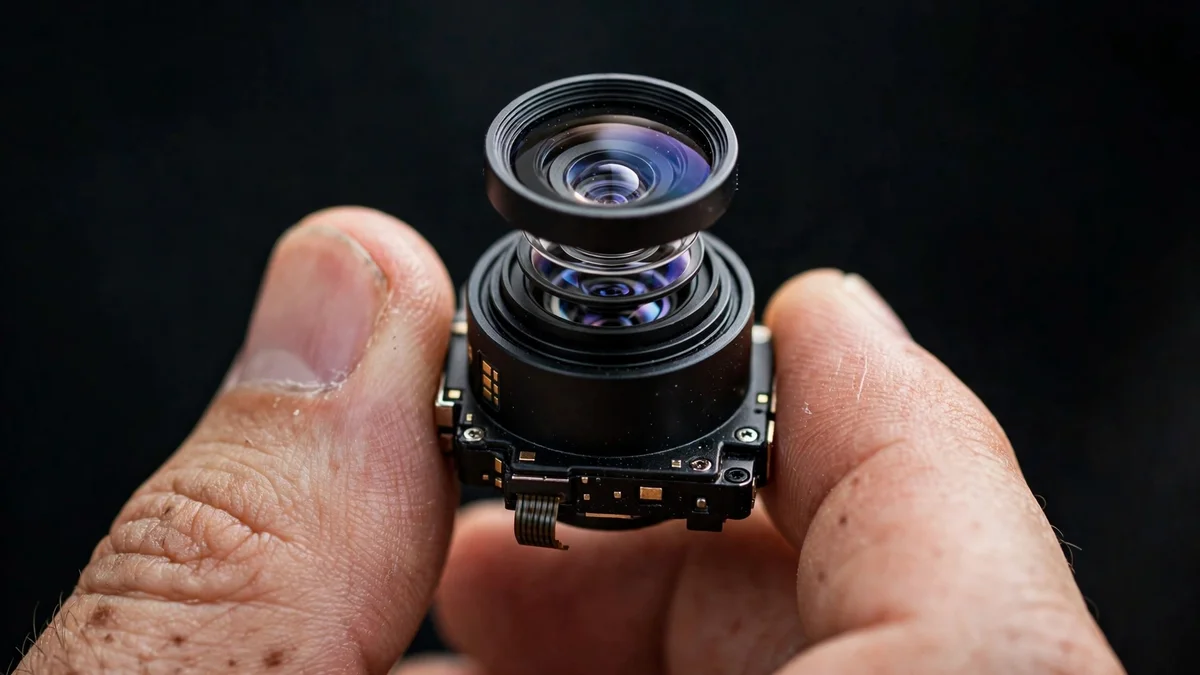
A phone camera lens looks simple from the outside, a dark circle of glass in a metal ring. Inside it are five to eight separate lens elements, each one a different shape, each one doing a different job. The cost comes from how those elements are made, how precisely they must fit together, and how few factories in the world can do the work at all.
Reason 1: The glass itself is exotic
Ordinary window glass would ruin a photograph. Phone lenses are made from specialised optical glass and moulded plastics with carefully chosen refractive indexes, some of them containing rare-earth elements such as lanthanum. These materials bend light more sharply than common glass, which is what lets a lens be thin and still focus well. They are produced in small batches by a handful of suppliers, and a single flawed batch can be worth a fortune in scrapped material.
Reason 2: Aspheric elements are brutally hard to make
Most of the elements in a phone lens are aspheric, meaning their curves are not simple spheres but complex shapes designed to cancel out distortion. Each one is moulded or ground to a profile accurate to within a few hundred nanometres, then polished until its surface is smoother than a mirror. A single speck of dust or a tiny mould defect shows up in every photograph the phone ever takes, so the yield — the share of lenses good enough to ship — is far lower than in ordinary glassmaking.
Reason 3: Coatings thinner than a soap bubble
Every element carries several anti-reflective coatings, laid down one atomic layer at a time in a vacuum chamber. These coatings stop stray light bouncing between elements, which is what prevents ghosting and flare when you photograph a bright window or a sunset. Applying them takes hours, needs a spotless cleanroom, and each coating recipe is a closely guarded secret tuned to that exact lens design. A lens without its coatings is a paperweight.
Reason 4: Alignment measured in microns
Stacking seven lens elements is only the beginning. They must sit on a single optical axis with almost no tilt or offset, or the image goes soft at the corners. Assembly happens on machines that align each element while watching a live test image, adjusting in steps smaller than a human hair. The same obsession with stacking tiny parts in perfect order drives the stacked layers in a modern phone camera sensor, where millions of light-sensitive points share a chip the size of a fingernail. One misaligned lens in a batch means the whole module is rejected.
Reason 5: Autofocus and stabilisation add moving parts
A modern phone lens does not sit still. Voice-coil motors shift it back and forth for autofocus, and optical stabilisation tilts it dozens of times a second to cancel the shake of your hand. Those motors, magnets and springs are built into a module only a few millimetres tall, and they must work silently, instantly and millions of times without wearing out. Designing a mechanism that small and that reliable is closer to watchmaking than to ordinary manufacturing.
Reason 6: The periscope zoom multiplies the problem
Flagship phones now add a folded periscope lens for long zoom, bouncing light sideways through a prism so the lens can be longer than the phone is thick. That means extra elements, a precision prism, and a second stabilisation system, all packed into a corner of the phone. The periscope module alone can cost more than some whole budget phones, and it is the reason flagship cameras keep getting better while phones stay thin.
Reason 7: Only a few factories can do it at all
The whole process — exotic glass, aspheric moulding, vacuum coatings, micron alignment — lives in a small number of factories, most of them in Asia, run by companies such as Largan Precision and Sunny Optical. Building a competing line costs hundreds of millions of dollars and takes years to bring up to yield. Phone makers therefore pay a premium for capacity, and the lens makers can charge for the scarcity of their skill. Keeping all of this cool and reliable inside a sealed phone is a challenge shared with processors, where sustained cooling decides real-world performance.

Specifications
| Specification | Detail |
|---|---|
| Lens elements | Typically 5 to 8 per main camera |
| Element material | Optical glass and moulded plastic, some with rare-earth elements |
| Surface accuracy | Within a few hundred nanometres |
| Coatings | Multiple anti-reflective layers, applied in vacuum |
| Aperture | Around f/1.6 to f/1.9 on flagship main cameras |
| Autofocus | Voice-coil motor, moving the lens stack in microns |
| Stabilisation | Optical image stabilisation, sensor-shift or lens-shift |
| Module thickness | Only a few millimetres, including motors |
Price
The camera module is one of the most expensive parts of a flagship phone. Industry estimates put the complete rear camera system of a top phone at roughly $50 to $100 per unit in volume (estimate), with the periscope zoom module adding substantially more, and a single replacement camera module through an official repair programme can cost several hundred dollars (estimate). The glass itself is cheap; the price is in the precision, the coatings, the yield losses and the few factories able to do the work. As with display panels, where OLED display panel specs show how much engineering hides behind a flat screen, the cost of a phone camera is the cost of shrinking a whole optical workshop into a speck.

Rare Fact
Some flagship phone lenses are polished to a surface accuracy of less than one-hundredth the width of a human hair, and a single lens element can pass through more than a hundred separate manufacturing steps before it is allowed into a phone. The glass in your pocket camera is shaped more precisely than the mirrors in many telescopes were a generation ago.
That is the quiet extravagance of the phone in your hand: a camera that fits in a few millimetres, built from exotic glass, coated one atom at a time, aligned by machines that watch what the lens sees. It costs so much because there is no cheap way to make light behave perfectly in a space thinner than a pencil. The lens is small. The engineering behind it is anything but.


