In a dark steel chamber, a needle of light thinner than a human hair touches two pieces of metal. There is no flame, no spark shower, no smoke. For a few seconds there is only a bright point of heat, and then the beam is gone, leaving behind a weld so deep and so narrow that it looks like a pencil line drawn through solid steel. The joint it leaves is stronger than the metal around it.
This is electron beam welding, a way of joining metal with a stream of electrons moving at close to the speed of light. It can weld parts too thick for any torch, join metals that refuse to be welded any other way, and do it all inside a vacuum where no air can contaminate the joint. It is one of the most precise welding methods ever built. Here is how the machine, and the weld, are made.
How It’s Made
Step 1: Building the electron gun
At the heart of the machine is the electron gun, a device that turns electricity into a beam. Inside it, a tungsten filament is heated until it glows white hot and starts throwing off electrons, which are then pulled forward and focused by magnetic lenses into a beam just a fraction of a millimetre wide. The gun is built like a piece of scientific equipment rather than a workshop tool: its parts are machined to fine tolerances, assembled in a clean room, and sealed into a column that can be pumped down to a vacuum. The gun sits on a rigid frame that never flexes.
Step 2: Making the vacuum chamber
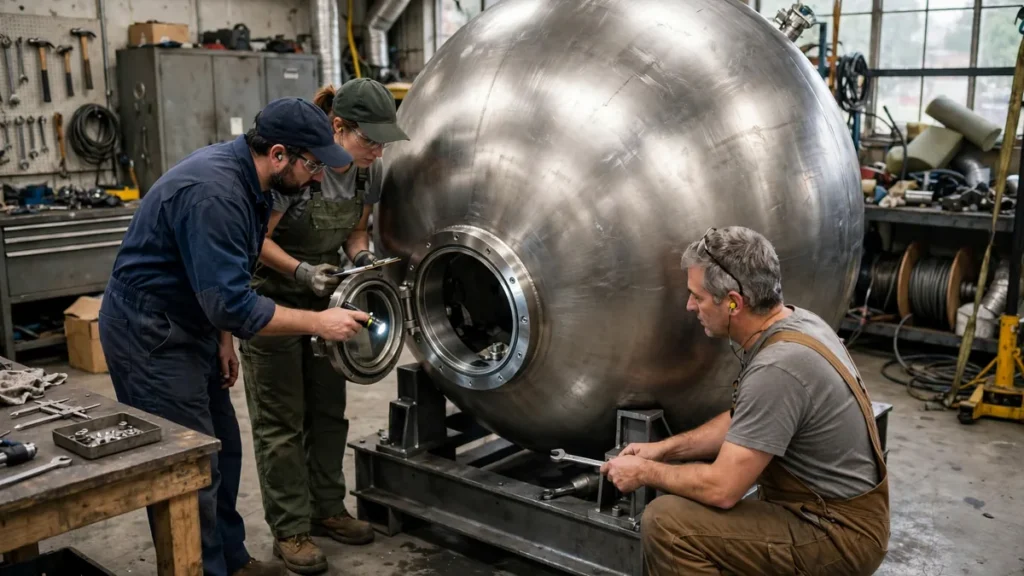
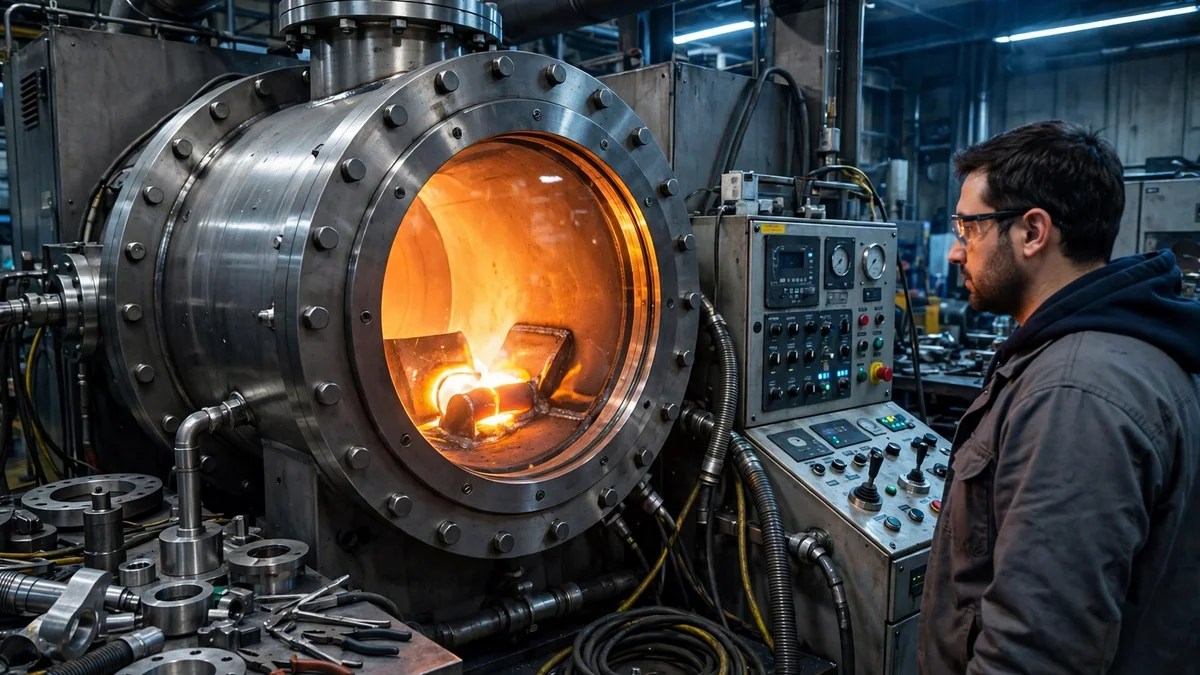
The welding itself happens inside a vacuum chamber, a steel box built to hold out the air while a pump pulls the pressure down to almost nothing. The chamber is made from thick stainless steel plate, welded and machined flat so its door seals perfectly against a rubber gasket. Inside, rails and rotary tables hold the parts to be joined, and the whole chamber sits on a bed that can move the work under the beam with great precision. Air would scatter the beam and oxidise the hot metal. Once the chamber is sealed and pumped down, the weld takes place in conditions closer to outer space than to a workshop.
Step 3: Preparing the parts
The parts to be welded are machined first, and the joint faces are made flat and clean. Electron beam welding needs a tight fit: the two pieces must sit together with almost no gap, because the beam adds no filler metal of its own. The parts are degreased, checked for cracks, and clamped into fixtures that hold them exactly in place. Round parts rotate under a fixed beam. The operator then programs the weld path into the machine’s computer, setting the beam power, the travel speed and the focus point, and runs a test pass on a scrap piece before committing to the real part.
Step 4: Firing the beam
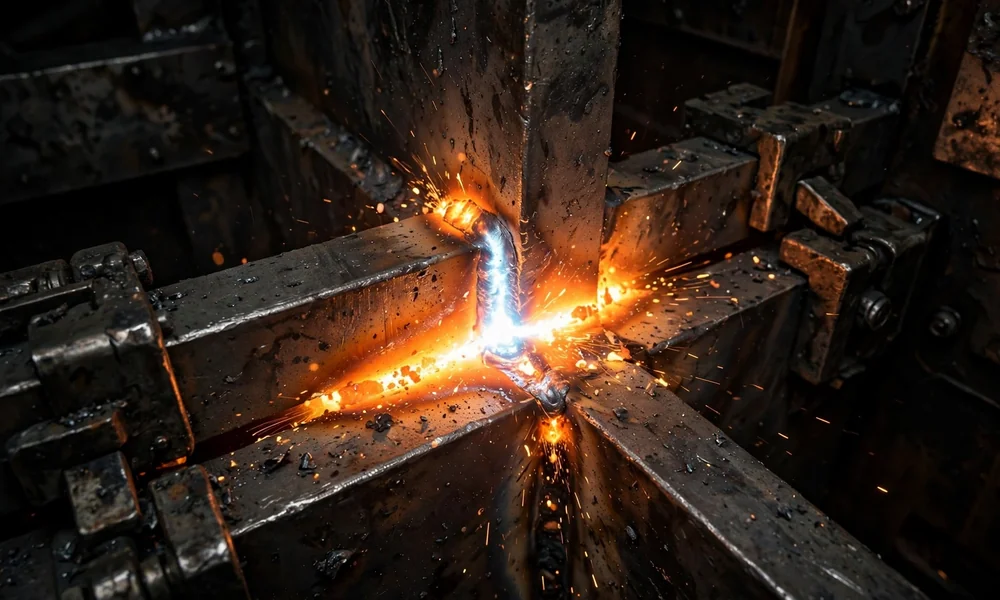
With the chamber pumped down, the operator fires the beam. The electrons strike the joint and their energy turns to heat in a spot so small and so intense that the metal melts instantly, forming a narrow keyhole of liquid metal that follows the beam along the seam. It can melt through steel over a hundred millimetres thick in one pass, something no flame or arc can do. The weld is deep and narrow, with very little heat spreading into the surrounding metal, so the parts barely distort. A camera or a viewing window lets the operator watch the glow, and the whole pass may take only seconds. The principle is the same careful control of heat that makes steel welding work, taken to an extreme of precision.
Step 5: Cooling and inspection
When the beam switches off, the weld freezes in a fraction of a second. The chamber is vented back to normal air pressure, the door is opened, and the part is lifted out. It is barely warm to the touch, because so little heat was put in. Inspection follows: the weld is checked by X-ray or ultrasound for hidden voids, and the surface is examined under magnification. A good electron beam weld is smooth, even and almost invisible, with a narrow heat-affected zone around it. Any weld that fails inspection is cut out and redone. Aerospace parts welded this way are trusted in jet engines.
Step 6: Finishing and fitting
The finished part is machined to its final shape, with the weld ground flush if it needs to be. Then it goes to its destination: a gear in a gearbox, a shaft in a turbine, or a pressure vessel in a power station. The weld is as strong as the parent metal. The machine itself needs little maintenance beyond replacing the filament in the electron gun and servicing the vacuum pumps, and a single machine can weld parts for decades. The cost is in the machine and the chamber, not in the welds, which use almost no material at all.

Specs
| Specification | Typical figure |
|---|---|
| Beam power | Up to 100 kW or more |
| Beam diameter | 0.1–1 mm at the weld |
| Maximum weld depth | Over 100 mm in a single pass |
| Chamber vacuum | About a millionth of normal air pressure |
| Weld speed | Roughly 10–50 mm per second |
| Heat-affected zone | Very narrow, under 1 mm |
| Materials welded | Steel, titanium, nickel alloys, copper |
| Typical use | Aerospace, gearboxes, power generation |
Price
An electron beam welding machine is a major purchase. As an estimate, a small chamber machine costs roughly $500,000 to $1 million, while a large industrial system with a chamber big enough for turbine parts can cost $2 million to $5 million — these are estimates, and the price depends on chamber size, beam power and automation. The running cost, by contrast, is low: the process uses no filler wire, no shielding gas and very little electricity per weld. For a factory welding high-value parts daily, that reliability pays for the machine.
A Rare Fact
Electron beam welding was first developed for the nuclear industry in the 1950s, where it was used to join metals that no other process could touch. The same technology later went into space: electron beam welders have been tested in orbit, where the vacuum of space does the pumping for free. The beam can weld a watch spring or cut metal like a scalpel. It is one of the few industrial processes where the tool is not a piece of metal at all, but a stream of particles you cannot see.
The weld is only as good as the metal it joins. The high-strength alloys that go into these joints are part of the same world as titanium forging specs, which cover the materials built for extreme loads. For the numbers behind the beam itself, the electron beam welding specs set out the power, depth and vacuum figures in detail. A weld made from light, in a chamber with no air, is one of the quietest marvels in engineering — and it holds together the machines that fly.