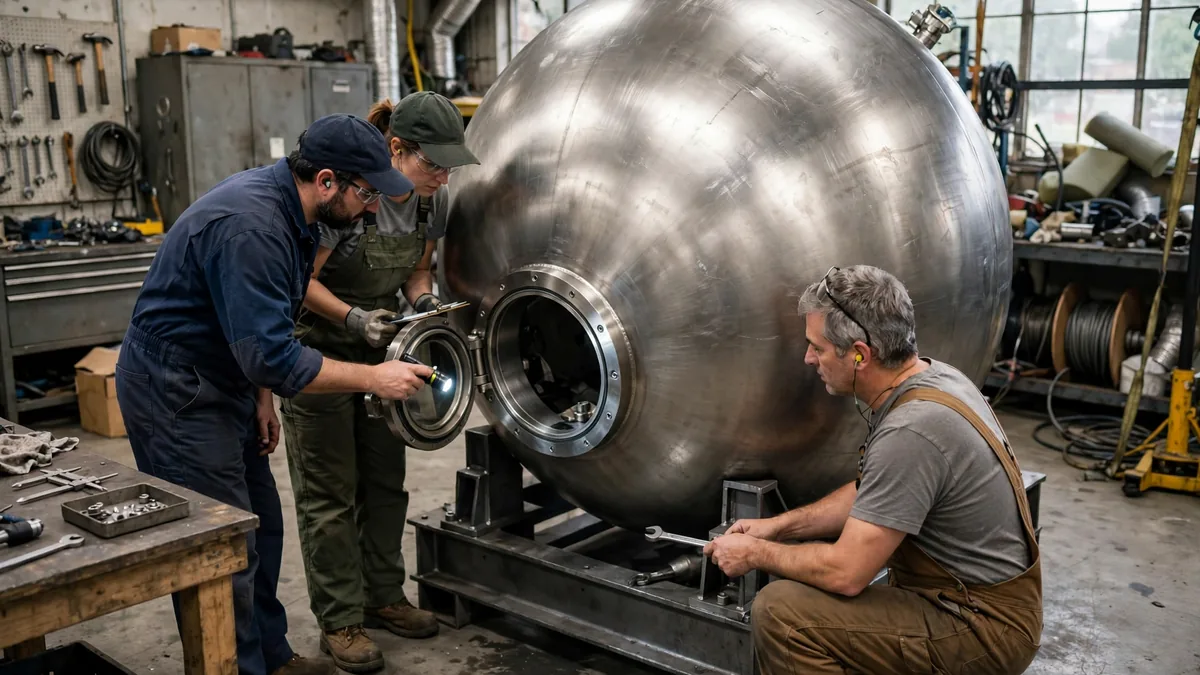
The sphere sits on its cradle in the workshop like a giant steel bubble, just wide enough for three people to crouch inside. There are no windows worth the name, only a few small thick portholes, and a hatch barely wider than a person’s shoulders. Lower it into the ocean and the water presses harder with every ten metres of depth, by roughly one atmosphere each time. Take it to six thousand metres, where the scientists want to go, and every square centimetre of that polished shell will carry about six hundred kilograms. The sphere is the most expensive single part of a research submersible, and its price is written in that pressure.
A research submersible sphere is not a container, it is a pressure vessel that happens to carry people. It must stay perfectly round under crushing load, stay sealed against freezing seawater, and still let its crew see out, breathe, and work for hours. It is built in numbers so small that each one is effectively a prototype, by workshops that can count their rivals on one hand. This is why it costs so much.
Why It Costs So Much
Reason 1: The metal is extraordinary
A deep-sea sphere is usually forged from titanium, a metal that is strong, light, and almost immune to seawater corrosion, but which is notoriously difficult and expensive to work. Titanium must be melted in a vacuum, forged in huge presses, and machined with fast-wearing tools. A sphere for a full ocean depth vehicle can need several tonnes of it, and the raw material alone costs far more than the steel that would do the same job on the surface. The build is shown in how a research submersible sphere is made, and the metal is the first reason that story is expensive.
Reason 2: It must be almost perfectly round
A sphere is the strongest shape for resisting pressure, but only if it is truly spherical. A dent, a flat spot, or a variation in wall thickness of even a millimetre can become the point where the shell buckles under load. The sphere is therefore machined on enormous lathes and measured with instruments that can detect errors smaller than a human hair. Each half is formed, machined, and checked again and again, and any half that fails is reworked or scrapped. That precision, across a shell more than two metres wide, is work that only a few workshops in the world can do.
Reason 3: The hatch and portholes are weak points by design
Every hole in a pressure sphere is a problem. The hatch that lets the crew in, the portholes they look through, and the penetrators that carry wires and pipes through the shell all interrupt the smooth curve that gives the sphere its strength. Each one needs a forged ring, a precision-machined seat, a seal that holds at full depth, and a thick window that takes the same load as the metal around it. The portholes alone can cost as much as a car, and they must be replaced on a strict schedule even if they look perfect.

Reason 4: It must be tested to destruction, almost
No sphere goes to sea on the strength of a calculation alone. The finished sphere is lowered into a pressure chamber and taken to pressures beyond its rated depth, while instruments listen for the tiny cracking sounds that warn of a flaw. The test chamber itself is a rare and expensive piece of equipment, and a failed test can mean months of rework. The vehicle that carries the sphere is tested the same way, and the figures behind the whole machine are set out in the deep-sea submersible specifications, where the depth rating is the number that drives every other cost.
Reason 5: Life support is built into the shell
The sphere is not just a shell, it is a tiny sealed world. Inside must fit oxygen supply, carbon dioxide scrubbers, heating, lighting, controls, and seats, all packed into a space smaller than a family car interior, and all of it must keep working for hours at depth. Every system inside the sphere must be tested, certified, and backed up, because at six thousand metres there is no rescue that can arrive in time. That life support, and the discipline of certifying it, is a large share of the sphere’s price.
Reason 6: Only a handful are ever built
The world has only a few research submersibles capable of reaching the deepest ocean, and each sphere is essentially a one-off. There is no production line, no shared tooling, and no chance to learn from building the same thing a hundred times. The design, the forging dies, the machining fixtures, and the test programme are all paid for by a single sphere. The hulls of larger submarines face the same economics of tiny numbers, and the numbers behind them are explored in the submarine pressure hull specifications, which show how depth and size push every cost upward.

Research Submersible Sphere at a Glance
| Specification | Detail |
|---|---|
| Main material | Forged titanium alloy |
| Typical diameter | About 2 to 2.3 metres inside |
| Crew | Usually 2 to 3 people |
| Depth rating | Up to 6,000 metres and beyond |
| Pressure at depth | About 600 bar at 6,000 metres |
| Wall thickness | Typically 70 to 90 millimetres |
| Main features | Hatch, portholes, cable penetrators |
| Testing | Full pressure chamber test beyond rated depth |
| Production volume | One-off, a handful ever built |
What Does It Cost?
All figures below are estimates, not quotes, and the real numbers vary with the depth rating, the diameter and the builder.
| Cost item | Typical estimate |
|---|---|
| Titanium forging and material | $500,000 to $1,500,000 (estimate) |
| Precision machining of the shell | $400,000 to $1,000,000 (estimate) |
| Hatch, portholes and penetrators | $200,000 to $500,000 (estimate) |
| Life support and internal systems | $300,000 to $800,000 (estimate) |
| Pressure testing and certification | $150,000 to $400,000 (estimate) |
| Finished sphere, ready for sea | $1,550,000 to $4,200,000 (estimate) |
Those estimates cover the sphere alone, not the frame, batteries, thrusters, cameras, and support ship a working submersible also needs. The sphere is the heart of the vehicle, and it is priced like a heart: the part that cannot fail, so the part where no cost is spared.
A Rare Fact
The first crewed vehicles to reach the deepest part of the ocean, the Challenger Deep, used spheres that were little more than steel balls with a hatch, and their crews could barely move inside them. Modern spheres are wider, lighter, and far stronger, yet the principle has not changed: a sphere is still the only shape that spreads deep-sea pressure evenly enough to keep people alive at full ocean depth. Every other shape, from cylinders to flat panels, needs far thicker walls to survive the same pressure, which is why the sphere endures.
A research submersible sphere is expensive because it is made from extraordinary metal, machined to near-perfect roundness, pierced by costly hatch and porthole openings, tested almost to destruction, filled with life support, and built in numbers you can count on one hand. Pay for all of that, and three people can sit in a steel bubble at the bottom of the ocean and look out at a world no sunlight has ever touched.


