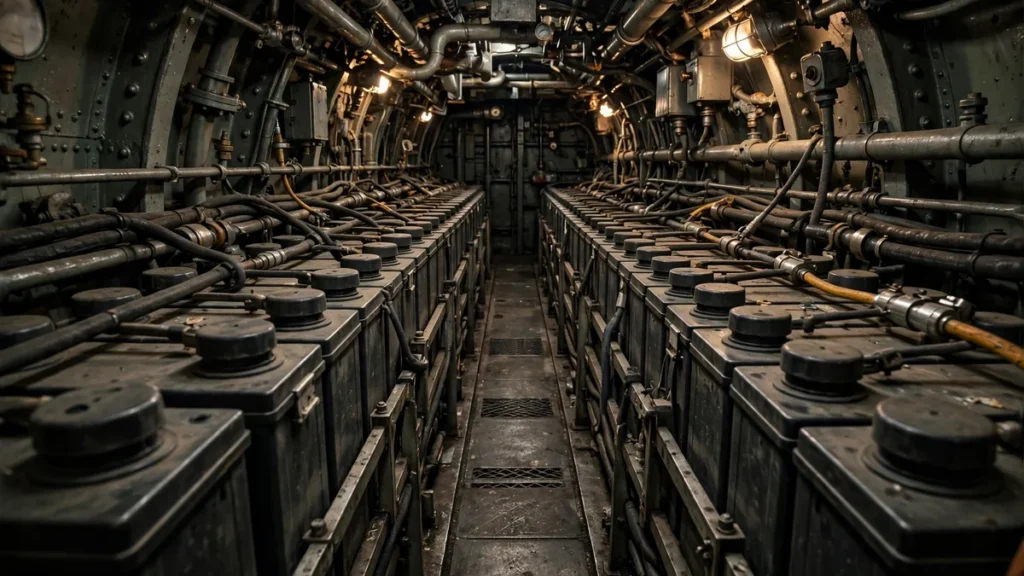
Deep below the surface of the ocean, a submarine can stay submerged for months at a time, travelling thousands of miles without ever coming up for air or fuel. No diesel engine can do that, and no battery comes close. The only machine that can is a nuclear reactor, a steel vessel the size of a small room that turns the heat of atoms into the steam that drives the boat. Building one is among the hardest manufacturing jobs in the world: the parts must survive decades of service, they can never be allowed to fail, and once the submarine is built around the reactor, much of it can never be taken out again.
A submarine reactor is not a power station shrunk down. It is a machine designed from the start to live inside a steel tube, to run silently, to survive depth charges and collisions, and to be operated by a small crew far from any help. Every weld is X-rayed, every pipe is tested to many times its working pressure, and every component is documented to prove it was made correctly.
How It’s Made
Step 1: Forging the pressure vessel
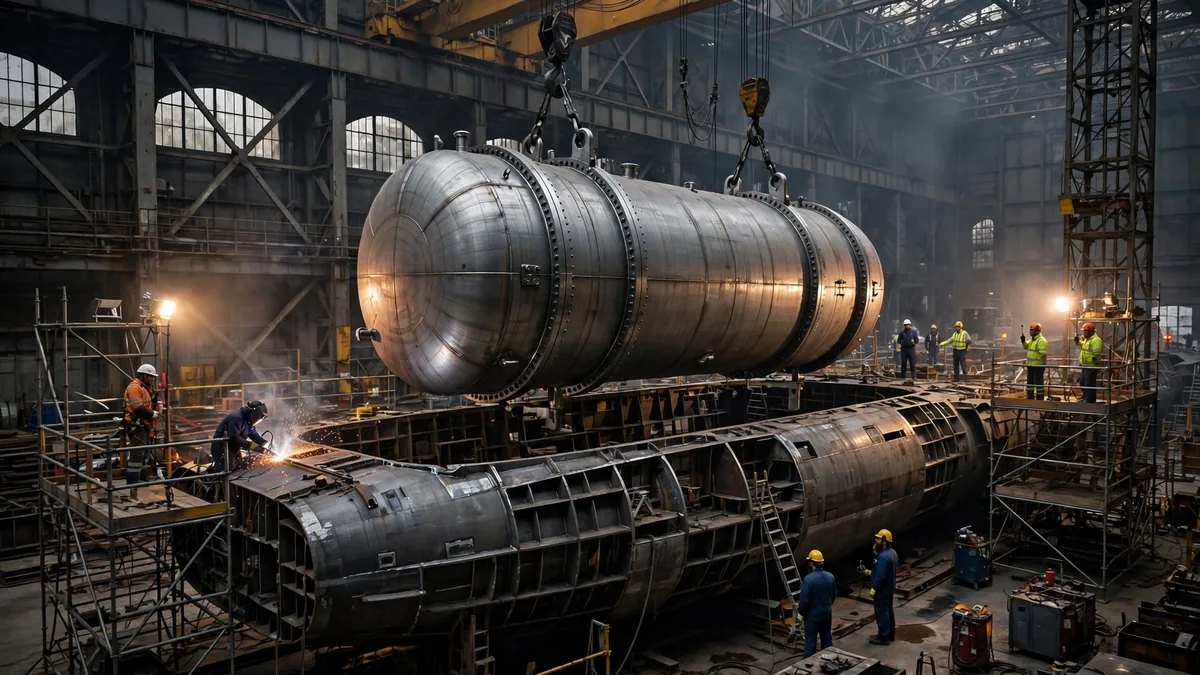
The reactor’s heart is its pressure vessel, a thick-walled steel cylinder with a domed lid that holds the nuclear core and the water that cools it. It begins as a huge steel forging, a single piece of specially made steel that is heated, pressed, and rolled into shape in a forge large enough to handle components weighing hundreds of tonnes. The vessel is then machined inside and out, and its walls — many centimetres thick — are inspected with ultrasound for the smallest flaw. A flaw in a pressure vessel cannot be patched later, so the forging is tested more thoroughly than almost any other steel object ever made. It is the same discipline of building a hull that must never fail under pressure, as our look at how a submarine pressure hull is made explains.
Step 2: Building the core and fuel assemblies
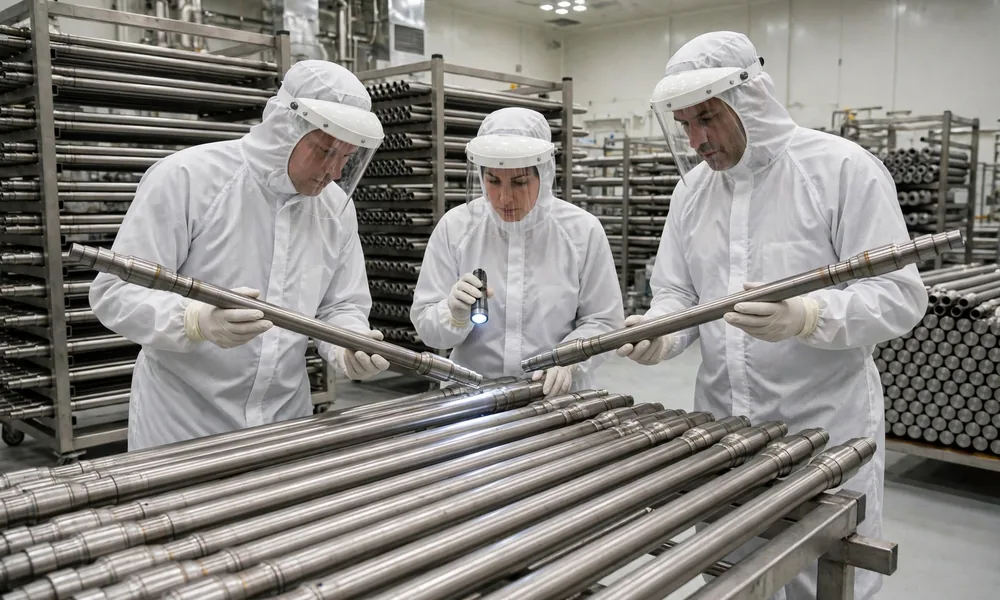
Inside the vessel sits the reactor core, made up of fuel assemblies: long bundles of metal tubes, each one holding pellets of uranium fuel sealed inside cladding that keeps the fuel separate from the cooling water. The assemblies are built in a specialised fuel factory, where the tubes are filled, sealed by welding, and tested for leaks with helium, because even a tiny leak would contaminate the cooling water. The fuel is designed to last for the life of the submarine — often decades — so the core is sealed up with the expectation that it will not be opened again until the boat is retired.
Step 3: Fitting the steam generators
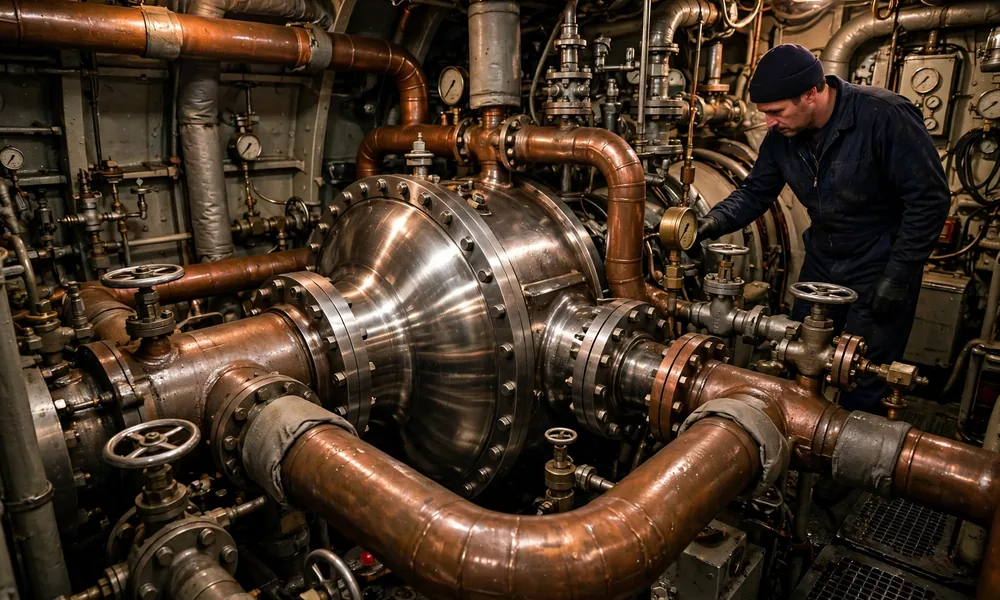
The heat from the core is carried away by pressurised water in a closed loop, and that water passes through steam generators — large heat exchangers where the hot water boils a second loop of water into steam without the two ever mixing. The steam generators are built from thousands of small tubes, each one welded into a tube plate and tested individually, because a leaking tube would mix the two loops. The steam that leaves the generators drives the turbines, and the same care with high-pressure steam plant shapes the engines of the largest ships, as our look at cruise ship engine materials engineering shows.
Step 4: Shielding and piping
Around the reactor, engineers build the shielding: layers of steel, water, and special materials that absorb radiation and protect the crew. The shielding is heavy — it can weigh hundreds of tonnes — and it is fitted as a complete compartment inside the submarine, with the reactor at its centre. Then comes the piping: the primary loop carrying hot water to the steam generators, the secondary loop carrying steam to the turbines, and the cooling systems. The compartment is built like a ship inside a ship, and it is the same modular approach used to build the rest of the vessel, as our look at modular ship construction explains.
Step 5: Installing the reactor in the hull
The reactor compartment is built as a complete section of the submarine, and it is lowered into the hull while the boat is still under construction in the shipyard. A heavy-lift crane moves the section into place, and the hull sections are welded together around it. From this point on, the reactor is part of the submarine: it cannot be removed without cutting the hull open. The turbines, the propeller shaft, and the electrical generators are connected, and the control room is wired to the reactor’s instruments.
Step 6: Testing and going critical
Before the reactor is ever started, the whole plant is tested with cold water, then hot water, then steam, checking every pump, valve, and instrument. Only when the shipyard, the navy, and the nuclear regulators are all satisfied is the reactor brought to power for the first time — a moment called going critical — under the watch of engineers who have rehearsed it for months. Sea trials follow, with the submarine diving, turning, and running at speed while the crew proves the plant can deliver full power and shut down safely on command. A submarine reactor is expected to run for decades without refuelling, and the testing is designed to prove, before the boat ever leaves the yard, that it will.
Specs
| Specification | Detail |
|---|---|
| Type | Pressurised water reactor (PWR), designed for submarine use |
| Pressure vessel | Thick-walled steel forging, domed lid, many centimetres thick |
| Core life | Designed to last the life of the submarine, often 25 to 30 years or more without refuelling |
| Cooling | Pressurised water primary loop, steam generators, separate steam loop to turbines |
| Propulsion | Steam turbines driving the propeller shaft, plus electrical generators for ship systems |
| Shielding | Layers of steel, water, and shielding materials around the reactor compartment |
| Testing | Every weld X-rayed, every tube leak-tested, full-power sea trials before service |
| Endurance | Months submerged, limited by food and crew rather than fuel |
Price
A submarine nuclear reactor has no public price tag, and it is never sold on its own. The reactor is part of a nuclear-powered submarine, and such submarines cost billions of dollars each to build (estimate, based on publicly reported programme costs), with the reactor plant — the vessel, the core, the steam generators, the shielding, and the testing — accounting for a large share of that cost. The expense reflects the materials, the years of skilled labour, and the testing regime, and it is why only a handful of countries in the world build nuclear submarines at all.
Rare Fact
A nuclear submarine’s reactor produces no smoke, no exhaust, and needs no air to run — which is why the boat can stay underwater for months. But the most remarkable fact is how quiet the whole plant must be: the reactor, turbines, and pumps are mounted on shock absorbers that stop vibration reaching the hull. The loudest machine on the boat is deliberately silenced, and the reactor that powers it is, at patrol speed, almost completely still — a furnace that burns without fire, and without a sound.