It is a single layer of carbon atoms, arranged in a honeycomb, and so thin that a stack of three million sheets would be a millimetre thick. It is also, gram for gram, the strongest material ever measured, it conducts electricity better than copper, and it conducts heat better than any other known material. It was first made with sticky tape and a lump of graphite, the same graphite in a pencil, and the two scientists who isolated it won a Nobel Prize for an experiment that cost almost nothing.
Graphene launched a thousand promises: unbreakable phones, aeroplanes lighter than air, batteries that charge in seconds. Most of those promises are still waiting. But quietly, graphene has started to appear in real products, mixed into other materials to make them stronger, lighter and more conductive. A graphene composite is not a sheet of pure graphene. It is an ordinary material, a plastic, a resin or a metal, with a tiny amount of graphene stirred into it, and the result is often dramatically better than the original. This is how it works.

How It Works
Step 1: Making the graphene
Graphene is made in several ways, and the method decides the quality and the price. Mechanical exfoliation peels layers from graphite with adhesive tape, making perfect graphene in tiny flakes, far too small and too slow for industry. Chemical vapour deposition grows graphene on a copper foil in a hot furnace, and it can make large, continuous sheets, but it is expensive. For composites, the most common route is to oxidise graphite, split it into flakes in a liquid, and then reduce it back, which makes graphene in bulk, as a powder of tiny platelets, at a price industry can afford.
Step 2: Mixing it into the host material
The hard part of a graphene composite is not making the graphene but mixing it in. Graphene platelets love to stick together, and a clump of graphene in a resin is just an expensive impurity. Manufacturers disperse the platelets with high-shear mixers, ultrasound, or chemical treatments that keep them separated, so they spread evenly through the host material. The loading is tiny, often less than one percent by weight, and that is enough: because each platelet is so thin and so wide, a small amount presents an enormous surface area to the material around it.
Step 3: Why a tiny amount changes everything
When a composite is loaded, pulled or bent, the stress is transferred from the soft host material into the stiff graphene platelets, which carry it without breaking. The platelets also block cracks: a crack running through a resin hits a graphene platelet and has to go around it, which takes energy and slows it down. The same network of platelets conducts electricity and heat through the material, which is why graphene composites are used for static dissipation and for spreading heat away from electronics. It is the same principle that makes other fibre composites strong, and the reason carbon fibre revolutionised engineering, as in carbon fibre weave specs explained.
Step 4: Shaping the composite
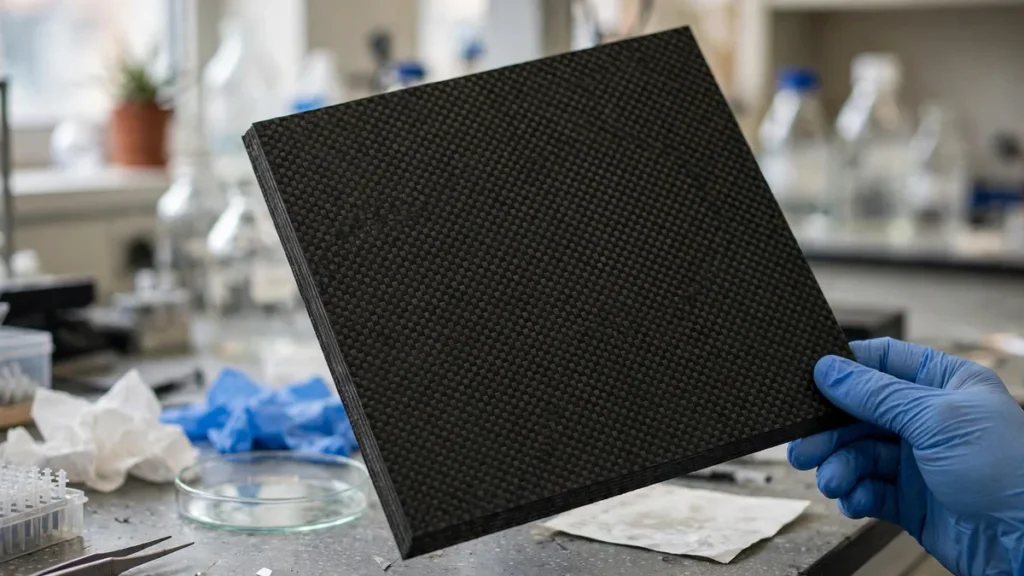
Once mixed, a graphene composite is shaped like any other composite. Graphene-enhanced epoxy is laid up with carbon fibre cloth to make panels, tubes and shells, and cured in an autoclave under heat and pressure. Graphene-filled plastics are injection moulded into housings and parts. The graphene survives the process because it is chemically stable and heat resistant, but the processing has to be tuned: too much heat or shear can damage the platelets, and too little mixing leaves clumps.
Step 5: Testing what was actually made
Because graphene is invisible to the naked eye inside a composite, testing is essential. Samples are pulled apart, bent and impacted to measure strength and toughness, and microscopes check that the platelets are dispersed and not clumped. The testing is the same discipline that goes into any high-performance composite, where a hidden flaw can be fatal, as in how Kevlar composite is made.

Step 6: Where graphene composites are used today
The real uses of graphene composites are less glamorous than the headlines but more interesting. Bicycle frames and tennis rackets use graphene-enhanced carbon fibre for stiffness. Helmets and protective gear use it for impact resistance. Concrete with a small amount of graphene is stronger and needs less cement, which matters because cement production is a large source of carbon dioxide. The pattern is always the same: graphene does not replace the old material, it improves it by a useful margin, and that margin is worth paying for.
Step 7: The limits and the future
Graphene composites are not a miracle. The material is still expensive compared with ordinary fillers, the supply chain is young, and the performance depends on getting the dispersion exactly right, which is not always easy at industrial scale. Some early products were found to contain far less graphene than claimed, and the industry has had to learn to verify what it is buying. The most promising directions are in energy storage, where graphene electrodes may make batteries charge faster, and in construction, where a small improvement in concrete multiplied by billions of tonnes is an enormous prize. Ceramic composites face the same challenge of turning a laboratory wonder into a reliable product, as in how ceramic matrix composite works.

Specs
| Specification | Typical figure |
|---|---|
| Graphene thickness | One atom, about 0.34 nanometres |
| Tensile strength | About 130 gigapascals, roughly 200 times stronger than steel by weight |
| Electrical conductivity | Higher than copper, about 10 to the power of 8 siemens per metre |
| Thermal conductivity | About 5,000 watts per metre-kelvin, higher than diamond |
| Typical loading in composites | About 0.1 to 1 percent by weight |
| Strength gain in epoxy | About 20 to 50 percent in stiffness and toughness at low loadings |
| Platelet size | About 1 to 10 microns across for industrial grades |
| Production methods | Chemical vapour deposition, liquid exfoliation, graphite oxidation |
| Key challenge | Dispersing platelets evenly without clumping |
| Main uses today | Sports goods, automotive parts, concrete, protective gear |
Price
Graphene has fallen sharply in price since it was first sold, but it is still expensive. As an estimate, industrial-grade graphene nanoplatelets cost roughly $50 to $200 per kilogram in bulk, while high-quality single-layer graphene made by chemical vapour deposition costs far more, and a finished graphene-enhanced product, such as a bicycle frame, can cost roughly $5,000 to $10,000. These are estimates, and prices vary widely with quality, quantity and supplier.
A Rare Fact
Graphene was first isolated in 2004 by Andre Geim and Konstantin Novoselov at the University of Manchester, who peeled layers from a block of graphite using ordinary adhesive tape, then pressed the tape onto a silicon wafer and looked for the thinnest flakes under a microscope. They won the Nobel Prize in Physics in 2010, only six years later, one of the fastest Nobel awards in history. Today the same tape method is still used in laboratories, because it makes the purest graphene of all, even though it will never make enough for a factory.
From a pencil to a bicycle frame to a bridge, graphene composites are the quiet version of a revolution: not a new material replacing the old ones, but an old material made better by a dusting of atoms. The promise of graphene is not that it will change everything at once, but that it will make a thousand things a little bit better, and a little bit better, multiplied across the world, is a great deal.