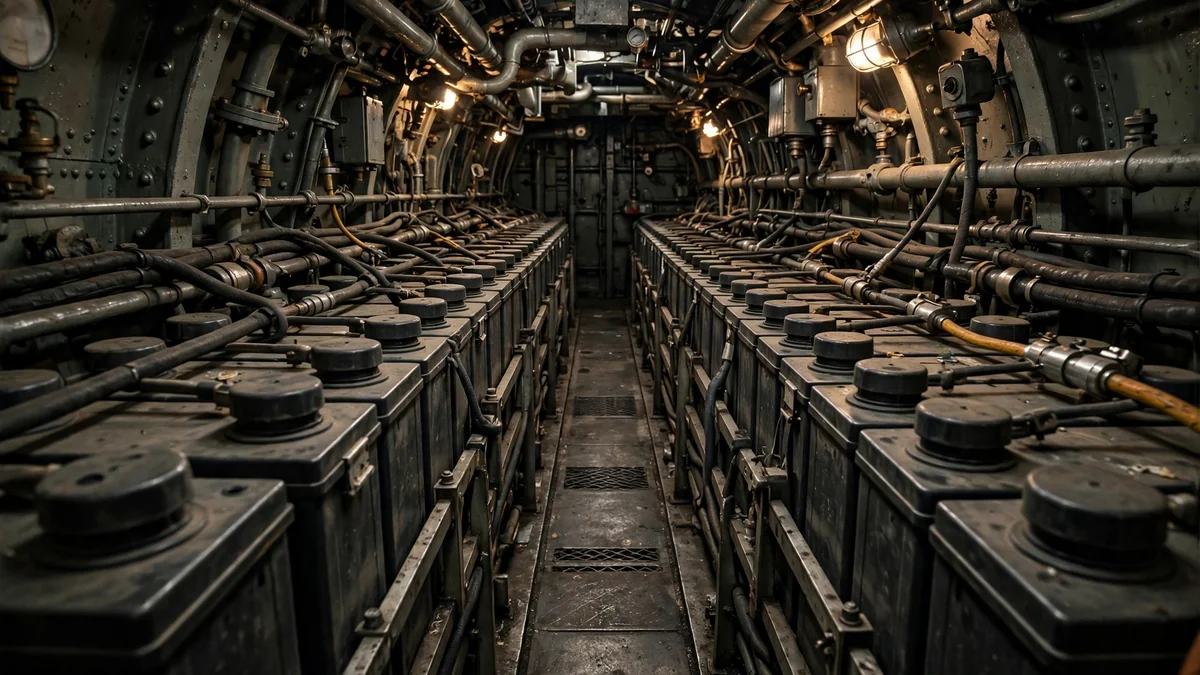
Below the control room floor of a diesel-electric submarine, behind a hatch that is always locked at sea, sits the heaviest single piece of equipment on the boat. It is not the engine, the propeller, or the torpedoes. It is a room full of batteries — hundreds of steel tanks, each the size of a wardrobe, filled with acid and lead, wired together into one silent bank. When the submarine slips beneath the waves and shuts down its diesels, this room becomes the whole ship: the engine, the lights, the air, everything.
The battery compartment smells faintly of acid and warm metal, and it hums — not loudly, but constantly, the sound of chemistry doing work. Each cell holds a little less than two and a half volts, barely enough to light a torch, yet together they deliver thousands of amps, enough to push thousands of tonnes of steel through the water at twenty knots. A watchkeeper walks the aisles between the cells every hour, checking temperatures and topping up water, because a battery this big is less like a piece of equipment and more like a living thing that must be fed, watered, and watched.
The numbers on a submarine battery tell the story of that compromise. Capacity, weight, voltage, and endurance are all traded against each other, and every navy in the world has argued over the same figures for a century. Diesel-electric boats today still rely on the same basic chemistry as the first submarines, even as a new generation of submarine nuclear reactors offers a different answer to the same question: how do you carry enough energy to live underwater? Here is what the battery specifications actually mean.
How It Works
Step 1: Storing energy as chemistry
A submarine battery is a lead-acid battery, the same chemistry as a car battery, scaled up beyond recognition. Each cell contains plates of lead and lead dioxide immersed in sulphuric acid. When the battery discharges, the plates and the acid react to form lead sulphate and water, releasing electrons that flow out as electric current. When the battery charges, the process runs in reverse, and the plates and acid are restored. It is an old, heavy, proven chemistry — and in a submarine, proven matters more than fashionable.
Step 2: Building voltage from small cells
A single lead-acid cell produces only about 2 volts, so the cells are wired in series, positive to negative, until their voltages add up to the few hundred volts the submarine’s motors need. A typical battery is split into two banks, one forward and one aft, so that damage to one half does not leave the boat dead in the water. Together the banks can hold well over a megawatt-hour of energy, and the cables that carry it are as thick as a man’s wrist.
Step 3: Charging on the surface
The battery is charged by the submarine’s diesel generators, which run while the boat is on the surface or at periscope depth with a snorkel mast raised. Charging a battery this large takes hours, and it is not a quiet business: the diesels roar, the snorkel mast pokes above the waves, and the boat is at its most detectable. That is why the charging cycle drives submarine tactics — a boat that has spent its battery must come shallow, and a boat that is shallow can be found.
Step 4: Running silent underwater
Once charged, the submarine dives and switches to battery power alone. The electric motor turns the propeller directly, and the boat becomes almost silent: no exhaust, no intake, no combustion, just the soft whine of the motor and the rush of water. Speed is the trade-off. A submarine can sprint at twenty knots or more on its battery, but only for a short time; at a slow patrol speed of a few knots, the same charge can last for days. The slower you go, the longer you live.
Step 5: The lithium-ion change
After more than a century of lead-acid, some modern submarines are switching to lithium-ion batteries — the chemistry behind EV battery cells and phone batteries alike. Lithium-ion cells store roughly twice as much energy for the same weight, charge faster, and need almost no maintenance — no topping up with water, no acid fumes. Japan’s newest submarines were the first to go to sea with lithium-ion batteries, and other navies are following. The catch is the same one that applies to every lithium battery: if a cell is damaged or overheated, it can catch fire, and a fire inside a sealed pressure hull is the nightmare every submariner trains for.
Step 6: Cooling, venting, and watching
Charging a lead-acid battery releases hydrogen gas, which is explosive in air. The battery compartment is therefore ventilated constantly, and hydrogen sensors watch the air around the clock. The cells are cooled by air blown between them, and the electrolyte level in each cell is checked by hand. It is slow, unglamorous work, and it never stops — because a battery that is neglected does not just go flat, it becomes dangerous. The battery is the heart of the submarine, and like a heart, it demands attention every day.

Submarine Battery Specs
| Specification | Typical range |
|---|---|
| Cell chemistry | Lead-acid (valve-regulated or flooded); lithium-ion on newest boats |
| Voltage per cell | About 2 volts (lead-acid); about 3.7 volts (lithium-ion) |
| Total battery voltage | About 200 to 500 volts across the banks |
| Energy capacity | About 1 to 5 megawatt-hours, depending on boat size |
| Battery weight | About 200 to 600 tonnes, up to a quarter of submerged displacement |
| Number of cells | About 200 to 500 cells in two banks |
| Maximum submerged speed on battery | About 15 to 21 knots for short bursts |
| Slow-speed endurance | Several days at 3 to 5 knots |
| Charge time | About 4 to 8 hours on diesel generators |
| Service life | About 5 to 10 years before the cells are replaced |
What Does a Submarine Battery Cost?
A full lead-acid battery bank for a modern diesel-electric submarine is estimated to cost roughly $5 million to $20 million, depending on the size of the boat and the number of cells, with a lithium-ion bank estimated to cost considerably more — roughly $20 million to $50 million — because of the cells themselves and the extra fire-protection and cooling systems they require. Prices are estimates only. Replacing a battery is a major dockyard job: the old cells are craned out through a hatch cut in the hull, and the new ones are lowered in one by one.
A Rare Fact
The battery of a large diesel-electric submarine can weigh more than 500 tonnes — heavier than four fully loaded jumbo jets’ worth of fuel, and heavier than the entire pressure hull steel of some smaller boats. In the Second World War, that weight was a tactical weapon in itself: a German Type XXI submarine, the first designed to spend most of its life submerged, carried a battery three times the size of earlier boats, and could stay underwater for days at a time — a leap that made every other submarine of the war obsolete overnight, and set the pattern for every diesel-electric boat built since.

Next time a submarine vanishes beneath the waves, remember what is keeping it alive down there: not an engine, but a room full of chemistry, watched over by a sailor with a thermometer and a jug of distilled water.


