There is an oven in the aerospace world that can swallow an entire aeroplane wing. It is a steel cylinder as long as a bus, and inside it, carbon fibre parts bake at temperatures that would roast a turkey, under pressures that would crush a submarine hatch. When the door opens hours later, the part that comes out is not just hard — it is a single, flawless piece of engineering, stronger than steel at a fraction of the weight.
That machine is an autoclave, and it is the gold standard for curing composite parts. The autoclave does two things at once: it heats the resin so it hardens, and it squeezes the laminate with pressurised gas so tightly that trapped air and excess resin have nowhere to hide.
The numbers behind the process are the difference between a perfect part and an expensive scrap heap. Temperature, pressure, ramp rate, and dwell time are the specifications written on every cure cycle. This guide explains those numbers in plain English: what each one means, and how autoclave curing compares with simpler ways of hardening composites.

How It Works
Step 1: Laying up the part on its tool
Everything starts with a layup. Sheets of prepreg — carbon fibre cloth already impregnated with uncured resin — are laid onto a mould, called a tool, one ply at a time, each at its specified angle. This is slow, skilled work: a complex part can take days to lay up, and every ply must be in exactly the right place. The cloth itself is the same material described in our guide to carbon fibre weave — the autoclave is where that cloth becomes a structure.
Step 2: Bagging the layup
Once the plies are in place, the whole layup is sealed under a vacuum bag, just as in infusion, but here the bag has a different job. It holds the plies tight against the tool, and it gives the vacuum a path to pull out trapped air and the volatile gases the resin releases as it heats. The bagged tool is then rolled into the autoclave on rails, and the great round door is swung shut and locked with a ring of bolts.
Step 3: Pressurising with inert gas
With the door sealed, the autoclave is filled with nitrogen gas and pressurised — typically to about 3 to 7 bar, several times normal air pressure. The gas presses on the outside of the vacuum bag with an even, all-round force that no mechanical press could match, squeezing the plies together and forcing out any remaining air bubbles. The pressure stays on for the entire cycle, from the first degree of heat to the final cool-down.
Step 4: Heating on a controlled ramp
Heaters bring the chamber up to the cure temperature — usually 120 to 180 degrees Celsius for epoxy resins — but slowly, at a controlled ramp rate of roughly 1 to 3 degrees per minute. The slow ramp matters: as the resin warms it first becomes runny, and the pressure squeezes the excess out through the bleeder layers before the resin starts to harden. Heat too fast and the outside of a thick part cures while the inside is still soft; heat too slowly and the production line crawls.
Step 5: Dwelling at cure temperature
At the top of the ramp, the temperature is held — the dwell — for one to two hours while the resin cross-links into a rigid solid, and the soft stack of cloth becomes a hard laminate. The pressure keeps squeezing throughout, so the final part has a high fibre content and almost no voids. This is the stage that makes autoclave parts better than oven-cured ones: the same heat, but with several atmospheres of pressure doing the consolidation. It is the same discipline that builds a Formula 1 monocoque, where a single void could cost a driver his life.
Step 6: Cooling down and de-bagging
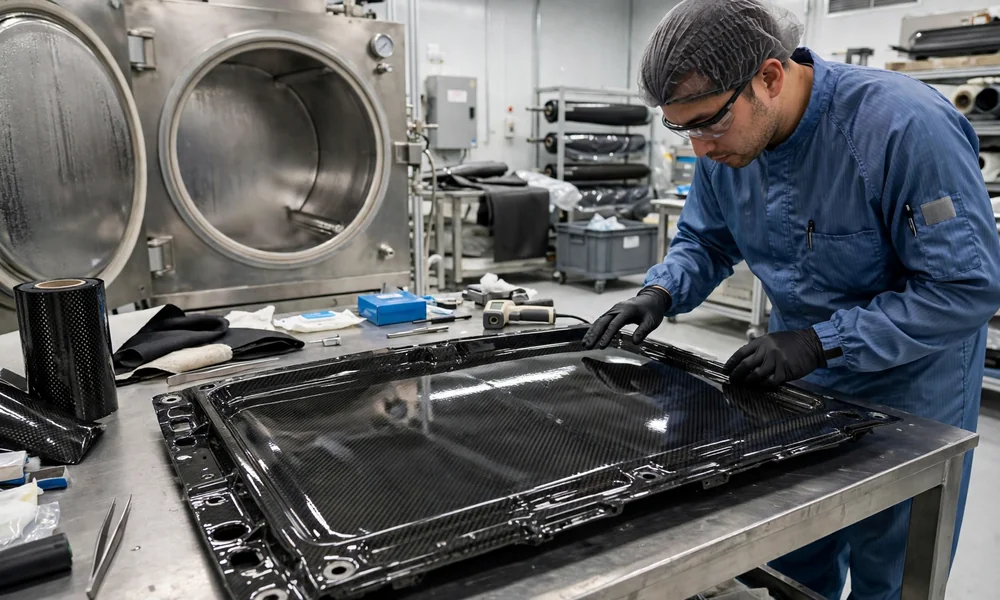
Cooling is as controlled as heating. The chamber is brought down at roughly 2 to 5 degrees per minute, still under pressure, because a part that cools too fast can crack or warp as its layers shrink at different rates. Only when the part is near room temperature is the pressure released and the door opened. The bag is stripped away, the part is lifted from its tool, and it goes for inspection — ultrasonic scanning that can find a void the size of a grain of sand. A part that passes is ready for trimming and assembly, built with the same care as Kevlar composite parts.

Autoclave Curing Specs
| Specification | Typical range |
|---|---|
| Cure temperature | About 120 to 180 degrees Celsius for epoxy resins |
| Pressure | About 3 to 7 bar of nitrogen gas |
| Heat-up ramp rate | About 1 to 3 degrees Celsius per minute |
| Dwell time at cure temperature | About 1 to 2 hours |
| Cool-down rate | About 2 to 5 degrees Celsius per minute |
| Vacuum level in the bag | About 90 to 98 percent vacuum |
| Fibre volume fraction | About 55 to 65 percent in a cured laminate |
| Void content | Less than about 1 percent, often under 0.5 percent |
What Does Autoclave Curing Cost?
Autoclave curing is the most expensive way to cure a composite, and the machine is the reason why. A small laboratory autoclave is estimated to cost roughly $100,000 to $300,000, while a large aerospace autoclave several metres across is estimated at roughly $1 million to $10 million or more, before the cost of the building to house it. The running cost is also high: nitrogen gas, electricity for heating, and hours of cycle time per part. That is why autoclaves are reserved for parts where nothing else will do — aircraft wings, racing car chassis, and satellite structures — and why cheaper processes are used everywhere else. All prices are estimates only and vary widely by machine size, energy prices, and volume.
A Rare Fact
The autoclave began life as a medical device. In the 19th century, autoclaves were invented to sterilise surgical instruments with pressurised steam, and the word itself comes from the Greek for self-locking — the pressure inside the chamber forces the door seal tighter as it rises. Composite engineers borrowed the machine wholesale in the 1960s and 1970s, replacing steam with nitrogen and surgical tools with carbon fibre wings. The self-locking door that once kept germs out now holds back seven atmospheres of pressure while a wing bakes inside.
Heat, pressure, and patience — that is all an autoclave really offers, and it is everything a composite part needs. Learn to read the specifications — temperature, pressure, ramp rate, and dwell — and the giant steel cylinder stops being an oven and starts being a precision instrument: the machine that turns a stack of sticky cloth into the strongest, lightest structures humans have ever built.