A luxury golf cart does not start life on a golf course. It starts on a factory floor, in a space that looks more like a small car plant than a workshop: welding jigs, paint booths, and benches covered in leather offcuts and polished wood. The first thing you notice is how little it has in common with the plain white carts that shuttle players around a club.
The difference is not one big thing. It is a hundred small ones, and they add up. A luxury cart is built the other way round, starting with the ride and the finish the maker wants, and engineering the frame, the powertrain and the cabin to deliver it. This is how a luxury golf cart is made.
Step 1: The frame
The build starts with the frame, and on a luxury cart the frame is not a folded steel tray. It is a welded aluminium structure, built in a jig that holds every tube and plate in exactly the right place while it is joined. Aluminium is chosen because it does not rust, which matters for a vehicle that spends its life outdoors, and because it is light enough that the cart can carry four adults and their clubs without feeling sluggish.
Once the frame is welded, it is checked for straightness and then treated against corrosion before anything is bolted to it. How a luxury golf cart works explains the machine this frame carries, from the motor and controller to the steering and brakes that all bolt onto the structure built here.
Step 2: The body and the paint
With the frame done, the body panels go on. On a luxury cart the body is usually a moulded composite shell rather than thin plastic, shaped with smooth curves and tight panel gaps. The shell is fitted to the frame, adjusted until the doors and the bonnet sit evenly, and then removed again for paint. That extra step is what gives a luxury cart its finish: the panels are painted off the frame, in a booth, so the colour is even and the clear coat is deep.
Paint on a luxury cart is applied in several coats, with flatting and polishing between them, much like a car.
Step 3: The battery and the motor
The powertrain is the heart of a modern luxury golf cart, and it is almost always electric. A lithium battery pack is built as a flat unit that sits low in the frame, under the seats, which keeps the centre of gravity down and leaves the cabin clear. The cells are wired to a battery management system that watches temperature and voltage, and the whole pack is sealed against rain and wash water.
The motor is usually a single alternating-current unit driving the rear axle, chosen for quiet running and strong low-speed torque. How an electric scooter battery works covers the same cell and management technology in a smaller package, and the same care with cells and cooling is what gives a luxury cart its range and its long battery life.
Step 4: Suspension, steering, and brakes
A luxury cart rides very differently from a rental cart, and the reason is underneath. Independent front suspension replaces the simple beam axle of a cheap cart, so each front wheel can move on its own over bumps instead of passing every jolt across the whole axle. Coil springs and gas dampers are tuned for a soft, level ride rather than for carrying maximum load, and the rear gets a proper suspension setup of its own.
The steering is a rack-and-pinion system, like a car, which gives a precise feel instead of the vague wander of a basic cart. Brakes are usually hydraulic discs on all four wheels, with regenerative braking from the motor adding stopping power and feeding a little charge back into the battery.

Step 5: The cabin and the trim
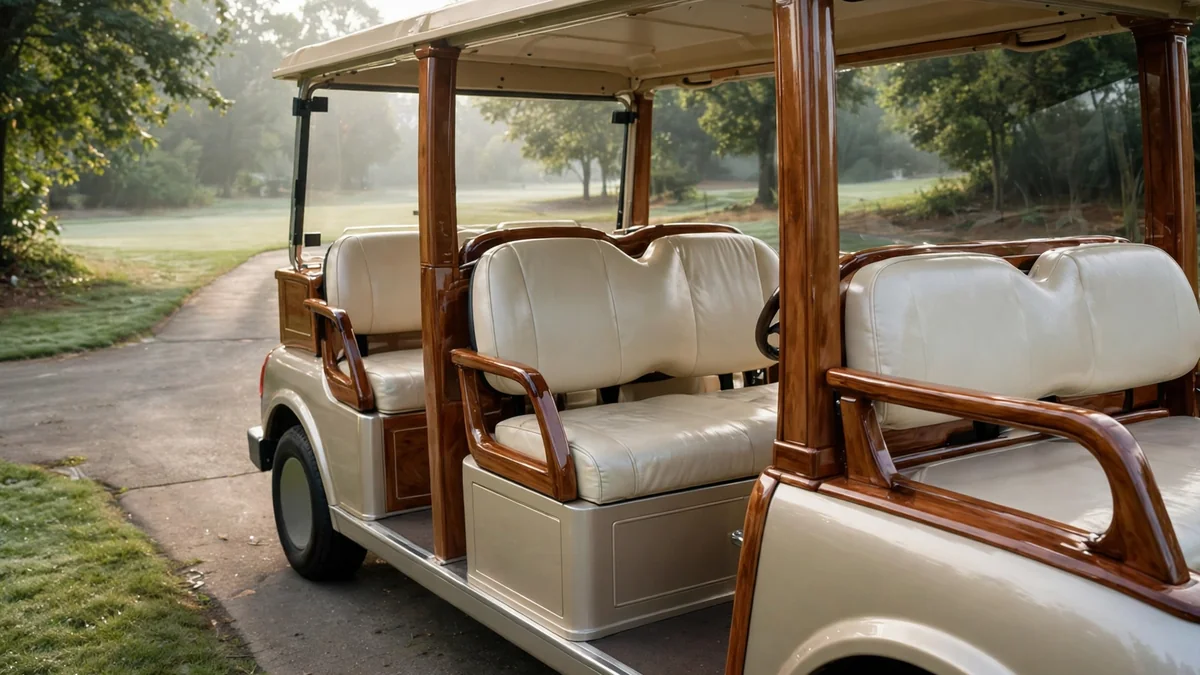
The cabin is where a luxury cart earns its price. The seats are built on shaped foam bases and trimmed in stitched leather or marine-grade vinyl, with contrast stitching and piping chosen by the buyer. The dashboard is a moulded panel in wood, carbon-look trim or brushed metal, and it carries a touchscreen display for speed, battery level and range, plus switches for lights and accessories.
Details that look decorative are often functional. The roof is a rigid canopy that keeps the rain off and carries the lights, the windscreen is a proper laminated panel rather than a thin sheet, and the floor is covered in carpet or rubber matting that can be lifted out and cleaned.
Step 6: Wiring, testing, and handover
With the cabin in place, the wiring loom is connected and every circuit is tested: lights, indicators, horn, display, charger, and the motor controller. The cart is then charged fully and driven through a test routine that covers acceleration, braking, hill climbing and range, with a technician listening for any noise the buyer should never hear.
The cart is cleaned, the paint is inspected under bright light, and the battery is left at a storage charge for delivery. The owner gets the cart, a fast charger, and a handbook that covers charging and care. How a luxury electric scooter is made follows the same logic on a smaller machine, where the battery, motor and trim are built to the same standard for the same reason: a quiet, smooth ride that feels finished rather than assembled.
Specifications
| Detail | Specification |
|---|---|
| Frame | Welded aluminium, corrosion treated |
| Body | Moulded composite shell, multi-coat paint |
| Motor | Single AC motor, rear axle drive |
| Battery | Lithium pack, around 5 to 10 kWh |
| Top speed | Around 25 to 40 kilometres per hour |
| Range | Around 60 to 100 kilometres per charge |
| Seating | Two or four seats, leather trimmed |
| Brakes | Hydraulic discs, regenerative braking |
| Suspension | Independent front, coil springs |
| Weight | Around 450 to 650 kilograms |
Price
The estimated price of a luxury golf cart is around 15,000 to 30,000 dollars, and that figure is an estimate only, because the cost depends on the battery size, the seating, and the level of trim. The lithium pack and the hand-finished cabin account for a large share, followed by the aluminium frame and the painted body.
A rare fact
Few people know that some luxury golf carts can drive themselves back to their parking bay. A small number of high-end models are fitted with a low-speed self-driving system that uses GPS and sensors to follow a course path and park itself, so the owner can step off at the clubhouse and let the cart put itself away. It is a quiet piece of car technology, shrunk down to fit a vehicle that never goes faster than a bicycle.
When the cart rolls out of the factory for the last time, it looks simple, just a neat little vehicle with shining paint and stitched seats. That simplicity is the achievement. Every wire is hidden, every panel gap is even, and the whole machine feels like one finished object rather than a collection of parts bolted together.