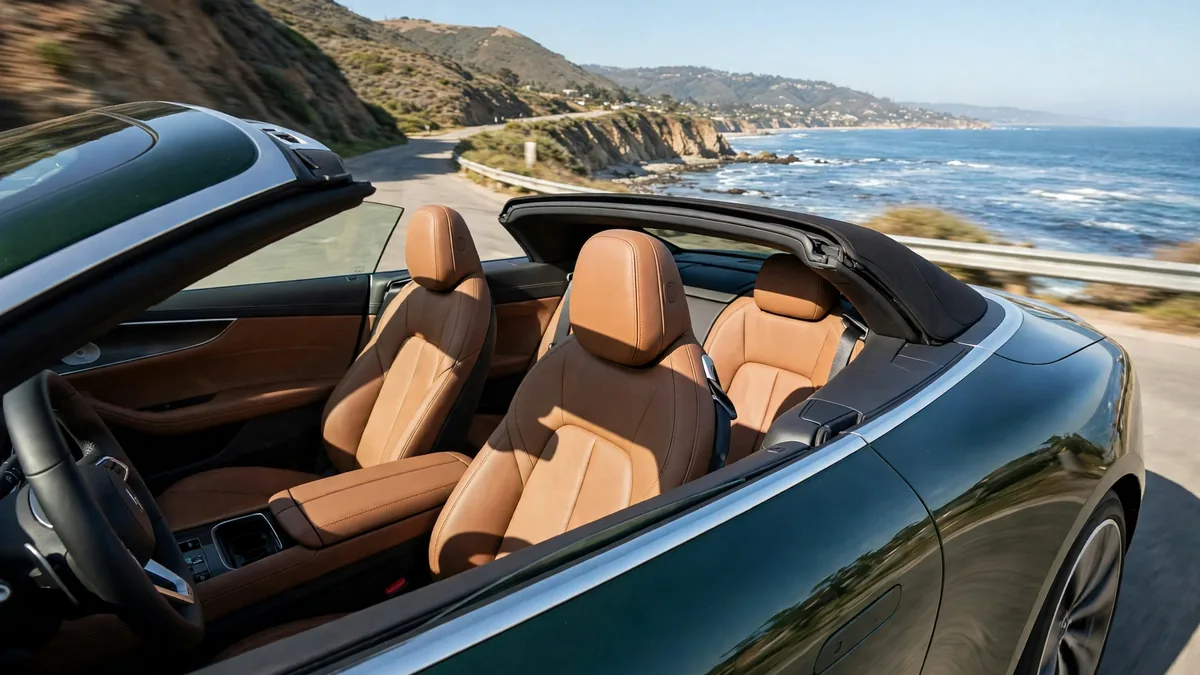
The roof folds away in about twenty seconds, the windscreen frame is the only thing left above you, and suddenly the car is not a car at all but a moving armchair with the sky for a ceiling. The road noise drops away, the electric motors hum softly, and the whole world smells of cut grass and sea air. A convertible has always been about this feeling, and an electric one adds a new one: silence.
A luxury electric convertible is one of the hardest cars to engineer well. Take the roof off a car and you take away part of its strength, so the body must be stiffened underneath. Add a folding roof mechanism, and you add weight and complexity exactly where an electric car least wants them.
The trick is that everything has to work together: the battery, the motors, the roof, and the body that holds them all. This is how a luxury electric convertible works, from the folding roof above your head to the motors under your feet.
How a Luxury Electric Convertible Works
Step 1: The folding roof opens the car
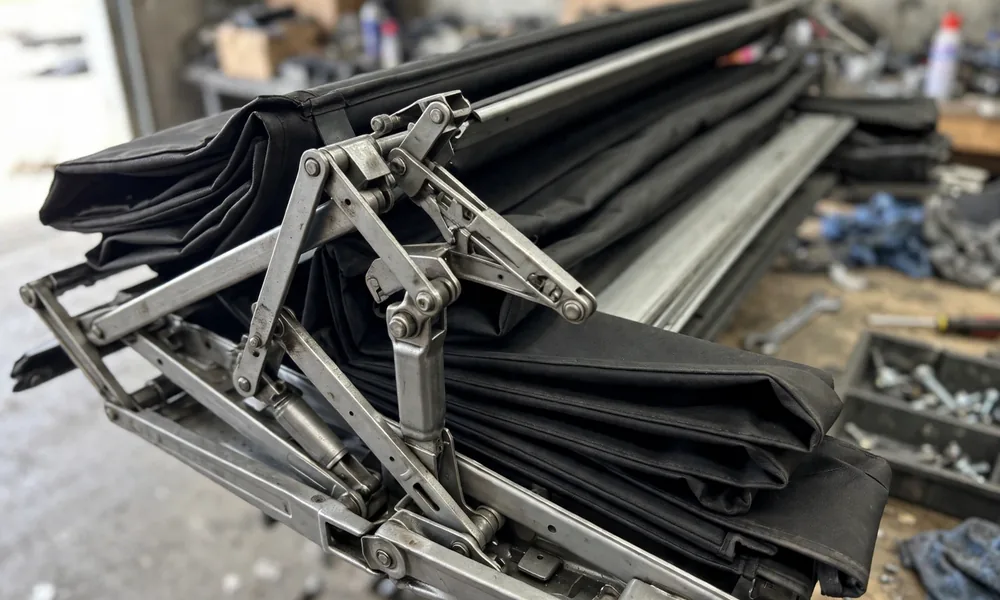
The star of the car is its roof, and it works like a piece of origami engineered to survive a motorway. Press a button and electric motors drive a set of hinged arms that fold the fabric or metal panels back into a compartment behind the seats, a dance of levers and latches that takes about fifteen to twenty seconds. Sensors watch every hinge, and if anything is in the way the roof stops rather than forcing itself shut. Making that roof is a craft of its own, as our guide to how a luxury electric convertible is made explains.
Step 2: The stiffened body holds it together
A car without a fixed roof loses a major structural member, so a convertible’s body is reinforced underneath to make up for it. Extra bracing runs across the floor, the sills are deeper, and the windscreen frame is strengthened to carry crash loads and to protect the passengers if the car rolls. In an electric convertible the battery pack helps enormously: the flat, rigid pack bolted under the floor acts like a giant stiffening plate, giving the open car a rigidity that petrol convertibles struggle to match. The result is a car that does not shudder over bumps or flex through corners, which matters twice as much when there is no roof to hide the shaking.
Step 3: The motors drive it silently
Under the floor, the electric drivetrain is much like any luxury electric car’s: a battery pack, inverters, and one or two motors driving the axles through single-speed gears. The silence of the motors is what changes the convertible experience, because with the roof down there is no roof to block the engine noise of a petrol car, and in an electric car there is almost no noise to block. The driver hears the wind, the tyres and the world outside, which is exactly what a convertible is for. The numbers behind that quiet performance are worth a look, as our guide to luxury convertible specs, explained shows.
Step 4: Wind management keeps the cabin calm
Driving with the roof down at speed should feel like a breeze, not a hurricane, and that takes careful engineering. A small wind deflector rises behind the seats to push the airflow up and over the cabin, and the shape of the windscreen and the side windows is tuned in a wind tunnel so the air flows smoothly past the passengers. It is a car designed around the feeling of the wind, not in spite of it.
Step 5: Sealing the car against weather
When the roof is up, a luxury convertible must be as dry and quiet as a coupe, which means the seals matter more than on any other car. Rubber seals run around the roof frame, the doors and the folding joints, and they are shaped to compress evenly so rain cannot find a path in. The car is tested in a rain chamber, with water sprayed from every angle while inspectors sit inside looking for drips, and the seals are checked again after the car has been driven. A convertible that leaks is a failed car, so this testing is taken as seriously as any crash test.
Step 6: Battery, range and charging
A convertible carries a little extra weight from its roof mechanism and its reinforced body, so its range is usually slightly shorter than the equivalent coupe, and the car manages that honestly. The battery is cooled and heated like any electric car, the regenerative braking recovers energy on downhill stretches, and fast charging can add hundreds of kilometres in the time it takes to drink a coffee. At home the car charges overnight, and the driver can pre-heat or pre-cool the cabin while it is still plugged in, so the first miles with the roof down are comfortable. The same electric systems drive its fixed-roof relatives, as our guide to how a luxury convertible works explains.
Step 7: Safety with no roof overhead
The last system is the one the driver hopes never to need. Behind the rear seats sit rollover bars that deploy in a fraction of a second if the car senses it is tipping, springing up to protect the passengers’ heads. The windscreen frame is reinforced to carry the car’s weight, the airbags are tuned for an open cabin, and the stability control works harder than in a coupe, because a convertible’s weight sits differently. The battery pack is protected by a reinforced case and crash structures, and it is designed to disconnect itself in a serious impact.
Luxury Electric Convertible Specs
| Specification | Typical range |
|---|---|
| Power | About 400 to 650 horsepower |
| 0 to 100 km/h | About 3.5 to 5 seconds |
| Battery | About 70 to 95 kWh |
| Range | About 380 to 500 kilometres |
| Roof type | Folding fabric soft top |
| Roof operation | About 15 to 20 seconds, powered |
| Weight | About 1,900 to 2,300 kilograms |
| Top speed | About 200 to 250 km/h |
What Does a Luxury Electric Convertible Cost?
A luxury electric convertible is estimated to cost roughly $100,000 to $180,000, while a high-performance model with every option is estimated at $180,000 to $250,000 or more. A replacement folding roof is estimated at $5,000 to $10,000 fitted. Prices are estimates only and vary by maker, battery and roof options.
A Rare Fact
The folding roof of a luxury convertible is tested by opening and closing it thousands of times, but the strangest test is the wind tunnel one: engineers drive the car with the roof half open at speed to make sure a gust cannot rip it off its hinges.
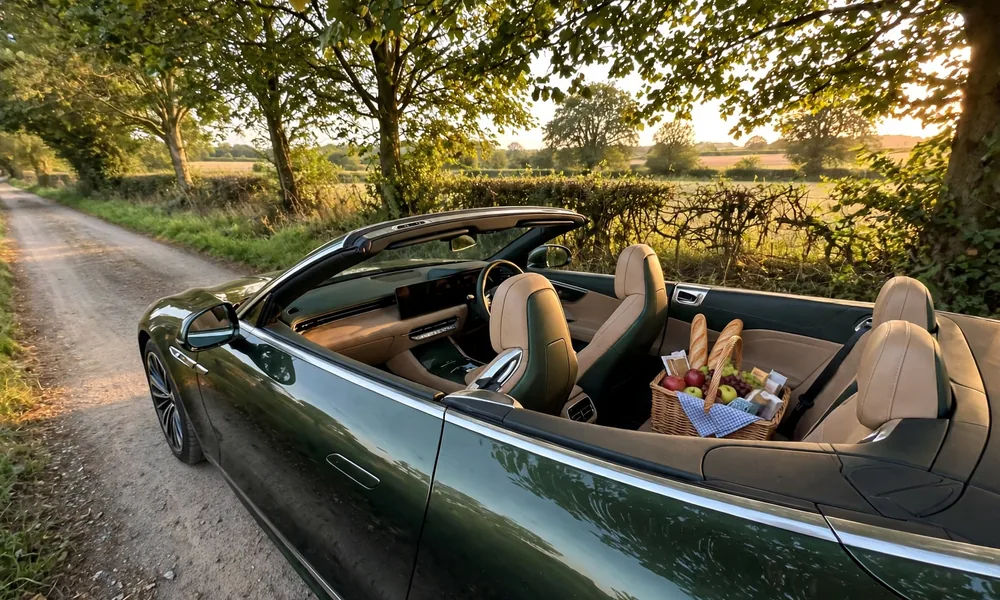
A luxury electric convertible works by solving a contradiction: a car with no roof that is still stiff, quiet, dry and safe, powered by a battery that makes the whole thing silent. The roof folds away in seconds, the motors push without a sound, and the wind does the rest. It is the car for the day when the weather is good and the road is open, and on that day nothing else will do.