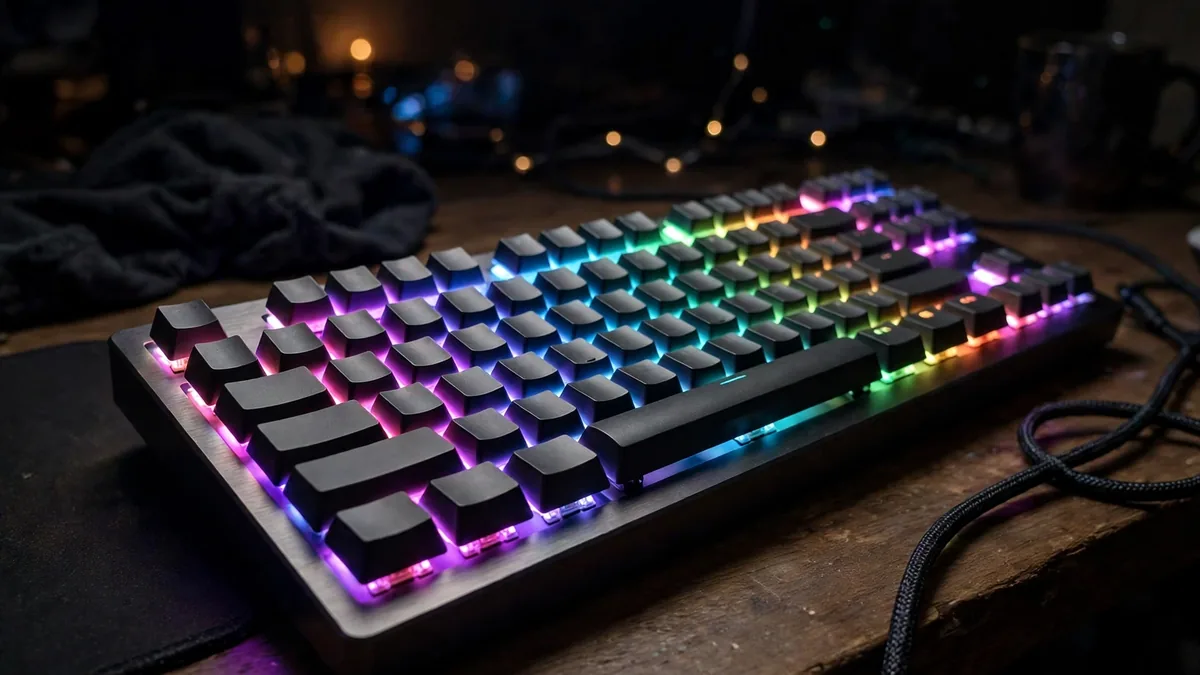
Pick it up and the first surprise is the weight. A luxury gaming keyboard does not feel like a computer accessory. It feels like a slab of metal with keys on top, dense and cold in the hands, and when you set it down on the desk it lands with a soft, solid thunk that no plastic board can copy. That weight is not an accident. It is the whole point.
Under the keycaps, a gaming keyboard is a small piece of precision engineering. Each key has its own switch, a tiny mechanism of spring, stem and metal contacts that must feel exactly the same on the hundredth press as on the first. Above that sits a case machined from a solid block of aluminium, and inside the case, layers of foam and film tuned by ear, the way a guitar maker tunes wood.
Most keyboards are made to a price. A luxury one is made to a feeling, and the factory process reads more like watchmaking than electronics assembly. This is how a luxury gaming keyboard is made, from a block of aluminium to the board that wins the match.
How a Luxury Gaming Keyboard Is Made
Step 1: The aluminium case is machined from a solid block
The build starts with a block of aluminium, clamped into a computer-controlled milling machine that carves away everything that is not a keyboard case. The machine cuts the top plate, the switch pockets, the cable channel and the weight cavity, working to tolerances measured in hundredths of a millimetre. After milling, the case is bead-blasted for texture, anodised in colour, and inspected under bright light for any mark. The case alone can weigh more than a whole budget keyboard, and that mass is deliberate: it stops the board sliding on the desk and deadens the hollow ring of the switches. The numbers behind that mass are worth a look, as our guide to luxury gaming keyboard specs, explained shows.
Step 2: The circuit board is printed and populated
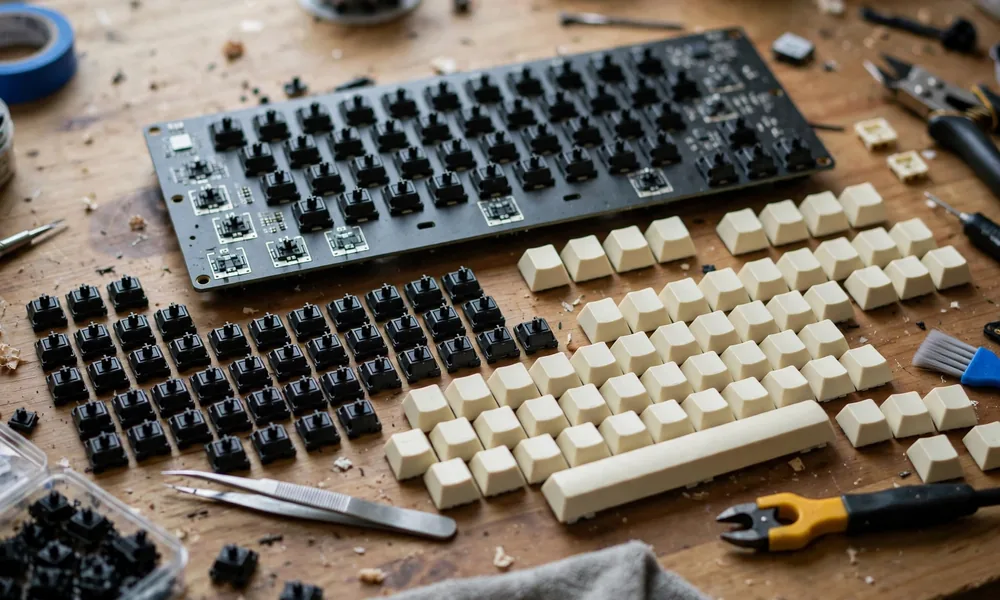
While the case is machined, the printed circuit board is made. Copper traces are etched onto fibreglass, sockets are soldered in place for the switches, and the controller chip, the diodes and the stabiliser mounts are fitted by machine and checked by eye. A hot-swappable board lets the owner change switches without a soldering iron, so every socket must grip tightly and survive hundreds of swaps. The board is then tested with a probe rig that presses every position, because a single dead socket would ruin the whole keyboard. The same patient electronics work powers its relatives, as our guide to how a luxury smartphone works shows.
Step 3: Switches are tuned one by one
The switches are the soul of the board. Each one is opened, its spring and stem inspected, and in a luxury build the parts are lubricated by hand with a thin film of grease, then reassembled and tested for smoothness. A good switch glides without scratch or wobble; a bad one is discarded. Springs are matched by weight so every key presses with the same force, and the switches are sorted into batches before they are pressed into the board. This is slow work, and it is the step a cheap keyboard skips entirely.
Step 4: Foam, film and the sound of the board
Between the circuit board and the case go the tuning layers: sheets of foam that absorb vibration, thin film between the board and the plate, and sometimes a layer of tape on the back of the board to deepen the sound. Builders test the result by typing on the half-assembled board and listening, adjusting the layers until the keys produce a soft, muted thock rather than a sharp clack. It is an oddly musical part of the build, and two boards with identical parts can sound different until this tuning is done. How those parts behave in play is another story, as our guide to how a luxury gaming keyboard works explains.
Step 5: Stabilisers keep the long keys level
The spacebar, enter and shift keys are too wide for a single switch, so they ride on stabilisers: wire bars that keep the key level no matter where the finger lands. In a luxury build the stabilisers are clipped, lubricated and tuned by hand, because a rattling spacebar is the first thing a typist notices and the hardest flaw to forgive. Each long key is pressed from its corners and its centre, and the wire is adjusted until the key drops flat and rises straight every time.
Step 6: Keycaps are moulded and finished
The keycaps are moulded from thick plastic, usually by double-shot moulding, in which the legend is formed from a second colour of plastic rather than printed on top, so it can never wear away. The caps are checked for thickness, for even colour and for a smooth texture under the fingers, then set into trays in layout order. Some luxury boards use metal or resin artisan caps for the escape key, each one cast and polished individually. A set of keycaps can cost more than an ordinary keyboard on its own.
Step 7: Assembly, firmware and the final typing test
Finally the board comes together: case, foam, circuit board, plate, switches, stabilisers and keycaps, screwed down in order and connected to its cable or wireless module. Firmware is loaded that sets the polling rate, the lighting and the key mapping, and the finished keyboard is typed on by a tester who works through every key, every layer and every lighting mode. Only when the board feels right, sounds right and types without a single missed press is it boxed with its cable, its spare switches and its puller. A luxury gaming keyboard is a small machine with a big job, and the final typing test is what proves it is ready for the desk.
Luxury Gaming Keyboard Specs
| Specification | Typical range |
|---|---|
| Case material | CNC-milled aluminium |
| Weight | About 1.2 to 2.5 kilograms |
| Switch type | Hot-swappable mechanical, linear or tactile |
| Actuation force | About 45 to 65 grams |
| Polling rate | About 1,000 to 8,000 Hz |
| Keycaps | Double-shot ABS or PBT plastic |
| Connection | USB-C wired, plus 2.4 GHz and Bluetooth |
| Layout | Full size, tenkeyless or 75 percent |
What Does a Luxury Gaming Keyboard Cost?
A luxury gaming keyboard is estimated to cost roughly $250 to $500, while a fully custom build with hand-lubed switches and artisan caps is estimated at $500 to $1,000 or more. A replacement switch set is estimated at $30 to $80, and a premium keycap set is estimated at $80 to $200. Prices are estimates only and vary by case, switches and keycaps.
A Rare Fact
The sound a mechanical keyboard makes is tuned like an instrument, and some builders test their boards by recording the keystrokes and studying the sound wave. A board that looks identical to another can be judged entirely by ear, and enthusiasts can often tell the case material and foam layout from a single typed sentence.

A luxury gaming keyboard is built the way a good instrument is built: a heavy body, tuned parts and a sound that was chosen rather than left to chance. The aluminium case, the hand-lubed switches and the foam layers all disappear under the keycaps, and what remains is the feeling under the fingers. When a match comes down to a single keypress, that feeling is the difference between the board and the player, and the factory knew it from the first cut of metal.


