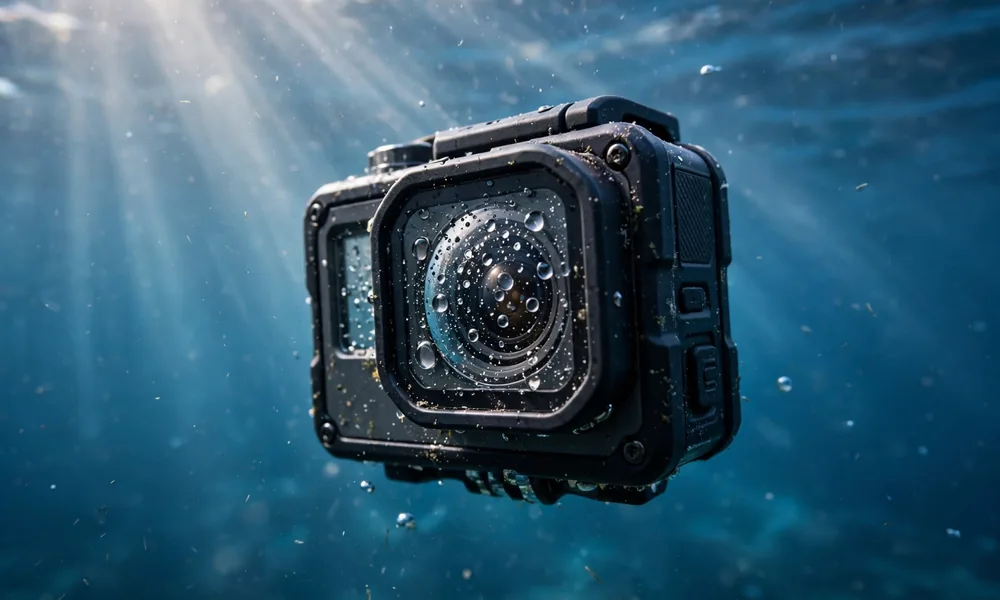
Drop an action camera off a cliff, drag it through a river, bury it in desert sand, and it keeps recording. The lens is fine, the battery is fine, and the footage looks as though nothing happened. The secret is not the electronics. It is the shell around them: a housing engineered to take punishment that would destroy a phone, built from materials chosen to be light, tough and waterproof all at once.
The modern housing is a precision part, moulded to fractions of a millimetre, with seals, coatings and reinforcements in exactly the places where water, dust and impact try to get in. The materials decide whether a camera survives a mountain bike crash or drowns in the first puddle, and they are a careful compromise between weight, strength and cost.

The Materials Behind the Housing
An action camera housing is built from a small family of materials, each chosen for a different kind of abuse. Polycarbonate forms the main shell, a transparent-tough plastic that absorbs impacts without cracking. Aluminium alloy reinforces the frame and the lens surround, adding stiffness where the plastic alone would flex. Stainless steel protects the lens bezel and the mounting points. Silicone rubber seals every opening, and a fluoropolymer coating on the lens cover sheds water so droplets slide off instead of blurring the shot. Inside, a magnesium alloy chassis cradles the electronics, chosen because it is lighter than aluminium yet stiff enough to protect the circuit boards.
Step 1: Moulding the polycarbonate shell
Everything starts with polycarbonate pellets, melted and injected at high pressure into a steel mould machined to a mirror finish. Polycarbonate was chosen because it is one of the toughest transparent plastics ever made: it can be bent, struck and dropped without shattering, and it stays strong from freezing mountain air to desert heat.
Step 2: Reinforcing the frame with aluminium
Where the shell needs extra stiffness, an aluminium alloy frame is bonded into the plastic. Aluminium was chosen because it is light, strong and easy to anodise into a hard, scratch-resistant surface. The frame carries the lens surround and the mounting fingers that clip the camera to helmets, handlebars and surfboards. A weak bond would let the camera tear free at the worst possible moment.
Step 3: Fitting the silicone seals
Every door, button and port is sealed with a silicone rubber gasket, compressed between the shell and the cover. Silicone was chosen because it stays flexible in freezing water and hot sun alike, and because it does not take a permanent set after months of being squeezed. A single hair caught in a seal is enough to flood a camera, which is why the assembly line inspects every gasket under magnification before the camera is closed, in the same way a woven composite must be inspected for a single broken fibre before it is trusted.
Step 4: Protecting the lens with hardened glass
The lens cover is a disc of chemically strengthened glass, coated with a fluoropolymer layer that repels water and oil. The glass is ion-exchanged in a bath of molten salt, swapping small sodium ions for larger potassium ones and squeezing the surface into compression, which makes it far harder to scratch or crack. Stainless steel rings the glass, protecting its edge from chips that would otherwise spread into cracks.
Step 5: Building the magnesium inner chassis
Inside the shell, the electronics sit in a magnesium alloy chassis, a skeleton that holds the sensor, battery and circuit boards in perfect alignment. Magnesium was chosen because it is the lightest structural metal available, about a third lighter than aluminium, and because it damps vibration better than plastic. The chassis is die-cast, then machined where the boards mount, and it doubles as a heat spreader, pulling warmth away from the processor during long recordings. It is the same reason magnesium appears in lightweight engineering far beyond cameras: when every gram matters, it is the metal engineers reach for first.
Step 6: Pressure testing every camera
Before a camera leaves the factory, it is sealed and lowered into a pressure chamber filled with water, held at the pressure of its rated depth for a set time, then opened and inspected for a single drop inside. Cameras that pass are dried and packed; cameras that fail are stripped down to find which seal or joint let water through.

Why These Materials Win
Polycarbonate was chosen because it absorbs impacts that would shatter glass or crack ordinary plastic, and because it can be moulded into complex shapes. Aluminium was chosen because it adds stiffness exactly where the shell needs it without adding much weight. Silicone was chosen because it seals in any weather and never forgets its shape. Magnesium was chosen because it protects the electronics while weighing less than any other metal.
The trade-off is cost and complexity. A housing built from a single plastic would be cheaper but would flex, leak and crack. The balance is struck by putting the expensive materials only where they earn their place, much as carbon fibre is used only where its strength justifies its price rather than everywhere at once.
Specifications
| Specification | Detail |
|---|---|
| Outer shell | Polycarbonate, injection moulded |
| Frame | Anodised aluminium alloy |
| Inner chassis | Die-cast magnesium alloy |
| Lens cover | Chemically strengthened glass, fluoropolymer coating |
| Lens bezel | Stainless steel |
| Seals | Silicone rubber gaskets |
| Waterproof rating | 10 metres without extra case (typical flagship) |
| Drop resistance | Survives drops of about 2 metres onto hard surfaces |
| Operating temperature | About minus 10 to 45 degrees Celsius |
| Weight | About 150 grams for a flagship camera |
Price
A flagship action camera such as the GoPro Hero 13 Black sells for around 400 dollars (estimate), and its housing is a significant share of that price. A replacement protective housing or dive case costs roughly 50 to 100 dollars (estimate), while a replacement lens cover is about 20 to 30 dollars (estimate).
Rare Fact
The polycarbonate used in an action camera housing is the same family of plastic used for bulletproof windows and aircraft canopies, and a shell only two millimetres thick can absorb the impact of a camera tumbling down a rocky trail at speed. Yet the part that most often fails is not the shell at all: it is a silicone seal the width of a shoelace, compressed to half its thickness, holding back the entire ocean with nothing but its own elasticity. The toughest camera in the world is only as strong as its softest part.
That is the quiet marvel of the action camera housing: a shell of polycarbonate, aluminium, magnesium and silicone that turns a fragile computer into a machine you can throw off a cliff. The materials are ordinary, the engineering is exact, and the result is a camera that keeps filming long after its owner has stopped to catch their breath.


