There is a car that makes Formula One engineers stop and stare, and it has number plates. The Aston Martin Valkyrie looks like a racing car that escaped from a wind tunnel, because that is almost exactly what it is: Adrian Newey, the most successful designer in Formula One history, was given a blank sheet and asked to build the fastest road car ever made, with almost no regard for comfort, cost, or common sense. The result is a machine with a 6.5-litre V12 that revs to 11,000 rpm, bodywork shaped almost entirely by airflow, and a floor so sculpted that it produces more downforce than the car weighs.
Most hypercars start as road cars and borrow racing ideas. The Valkyrie started as a racing idea and was reluctantly given headlights. There is almost no bodywork in the conventional sense: the cabin is a teardrop pod suspended between two huge venturi tunnels, and the air passing underneath the car does most of the work of holding it to the road. It weighs about as much as a small hatchback, yet at speed it presses itself into the tarmac with the force of a second car sitting on its roof. Here is how it works.
The Valkyrie is also a study in what happens when a manufacturer stops compromising. This is the machine underneath the madness.

How It Works
Step 1: Breathing through a 6.5-litre V12
At the heart of the Valkyrie sits a naturally aspirated 6.5-litre V12, built by Cosworth, that produces about 1,000 horsepower on its own and revs to 11,000 rpm. There is no turbocharger and no supercharger: the engine makes its power the old-fashioned way, by spinning extraordinarily fast and breathing deeply. The sound is unlike anything else on the road — a scream that climbs past 10,000 rpm and can be heard from a mile away. The engine is a stressed member of the chassis, bolted directly to the carbon-fibre monocoque, which is why the whole car vibrates with it. The monocoque itself is a masterpiece of composite engineering, built around the same principles as the structures in carbon monocoque production.
Step 2: Adding an electric boost
Behind the engine, a small electric motor adds about 160 horsepower, taking total output past 1,150. Energy is recovered under braking and released in short bursts, much like the KERS systems once used in Formula One. The hybrid hardware adds weight, so every component was pared back to the minimum — the battery is barely larger than a shoebox, and there is no electric-only driving mode at all. The result is a car that accelerates from standstill to 100 kilometres per hour in about two and a half seconds, and keeps pulling long past 320.
Step 3: Turning air into grip
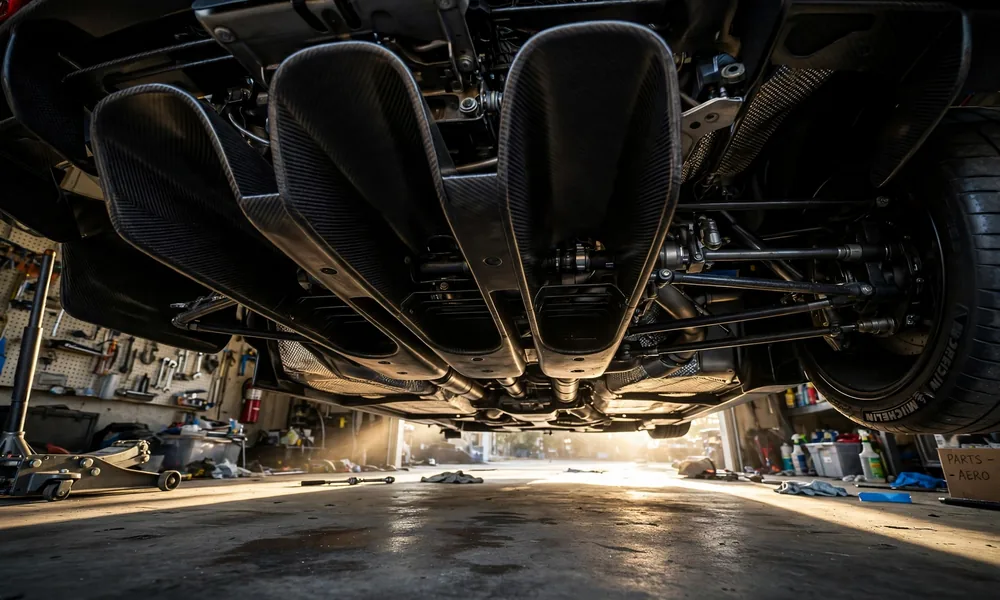
The Valkyrie’s real magic is underneath. Two enormous venturi tunnels run the full length of the car’s floor, shaped like the throat of a jet engine. As air rushes through them it speeds up, its pressure drops, and the car is sucked downwards — the venturi effect, the same principle that holds a racing car to the track. At top speed the car generates roughly 1,800 kilograms of downforce, more than its own weight, which means that in theory it could drive upside down on a ceiling. Every surface, from the front splitter to the diffuser, is part of one aerodynamic system, and the lessons are the same ones that govern active aerodynamics explained on other extreme machines.
Step 4: Weighing almost nothing
A hypercar that relies on downforce must be light, or the downforce is wasted hauling mass. The Valkyrie weighs about 1,030 kilograms dry — less than a city car — thanks to a carbon-fibre monocoque, carbon bodywork, and a ruthless approach to everything else. The seats are fixed to the floor and moulded to each owner’s body; the driver adjusts the pedals and steering wheel instead of the seat. Nothing that is not essential survives, and the result is a power-to-weight ratio of more than one horsepower per kilogram — the benchmark every hypercar chases.
Step 5: Shifting with a racing gearbox
Power reaches the rear wheels through a seven-speed single-clutch sequential gearbox, built by Ricardo. A dual-clutch gearbox would have shifted more smoothly, but it would also have weighed more, so the Valkyrie uses the racing solution instead: brutal, instant shifts and no torque converter. The suspension is equally uncompromising — pushrod-operated, like a Formula One car, with the dampers mounted inside the bodywork to keep the airflow clean. It is firm enough that the car is punishing on a normal road, and that is entirely the point: the Valkyrie was tuned for a circuit, and the road is a compromise it tolerates.
Step 6: Driving it like a racing car
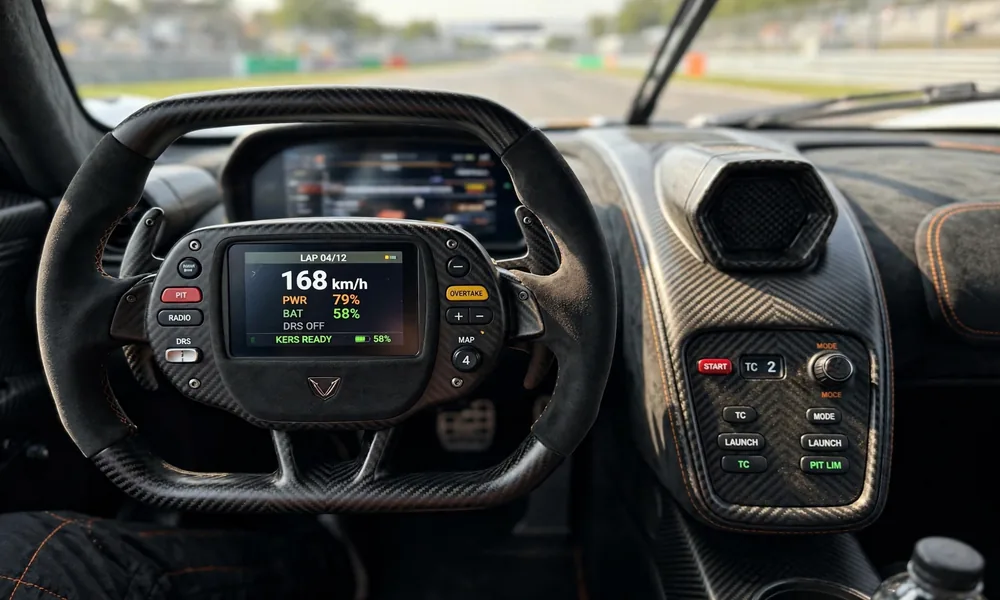
The cockpit completes the illusion. The driver sits almost lying down, feet raised high, hands on a rectangular steering wheel covered in buttons and a small central screen — a layout lifted directly from Formula One, as explained in the engineering behind how a hypercar V12 engine is made. There are no door mirrors in the usual sense: cameras feed screens inside the cabin, because mirrors would disturb the airflow. The steering wheel detaches so the driver can climb in and out of the narrow cockpit. Visibility is poor, the cabin is hot, and the noise is overwhelming. Owners accept all of it, because no other road car feels like this one: a machine that behaves less like a car and more like a jet fighter with wheels.
Aston Martin Valkyrie Specs
| Specification | Typical range |
|---|---|
| Engine | 6.5-litre naturally aspirated V12 by Cosworth |
| Total power | About 1,160 horsepower, including hybrid boost |
| Maximum revs | 11,000 rpm |
| Dry weight | About 1,030 kilograms |
| Top speed | Over 350 kilometres per hour |
| 0 to 100 km/h | About 2.5 seconds |
| Downforce | About 1,800 kilograms at top speed |
| Gearbox | Seven-speed single-clutch sequential |
| Production | 150 road cars |
What Does a Valkyrie Cost?
The Aston Martin Valkyrie was estimated to cost around $3 million to $3.5 million when new, before options and taxes. Prices are estimates only, and the car’s rarity has pushed values on the resale market higher still, with some examples estimated well above their original price. The Valkyrie was never meant to make financial sense. It was meant to answer a question — how fast can a road car be? — and the price was simply whatever the answer cost.
A Rare Fact
The Valkyrie’s downforce is so great that it can, in theory, drive on a ceiling. At around 250 kilometres per hour it already produces more downforce than its own weight, which means the car is pressed into the road harder than gravity alone could manage. The same venturi tunnels that make this possible are so large that the car’s cabin had to be squeezed into a teardrop pod between them, which is why the Valkyrie looks like no other road car ever built.
The Valkyrie is not a car in the usual sense. It is a Formula One car that was persuaded, very reluctantly, to wear number plates — and it remains the closest a road car has ever come to the machines that race on Sundays.


