There is a car that was designed backwards. Most road cars start with an engine and a body, and the aerodynamics are fitted around them. The Aston Martin Valkyrie started with the air itself: with the idea that a road car could generate the downforce of a Formula 1 car, and everything else, the engine, the seats, the shape of the body, was built to serve that idea. The result is a machine that weighs barely more than a tonne, makes more than a thousand horsepower, and looks like nothing else on the road, because nothing else on the road was designed this way.
Its structure is carbon fibre, its engine is a naturally aspirated V12 that revs beyond 11,000 rpm, and almost every part on it was made from a material chosen for one reason: weight. The car is a catalogue of the lightest, strongest materials that modern engineering can produce, assembled with a discipline that comes from Formula 1. The materials are the car.

The Materials Behind the Aston Martin Valkyrie
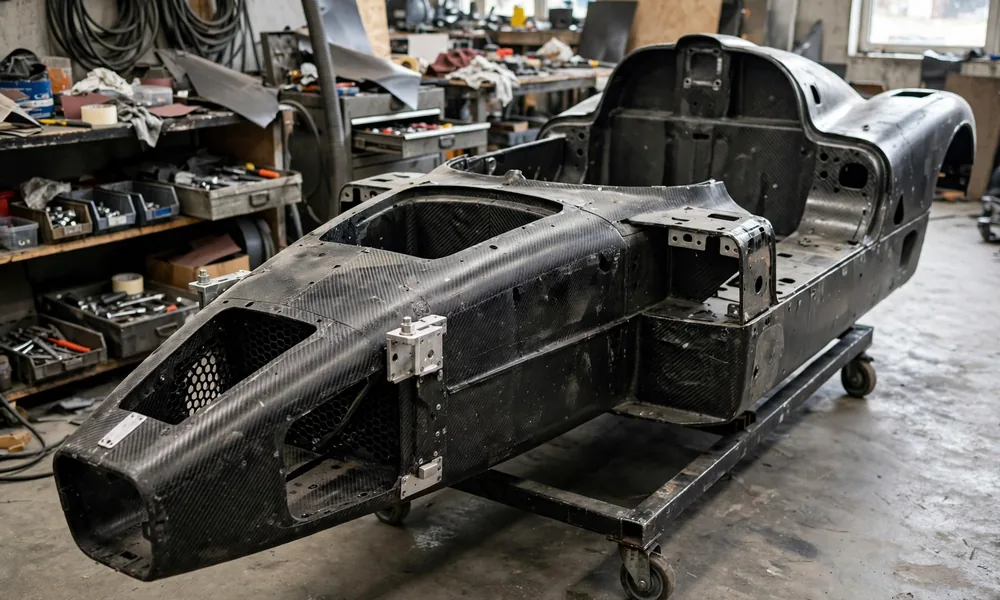
The core of the Valkyrie is a carbon fibre monocoque, a single rigid tub that forms the cabin and the structural heart of the car. Carbon fibre is the material that makes the whole project possible: it is stronger than steel by weight, stiffer than aluminium, and it can be moulded into shapes that no metal could achieve. Around the monocoque, the bodywork is also carbon fibre, shaped into tunnels and wings that manage the air flowing under and over the car. The engine is a 6.5-litre V12 built from titanium, aluminium, and magnesium, and the suspension is titanium and carbon fibre.
Step 1: The carbon fibre monocoque
The monocoque is built from carbon fibre prepreg, sheets of carbon cloth already impregnated with resin, laid up by hand in a mould, layer by layer, in directions chosen to carry the loads the car will see. The result is a tub that weighs a fraction of a steel chassis and is stiffer than any metal equivalent, which is why the suspension can be tuned so precisely. The Valkyrie is shaped by this tub, and its tight cabin is the price of its lightness.
Step 2: Bodywork shaped by the wind
The body panels are carbon fibre too, but their job is different. They are not just a skin; they are wings. The underside of the car is shaped into two huge Venturi tunnels that accelerate the air beneath it, creating a low-pressure zone that sucks the car onto the road. The upper bodywork guides air to the rear wing and the diffuser, and every surface is designed to work with the air rather than fight it. The Huayra monocoque follows the same philosophy.
Step 3: A V12 built from titanium and light alloys
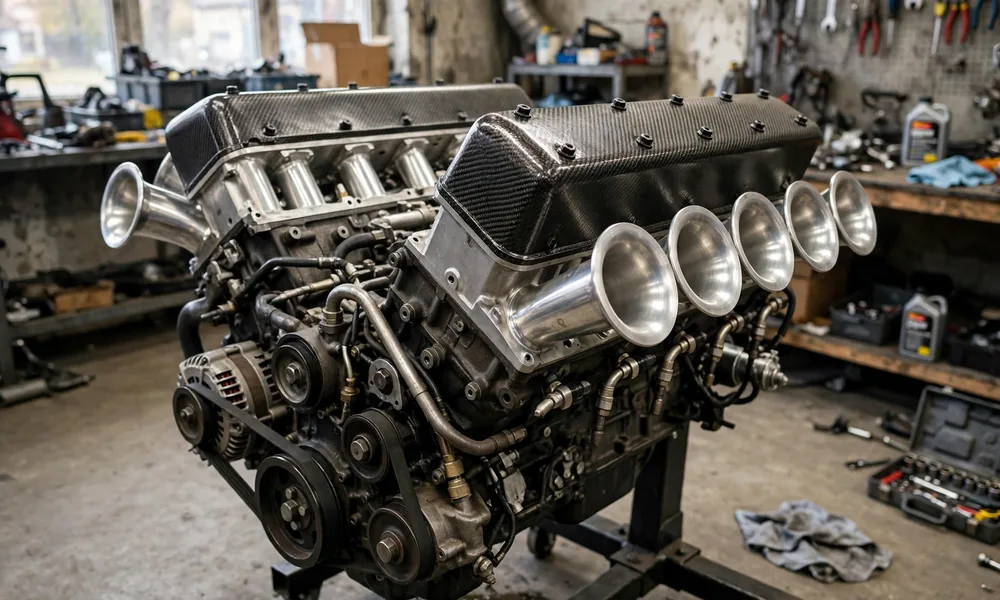
The engine is a 6.5-litre naturally aspirated V12, built by Cosworth, and it is one of the most extraordinary engines ever fitted to a road car. It revs to more than 11,000 rpm, which is only possible because its moving parts are made from the lightest materials available. The connecting rods are titanium, the pistons are forged aluminium, and the block is cast aluminium alloy, with magnesium used for parts where even aluminium is too heavy. The engine is a stressed member of the chassis, bolted directly to the monocoque, which saves the weight of a subframe.
Step 4: Suspension in titanium and carbon fibre
The suspension is where the Valkyrie shows its Formula 1 heritage most clearly. The wishbones are machined from titanium, the pushrods are carbon fibre, and the dampers are mounted inboard, operated by rockers, so that the air flowing over the car is not disturbed by bulky suspension parts. The wheels are magnesium, the lightest metal that can be used for a wheel, and the tyres are bespoke, built to cope with downforce that at speed exceeds the weight of the car itself.
Step 5: Brakes, electronics, and the weight of everything else
The brakes are carbon-ceramic, discs made from carbon fibre reinforced with silicon carbide, which can survive temperatures that would destroy steel brakes and which weigh far less. The calipers are aluminium, machined from billet, and the brake lines are titanium. The electronics are kept to a minimum: there is no heavy infotainment system, no powered seats, no sound deadening, because each of those would add kilograms that the car cannot afford. Even the battery for the hybrid system is small and light, a reminder that the Valkyrie is a hybrid only in the sense that a small electric motor fills in the gaps in the V12’s power delivery. The carbon fibre weave behind it appears in almost every part that matters.
Step 6: Assembly by hand, checked by laser
Putting a Valkyrie together is not a production line job. Each car is assembled by hand, with the monocoque checked by laser measurement at every stage, because a tub that is a millimetre out of true will never handle correctly. The body panels are fitted, removed, trimmed, and fitted again, until the gaps are even and the aerodynamics are exactly as designed. The result is a car that takes hundreds of hours to build, and that feels like it, in the precision of every shut line and the tightness of every control.
Aston Martin Valkyrie at a Glance
| Specification | Detail |
|---|---|
| Chassis | Carbon fibre monocoque, cured in an autoclave |
| Bodywork | Carbon fibre, shaped for Venturi downforce |
| Engine | 6.5-litre naturally aspirated V12, over 11,000 rpm |
| Engine materials | Titanium rods, forged aluminium pistons, magnesium parts |
| Power output | Over 1,000 horsepower combined with hybrid assist |
| Weight | Around 1,000 kilograms dry, depending on specification |
| Suspension | Titanium wishbones, carbon fibre pushrods, inboard dampers |
| Brakes | Carbon-ceramic discs, aluminium calipers |
What Does It Cost?
The Valkyrie is one of the most expensive road cars ever built, and its price reflects the materials and the hand-building that go into it. New, the car was priced at around two to three million dollars (estimate), with the track-only AMR Pro version costing more still (estimate). The car was built in a limited run of 150 road cars, and values on the second-hand market have remained at or above the original price (estimate), because the Valkyrie is not just a car. It is a statement about what is possible when a manufacturer decides that weight, not power, is the thing that matters most.
A Rare Fact
The Valkyrie generates so much downforce that at top speed, it could theoretically drive on the ceiling of a tunnel. The tunnels under the car and the wings above it produce downforce that exceeds the car’s own weight, which means the aerodynamic grip alone would hold it upside down, if only the engine could be kept fed with oil and fuel while inverted. A car that could drive on the ceiling is a car that has stopped being a car in the ordinary sense, and become something closer to an aircraft that happens to touch the ground.


