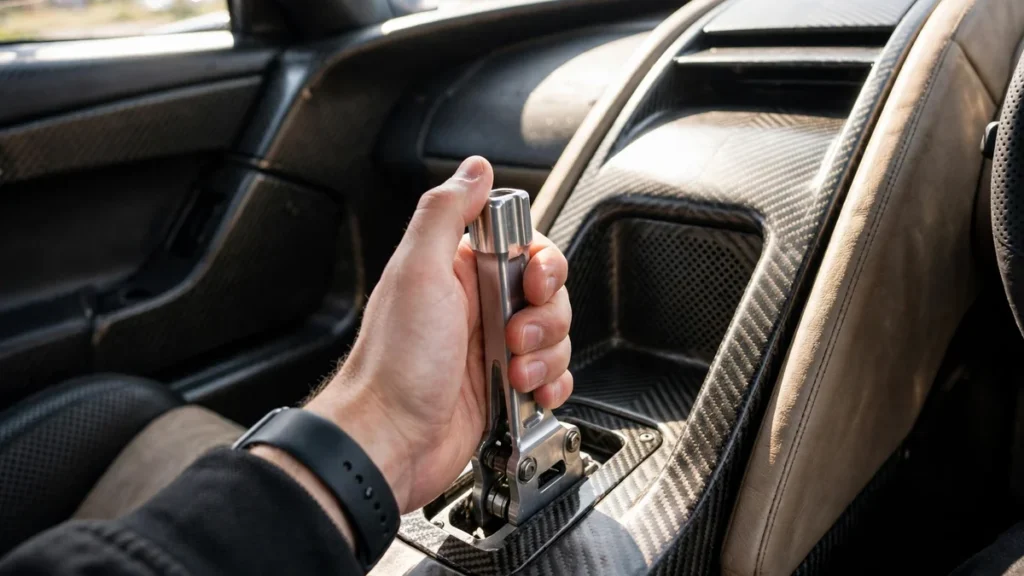
There is a moment, just before a fast corner, when a driver needs exactly one piece of information: how fast the engine is spinning. Not a menu, not a notification, not a configurable widget. One needle, sweeping toward a red line, read in a fraction of a second without taking your eyes off the road. For fifty years, the analogue gauge answered that question perfectly. Then the industry replaced it with a screen, and in doing so it solved a problem nobody had while creating one that every driver now lives with.
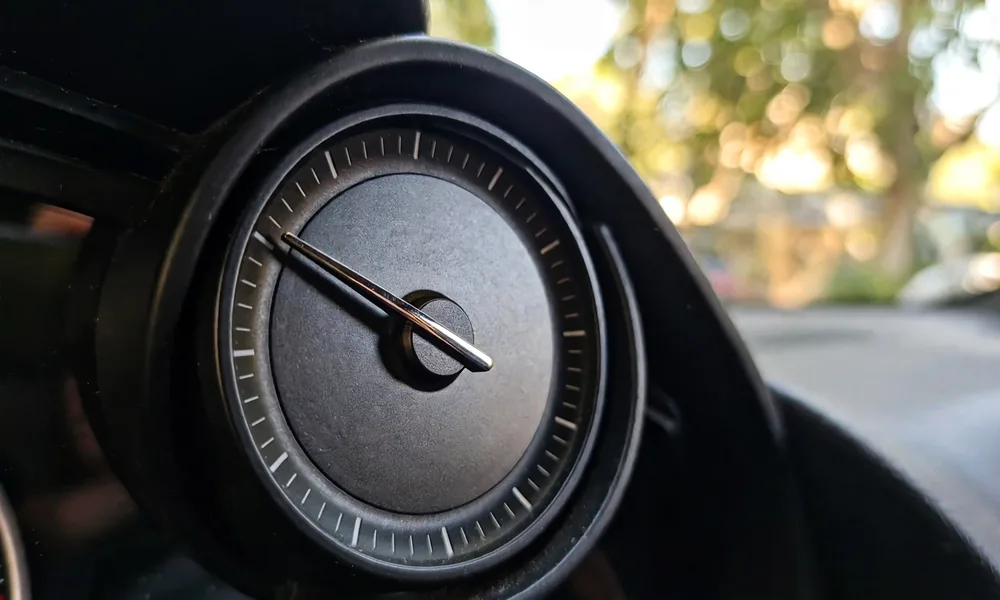
The case for analogue gauges in hypercars is not about nostalgia, and it is certainly not about rejecting technology. It is about the way human beings actually read information at speed. A needle has a position, and position is understood instantly, the way you know where the hands of a clock are pointing without reading the numbers. A digital display has a value, and a value must be read, parsed, and understood, which takes longer and demands more attention. At 180 miles per hour, that difference is not a matter of taste. It is a matter of safety, and of the connection between driver and machine that a hypercar exists to provide.

Why a needle beats a number
The human visual system is built for position and movement, not for digits. Experiments in aviation and motorsport have shown for decades that a pilot or driver reads an analogue dial faster and with fewer errors than a digital readout, particularly under stress, vibration, and changing light. A needle sweeping toward a red zone is a shape, and shapes are processed almost instantly. A number like 8,400 has to be read character by character and compared against a remembered limit, which is a slower, more deliberate act. When the difference is a tenth of a second of eyes-off-road time, repeated dozens of times on every lap, it adds up to real distance travelled blind.
Analogue gauges also give information that a digital display hides. A needle shows not just the current value but its rate of change: you can see it climbing fast, slowing, or hovering, and you can feel the engine’s state from the movement alone. A digital number jumps from one value to the next and tells you nothing about the trend between them. That is why racing cars, even today, use analogue-style rev counters and shift lights alongside their screens. The data is digital underneath, but the presentation is analogue, because the people who drive fastest have already settled this argument in practice.
There is also the question of what a gauge is for in a hypercar. These are not cars that need to show tyre pressures, navigation, and a music playlist on the same display. They are cars built around one job: going fast, well. A rev counter and a speedometer, done beautifully, are the entire instrument panel a hypercar needs. Everything else is a distraction dressed as a feature. The Aston Martin Valkyrie, a car that strips away almost everything in pursuit of speed, still puts the driver at the centre of a cockpit designed around immediate information, and our look at the Aston Martin Valkyrie’s specs shows how ruthlessly a hypercar can be focused when its designers refuse to compromise on the driving experience.
Screens fail in ways dials do not
A screen is a computer, and computers fail in ways that a needle and a spring do not. A screen can freeze, reboot, wash out in direct sunlight, or dim itself at the worst moment. A dial works in any light, at any temperature, with no software updates and no boot time. It is there the instant the car starts, and it is still there if the infotainment system crashes. In a machine that costs more than a house and is expected to last for decades, that durability matters. A beautifully made analogue instrument is also a piece of engineering in its own right: a mechanism, not a picture of one. It will still be working, and still be beautiful, long after the screen that replaced it has become an obsolete panel that no supplier supports.
The screen also invites a kind of creep that a dial resists. Once the dashboard is a display, every department in the company wants a piece of it: warnings, menus, modes, animations, branding. The instrument panel becomes a billboard, and the information the driver actually needs gets smaller and harder to find.
The counter-argument, honestly stated
The honest case for screens is strong, and it would be dishonest to pretend otherwise. A digital display can show more information than a dial, and it can change what it shows to suit the moment: navigation on a road trip, lap timing on a circuit, efficiency data in traffic. It can be updated, customised, and integrated with driver assistance systems in ways a mechanical gauge never will. For most cars, most of the time, that flexibility is a genuine improvement, and the industry’s move toward screens has made ordinary cars easier to use.
There is also the argument that a well-designed screen can present information in an analogue style, with a virtual needle sweeping across a virtual dial, which would seem to give the best of both worlds. Modern head-up displays take this further still, projecting information onto the windscreen so the driver never looks down at all, and our guide to hypercar head-up display specs shows how far that technology has come. These are real advances, and they deserve to be taken seriously.
But the virtual needle is still a picture of a needle, drawn by software, on a panel that can fail, wash out, or be redesigned by an update. It inherits the fragility of the screen while imitating the strength of the dial, which is the worst of both worlds rather than the best. And the flexibility of a screen is precisely what makes it dangerous in a hypercar: the more the display can do, the more it will be asked to do, and the further the cockpit drifts from its one essential job. The answer is not to ban screens from cars. It is to keep them where they belong, in the centre console, and to keep the instruments the driver actually watches while driving as physical, analogue, and immediate as the steering itself. The steering, after all, is still a mechanical connection in the best hypercars, and our look at hypercar steering system specs shows why: some connections should not pass through software, because the driver needs to feel them directly.

Verdict
Hypercar makers should bring back the analogue gauge, and keep it. A needle is faster to read, harder to misread, more durable, and more honest than any screen, and in a car whose whole purpose is the connection between driver and machine, those are not minor virtues. They are the point. Screens have their place in a car, but the instrument panel is not it. The rev counter should be a thing, not a picture of a thing, and the driver should be able to read it in the time it takes to blink. The best hypercars of the future will be the ones that understand that some old ideas are old because they work, and the analogue gauge is the oldest and best of them.