The door weighs more than a family car and has no motor. As pressure rises, it seals itself tighter — the pressure-cooker trick, scaled up to a steel cylinder as long as a bus. Behind it, a wing of black cloth bakes in nitrogen at seven times normal air pressure, and nothing inside may melt, leak, or burn.
An autoclave is a machine of contradictions: its shell must hold back tonnes of pressure yet heat and cool on schedule; the bag wrapping the part must be airtight yet let gases escape; the resin must flow like honey, then turn to stone — and never catch fire. Every material was chosen for one of these impossible jobs.
This guide looks at the materials behind autoclave curing: the steel and seals of the machine, the resins and fibres of the parts it bakes, and the thin films and fabrics that make it work — why engineers chose them, how they are shaped, and what happens when they fail.

The Materials Behind the Autoclave Curing
Step 1: The steel pressure vessel
The vessel is the heart of the machine, made from thick plates of carbon steel or stainless steel, rolled into a cylinder and welded along seams that are X-rayed for flaws. Steel was chosen because it is strong, weldable, and predictable: engineers know how it stretches under pressure and expands as it heats. A small laboratory autoclave has walls a few centimetres thick; a large aerospace vessel, over ten, and the whole machine can weigh more than a hundred tonnes. The steel is why an autoclave can hold seven atmospheres of pressure at 180 degrees Celsius — and also why it heats and cools slowly, like a giant cast-iron pan. The numbers behind the machine are set out in our guide to autoclave curing specs.
Step 2: Seals and the self-locking door
The door is where the pressure wants to escape, so its seal is the most closely watched material in the machine: a ring of silicone rubber that stays flexible at cure temperatures where ordinary rubber would harden and crack, squeezed between two machined steel faces. The door locks with a ring of bolts or a bayonet twist, and the pressure inside pushes it harder against its seal as it rises — the self-locking trick that gives the autoclave its name. When a seal ages, it leaks nitrogen, the pressure falls, and the part inside cures soft and full of voids. Factories replace seals on a strict schedule — one that looks fine can fail without warning.
Step 3: Nitrogen, the invisible material
The gas filling the chamber is nitrogen, chosen for what it does not do. At 180 degrees Celsius, ordinary air would feed a fire: hot resin, breather cloth, and plastic bagging film are all flammable, and a spark could set the whole load alight. Nitrogen is inert — it cannot burn and does not react with the resin — so it presses on the part without adding risk. It is delivered as a liquid in tanks outside the factory, boiled into gas, and piped in. It is also dry: moisture becomes steam bubbles in the laminate.
Step 4: Prepreg and epoxy resin
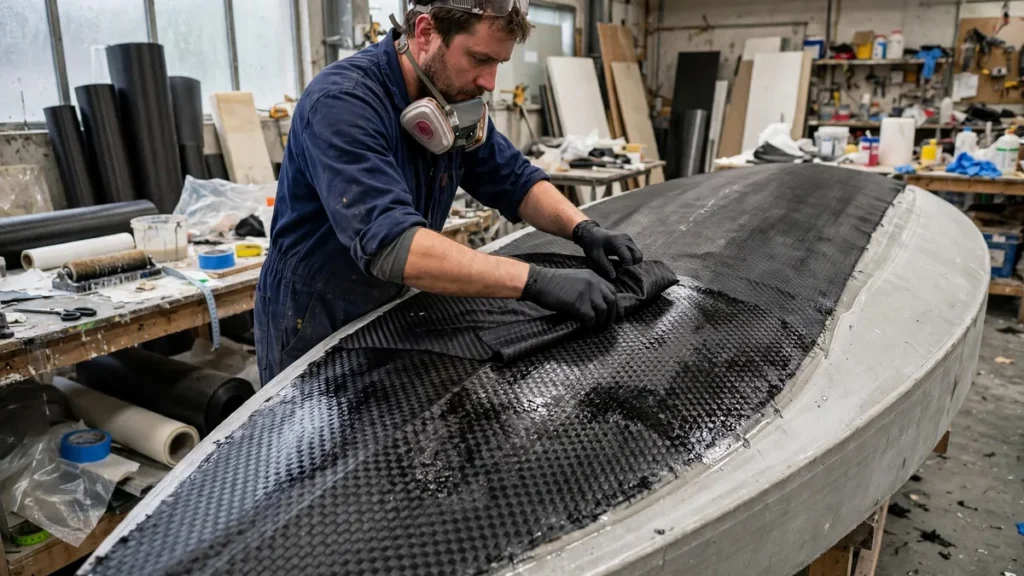
The part starts as prepreg: carbon fibre cloth already impregnated with epoxy resin, kept frozen until needed. Epoxy was chosen because it bonds fiercely to carbon fibre, shrinks very little as it hardens, and keeps its strength at the temperatures an aircraft wing reaches in service. Inside the autoclave the resin first melts and flows, letting pressure squeeze out air and excess resin, then cross-links into a rigid solid that will never melt again. The fibre is the same material described in our guide to carbon fibre weave materials, and the fibre-and-epoxy pairing is what makes the finished part stronger than steel for its weight.

Step 5: Bagging film, breather, and bleeder
Between the part and the pressure sits a stack of thin materials that do the quiet work. The vacuum bag is a film of nylon or polyimide, heat-resistant enough to survive the cure without melting, sealed to the tool with tacky tape. Under the bag, breather cloth — a fluffy polyester or glass fabric — gives the vacuum a path to pull air out from every corner. Beside the part, bleeder cloth soaks up excess resin like blotting paper. Each is a consumable: used once, then thrown away. A failed bag is the most common cause of a scrapped part — a pinhole leak lets pressure in unevenly, and the laminate cures with dry patches and bubbles.
Step 6: What happens when the materials fail
Failure in an autoclave is usually quiet. If the resin is too old or was left out of the freezer too long, it starts curing before the pressure is on, and the laminate locks in its air bubbles forever — a defect called porosity, visible as a dull patch on an ultrasound scan. If the bag leaks, the part cures dry and starved of resin. If the temperature ramps too fast, a thick part can overheat in its core as the resin’s curing reaction releases heat — an exothermic runaway that can scorch the laminate from the inside. And if the nitrogen supply fails, the cure must be aborted or the part risks a fire. Every failure is a material pushed past its limit — which is why the process is watched by sensors and logged second by second. The same bagging care applies in our guide to how vacuum infusion works, where no pressure hides a mistake.
Autoclave Curing at a Glance
| Specification | Detail |
|---|---|
| Vessel material | Carbon steel or stainless steel plate |
| Door seal material | Silicone rubber ring |
| Pressurising gas | Nitrogen, dry and inert |
| Part resin | Epoxy, supplied as frozen prepreg |
| Fibre volume in cured part | About 55 to 65 percent |
What Does It Cost?
The machine dominates the cost: a small laboratory autoclave is estimated at roughly $100,000 to $300,000, while a large aerospace one is estimated at roughly $1 million to $10 million or more, before the building to house it. Consumables add up too — prepreg cloth is estimated at roughly $50 to $200 per square metre, and every cycle burns nitrogen, electricity, and a full set of single-use bagging materials. One cured aircraft part can carry thousands of dollars of material and machine time before inspection. All prices are estimates only.
A Rare Fact
The largest autoclaves can cure an entire aircraft wing in one piece: some are over 30 metres long and 8 metres across — longer than a blue whale, with a door weighing more than ten tonnes. They were built for airliners whose wings and fuselage sections are single composite pieces, too large to cure any other way. Loading one takes a rail trolley and hours of preparation, and the cure itself can last a full working day. The humble pressure cooker has grown into a machine the size of a house.

An autoclave is only as good as its materials: steel that holds pressure, seals that stay flexible, nitrogen that cannot burn, resin that flows before it hardens, and film that survives the heat. Each was chosen for a single impossible job, and each fails in its own quiet way. Understand them, and the giant steel cylinder stops being a mysterious oven — a careful balance of materials turning sticky black cloth into the strongest, lightest structures humans have built.