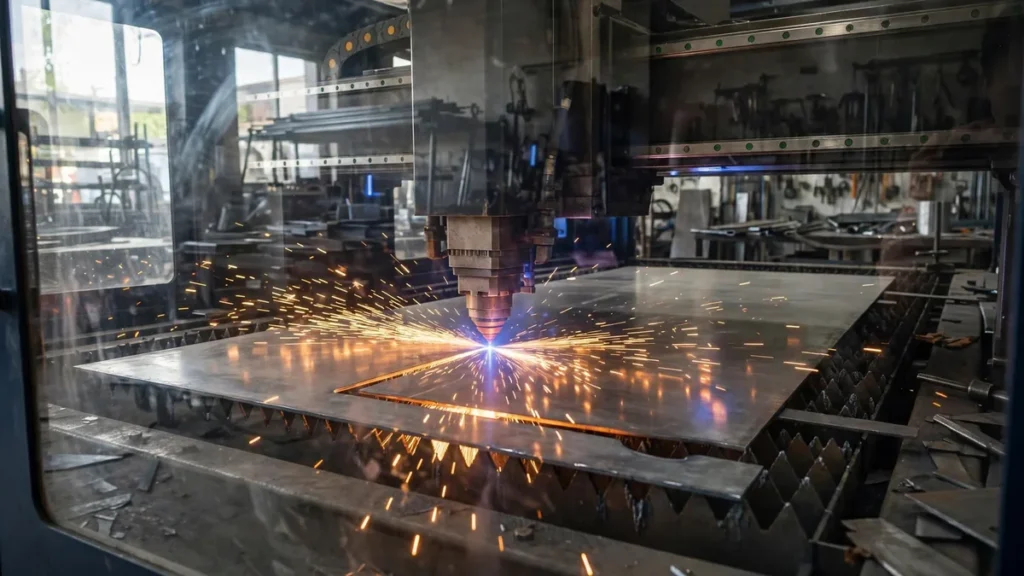
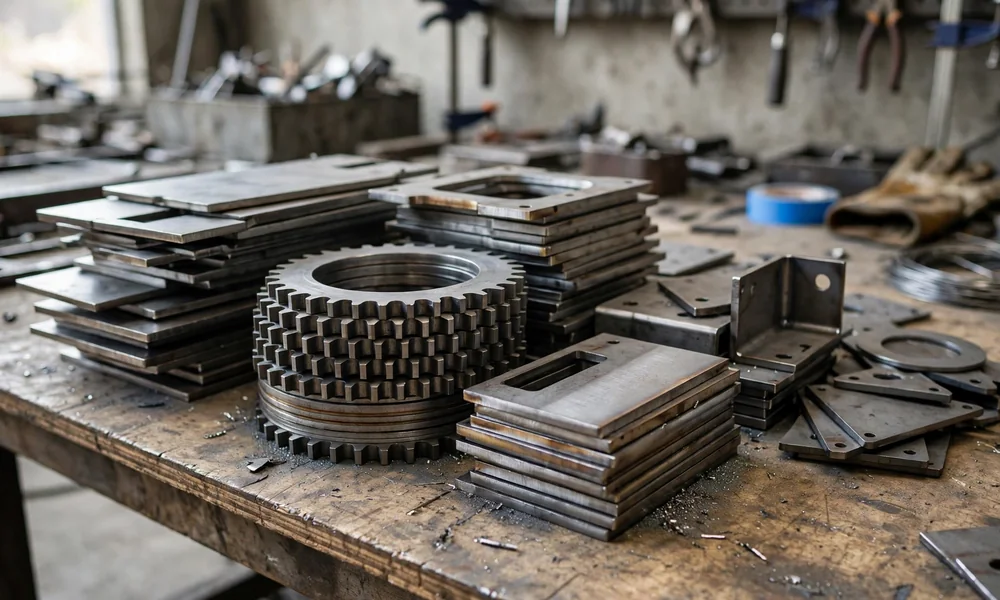
A flat sheet of steel goes in, and a minute later the parts fall out like pieces of a jigsaw: brackets, gears, panels, each with edges so clean they look machined. Nothing touched the metal — no blade, no saw, no drill — only a beam of light thinner than a hair, hot enough to melt steel in a blink.
Laser cutting looks like magic, but it is a careful match. The metal must absorb the light instead of reflecting it. The gas must help the melt along without ruining the edge. The lens must survive heat that would destroy ordinary glass. Change one and the same machine cuts beautifully — or not at all.
This guide looks at the materials behind laser cutting metal: the metals, the laser, the gases that shape the cut, and the optics that focus the beam — why engineers chose them, how they are shaped, and what happens when they fail.

The Materials Behind the Laser Cutting Metal
Step 1: The metals that cut well
Not every metal welcomes a laser. Mild steel is the easiest: it absorbs the beam well, melts cleanly, and cuts fast, which is why most laser-cut parts start as mild steel sheet. Stainless steel cuts almost as well, but needs more power and cleaner gas, because oxygen leaves a dark, oxidised edge. Aluminium is harder — it reflects much of the beam and conducts heat away, so it needs a powerful fibre laser and careful settings. Copper and brass are the hardest: they reflect so much light that early lasers could not cut them, and even today they cut slowly, risking damage from reflected light. Titanium cuts beautifully but catches fire in oxygen, so it is always cut with inert gas. The metal decides the laser, the gas, and the speed.
Step 2: The laser itself
The beam comes from one of two sources. A carbon dioxide laser makes its light in a tube of gas, excited by electricity, and was the workhorse for decades. A fibre laser makes its light inside a hair-thin strand of glass doped with ytterbium, and it has taken over: more efficient, almost no maintenance, and its shorter wavelength is absorbed far better by metal. The fibre is the key material — silica glass, thinner than a human hair, carrying kilowatts of light without melting. Modern machines cut thin sheet several times faster than the carbon dioxide machines they replaced. The numbers behind the beam are set out in our guide to laser cutting metal specs.
Step 3: The assist gas
A jet of gas blows through the nozzle with the beam, doing three jobs: blowing molten metal out, cooling the edge, and changing the cut’s chemistry. Oxygen is fastest for mild steel: it burns with the hot metal and adds its own heat — but it leaves an oxidised edge to clean before welding or painting. Nitrogen is slower and dearer, but leaves a bright, clean edge on stainless and aluminium, ready to weld. Compressed air is the cheap compromise, good enough where a perfect edge is not needed. The wrong gas is the most common beginner mistake: oxygen on stainless steel ruins the finish, and nitrogen on thick mild steel doubles the cutting time.
Step 4: The lens and the nozzle
The beam leaves the laser as a wide, gentle column, and a lens squeezes it to a spot about a tenth of a millimetre across — where all its energy concentrates. The lens is zinc selenide or fused silica, chosen because they let the laser’s wavelength through without absorbing it, and it sits behind a protective window that takes the spatter instead. Below the lens is the nozzle, a small copper cone shaping the gas jet; copper conducts heat away from the tip, millimetres from molten metal. A dirty lens is the quiet killer of cut quality: a speck of spatter absorbs the beam, heats up, and cracks the lens — hundreds of dollars and a day of downtime.
Step 5: How the metal is shaped
Cutting happens in a line thinner than a pencil mark. The focused beam melts a tiny pool of metal, the gas jet blows it out of the bottom of the cut, and the head moves on, leaving a slot called the kerf, usually about 0.1 to 0.3 millimetres wide. Heat spreads only a fraction of a millimetre into the metal around it, leaving a narrow heat-affected zone where the steel is slightly harder and more brittle. Underneath, resolidified metal can cling as dross. It is a balance: too slow and heat spreads and warps the sheet; too fast and the beam does not cut through. That precision makes laser cutting the first step for parts finished by other machines, as in our guide to precision CNC machining materials.
Step 6: What happens when the materials fail
Failure usually starts with the wrong match. Cut reflective copper on an old machine and the beam can bounce back into the optics, cracking the lens or damaging the laser — the reason early machines simply refused copper. Cut with a dirty lens and the beam spreads, the edges go rough, and every part comes out with dross. Cut thick steel too fast and the beam does not reach the bottom, leaving the part attached by a thin web. Cut titanium with oxygen and the part can catch fire. Every failure is a material pushed past its limit; the fix is almost always the same: the right metal, the right gas, and clean optics. The same respect matters when parts are joined, as in our guide to how steel welding works, where a laser-cut edge is often the starting point.
Laser Cutting Metal at a Glance
| Specification | Detail |
|---|---|
| Mild steel, fibre laser | Up to about 25 millimetres thick |
| Stainless steel, fibre laser | Up to about 20 millimetres thick |
| Aluminium, fibre laser | Up to about 15 millimetres thick |
| Kerf width | About 0.1 to 0.3 millimetres |
What Does It Cost?
The machine dominates the cost: a small fibre laser cutter is estimated at roughly $50,000 to $150,000, a large industrial one at roughly $300,000 to $1 million or more. The metal is the running cost — mild steel sheet is estimated at roughly $1 to $3 per kilogram, stainless several times more — plus nitrogen, electricity, and new lenses and nozzles. Per part, though, it is cheap: a small bracket is estimated at roughly $1 to $5, a large panel at roughly $20 to $100, because the machine needs no tooling and cuts fast. All prices are estimates only.
A Rare Fact
The first industrial use of laser cutting, in 1965, was not cutting steel at all — it was drilling tiny holes in diamond dies, the discs used to draw wire. Nothing else could shape diamond, and only a laser could drill through one without shattering it. From holes in gemstones, the technology grew into machines slicing through centimetres of steel. The laser cutter started life as a jeweller’s tool, not a steelworker’s.

Laser cutting is a partnership: metal that absorbs light, a glass fibre carrying kilowatts, gas that clears the cut, and a lens focusing it all onto a spot thinner than a hair. Get the match right and steel falls into perfect parts; get it wrong and the machine burns, reflects, or stalls. Understand the materials, and the beam stops being magic and becomes engineering — the most precise way ever found to take metal apart.