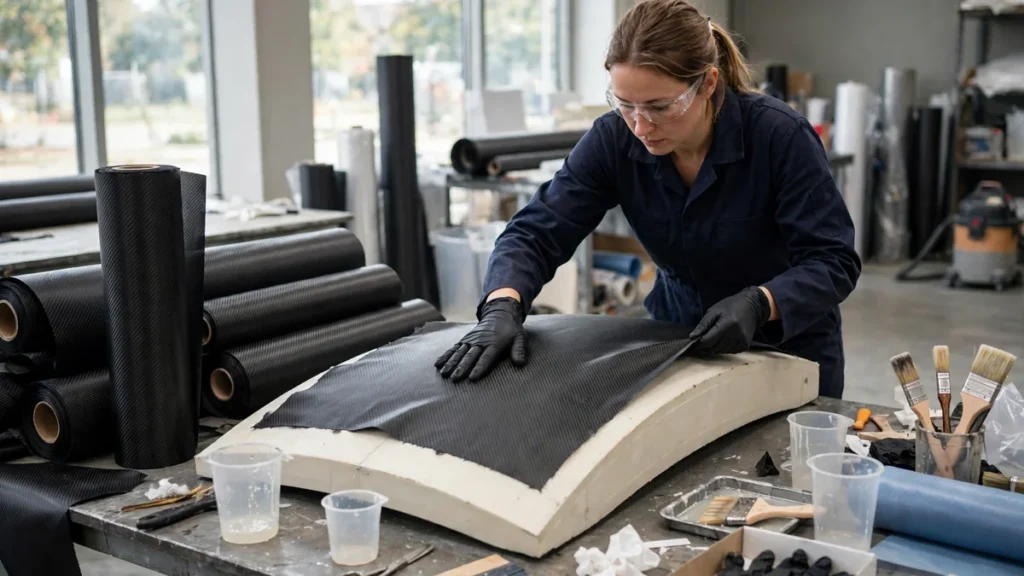
The sheet on the bench looks like black cloth, and behaves like it too: it drapes, wrinkles, and catches on a rough edge. Yet within a few hours this soft fabric will become a panel stiffer than steel for its weight. Nothing about it looks strong — that is the first surprise of composite layup.
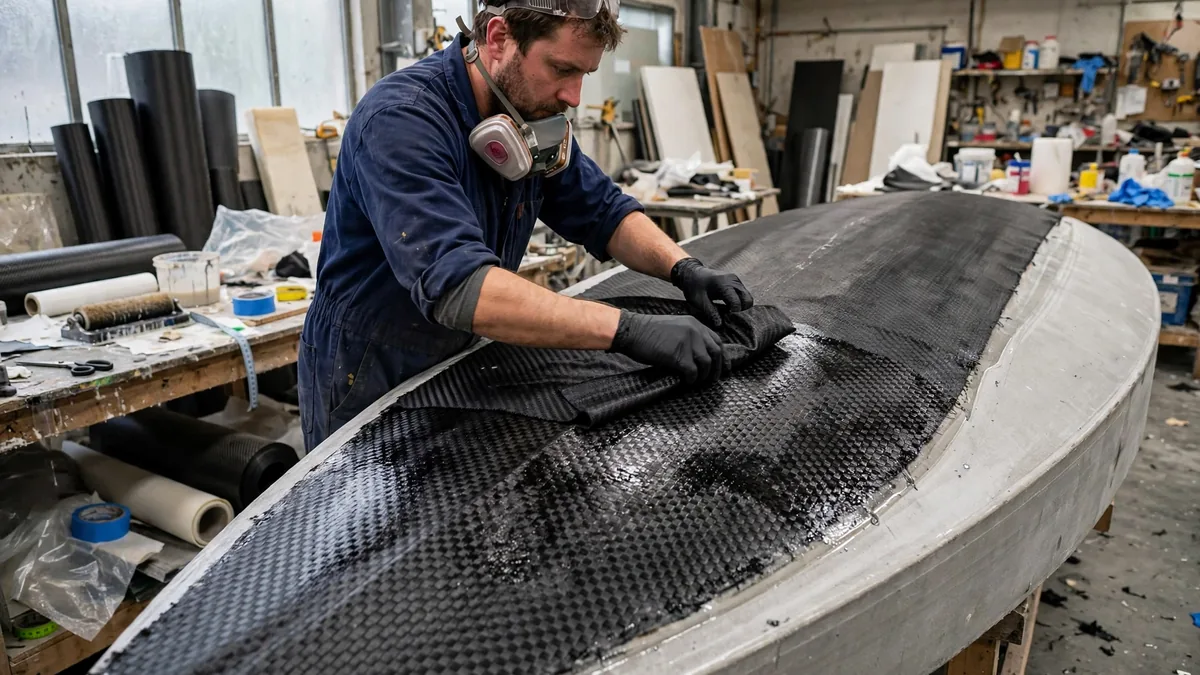
A composite layup is a sandwich built by hand, layer by layer: thin sheets of fibre — usually carbon, sometimes glass or aramid — laid onto a mould in a chosen order, wetted or pre-coated with resin, then pressed and baked until hard. The fibre carries the load; the resin holds the fibres in place. Get the order, the direction, or the cure wrong, and the panel looks perfect while hiding a weakness that only appears under load.
This guide looks at the materials behind the composite layup: the fibres and resins that carry the strength, the cores and moulds that give them shape, and the films that make the cure work — why engineers chose them, how they are shaped, and what happens when they fail.
The Materials Behind the Composite Layup
Step 1: Carbon fibre, the load carrier
The fibre is the muscle. Carbon fibre is made by heating strands of polyacrylonitrile until almost everything but carbon burns away, leaving filaments a fraction of a hair’s width. Woven into cloth, they are enormously strong in tension — one strand carries far more than a steel wire of the same weight — but snap if bent sharply and carry almost nothing across their width. So a layup is never one direction: plies are stacked at 0, 45, and 90 degrees, making the panel strong in every direction it will be loaded. The weave itself matters, as explained in our guide to carbon fibre weave materials, where the cloth pattern decides how it drapes and how it fails.
Step 2: Glass and aramid, the quieter fibres
Not every ply is carbon. Glass fibre is heavier and less stiff, but it is far cheaper, tougher against impact, and transparent to radio signals — which is why radomes and boat hulls use it, and why it often appears as a first ply to protect the carbon beneath. Aramid, sold as Kevlar, is the fibre of bulletproof vests: it stretches before it breaks, absorbing energy that would shatter carbon. Engineers mix fibres deliberately, putting carbon where stiffness matters and aramid or glass where a blow might land.
Step 3: Epoxy resin, the glue that becomes structure
Resin is the material that turns cloth into a solid. Epoxy is the usual choice because it bonds fiercely to carbon fibre, shrinks very little as it hardens, and keeps its strength at the temperatures a wing or engine cover reaches in service. It arrives as a liquid, brushed or infused into dry cloth, or already inside the cloth as prepreg, kept frozen until use. During the cure the resin first flows like warm honey, letting pressure squeeze out air, then hardens into a rigid network that will never melt again. If the resin is old, or left out of the freezer too long, it starts curing before the pressure is on, locking air bubbles in forever.

Step 4: Core materials, the hidden middle
Many panels are not solid fibre at all. Between two thin skins of carbon sits a core — foam, balsa wood, or aluminium honeycomb — that makes the panel thick without making it heavy. A thick panel resists bending far better than a thin one, so the core is what gives a wing skin or a boat deck its stiffness. Foam cores are light and easy to shape; honeycomb is stiffer but hates moisture — a dent can let water in and freeze, splitting the skins apart.
Step 5: The mould, the shape keeper
Every layup needs a mould, called a tool, and the tool is itself an engineering problem. It must hold its shape through the heat of the cure, expand at a similar rate to the part, and release the finished panel without tearing it. Aluminium tools are machined for accuracy and survive hundreds of cycles; composite tools are lighter but wear faster. Before the first ply goes down, the tool is polished and coated with release agent — a waxy film so thin it is invisible — because a part that sticks to its mould has to be cut out and thrown away.
Step 6: Bagging, pressure, and what happens when materials fail
The final step is the least visible and the most unforgiving. The layup is sealed under a vacuum bag, a heat-resistant film taped to the tool, and air is pulled out so the atmosphere itself presses the plies together. Breather cloth under the bag gives the vacuum a path to every corner, and bleeder cloth soaks up excess resin. Then the tool goes into an oven or an autoclave to cure under heat and pressure. Failure here is quiet: a pinhole in the bag lets pressure in unevenly and the laminate cures dry and starved of resin; a temperature ramp too fast makes a thick part overheat in its core, scorching the laminate from the inside. The cure cycle is described in our guide to autoclave curing materials, and the same bagging care applies in our guide to how vacuum infusion works.
Composite Layup at a Glance
| Specification | Detail |
|---|---|
| Main fibre | Carbon fibre, woven cloth or unidirectional tape |
| Other fibres | Glass fibre for cost and toughness, aramid for impact |
| Resin | Epoxy, liquid-infused or frozen prepreg |
| Core options | Foam, balsa wood, or aluminium honeycomb |
| Fibre volume in cured part | About 55 to 65 percent |
| Cure temperature | About 120 to 180 degrees Celsius |
What Does It Cost?
The cloth sets the price. Carbon fibre prepreg is estimated at roughly $50 to $200 per square metre, and a single wing or hull can need hundreds of square metres laid by hand over days. The mould adds more: a machined aluminium tool for a car body panel is estimated at roughly $10,000 to $100,000, and a large aerospace tool far more. Then comes the cure — oven or autoclave time, nitrogen, electricity, and single-use bagging materials for every cycle — plus inspection, because every structural part is scanned for voids before it flies or races. A finished part can cost ten times its raw materials, and most of that is skilled hands and time. All prices are estimates only.
A Rare Fact
A composite layup can be stronger than steel and still float: some carbon fibre panels are so light that a square metre of finished laminate weighs less than a paperback book, yet the same panel can carry the load of a small car. The trick is fibre direction — engineers point the strongest fibres exactly along the load path, and put almost nothing where no load goes. A steel plate cannot do that; it is equally strong in every direction, which means it is overweight in all of them.

A composite layup is only as good as its materials: fibre pointed the right way, resin that flows before it hardens, a core that stays dry, a mould that holds its shape, and a bag that never leaks. Each was chosen for a single job, and each fails in its own quiet way. Understand them, and a black sheet on a bench stops looking like cloth — it is the start of the lightest, strongest structures humans have built.