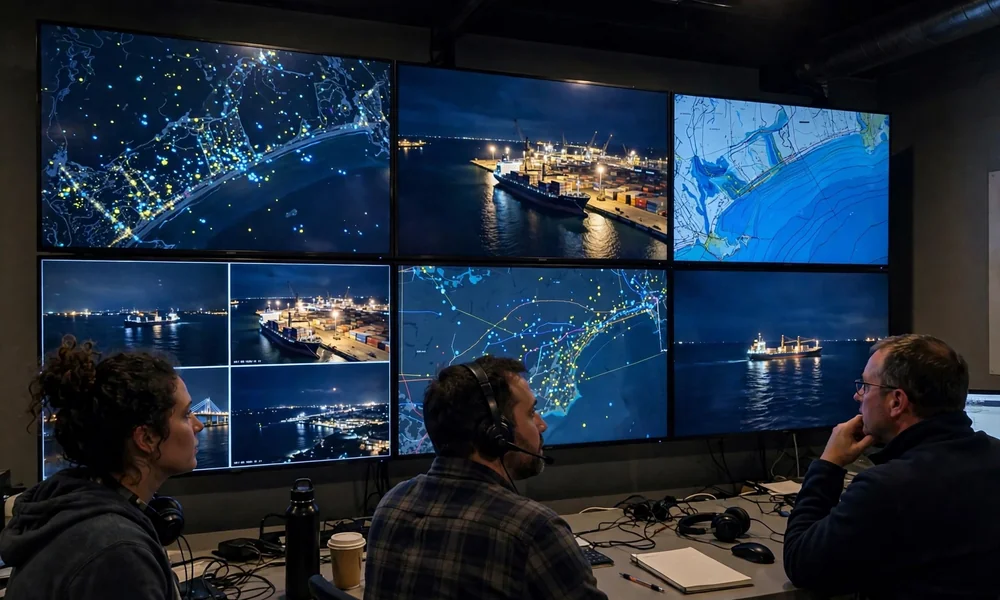
Somewhere in the North Sea, a grey hull the length of two football pitches is holding its course through a February swell with nobody on the bridge. No captain watches the radar, no officer drinks coffee at midnight, no helmsman feels the roll. Computers below deck read lidar, radar, cameras and satellite data, compare them against a chart, and make the small rudder corrections that keep two thousand containers on schedule. The crew sit in an office ashore, watching the same screens, ready to take over if the machine asks. Short-sea vessels already run trials and limited commercial routes with no crew on board, and the big ocean-going designs are queuing up behind them.

What autonomous actually means on a cargo ship
The word autonomous gets stretched until it means almost anything, so shipping grades it in levels. At the lowest end, a ship is simply well automated: the autopilot holds course, the engine room runs itself, and the crew does the thinking. One step up, the ship makes decisions on its own but a human watches and can override at any moment. Higher still, it handles the ordinary work alone and calls home only when something unusual happens.
When a builder advertises an autonomous cargo ship, look for which level it actually claims, whether it is approved for a specific route or only for trials, and what happens when the satellite link drops. A ship that can safely hold position and wait for instructions is a very different proposition from one that keeps steaming blind. The most useful way to think about it is that an autonomous cargo ship is not a ship with a clever autopilot bolted on. It is a ship designed around the absence of people: no cabins, no galley, no lifeboats for thirty sailors, no bridge with a view. The case against the idea is worth reading too, and our piece on the case against autonomous ships lays out the safety, legal and employment arguments that still slow the technology down.
How an autonomous cargo ship works
A crewless voyage is a chain of systems handing work to one another. Here is how it runs.
Step 1: The voyage is planned ashore
Before the ship moves, a shore team plots the route with weather forecasts, traffic density, fuel prices and port schedules folded in. The plan is a set of corridors, speed targets and fallback options, uploaded with its rules: keep this distance from other traffic, slow down in these zones, and never enter that area without permission.
Step 2: Sensors build a picture of the world
Once underway, the ship watches its surroundings with radar, lidar, daylight and thermal cameras, automatic identification system receivers and satellite positioning. No sensor is trusted alone. The software fuses them into one model of the sea, tracking every contact, its speed and course, and whether it may become a problem.
Step 3: The navigation brain decides
The fused picture goes to the navigation system, which compares it with the voyage plan and the collision regulations. When another vessel approaches, the system decides whether to hold course, alter to starboard, slow down or stop, and it decides early, the way a good officer would.
Step 4: Propulsion and steering follow orders
Commands go to the propulsion system, usually a single efficient slow-speed diesel, a dual-fuel engine, or a battery-electric drive on short routes. With no engineer walking the engine room, temperatures, pressures, vibration and fuel quality are monitored continuously, and the system can derate the engine, switch to a backup, or shut a failing unit down before damage spreads.
Step 5: The shore centre watches and intervenes
Everything is mirrored to a remote operations centre ashore, where a small team watches several ships at once. Most of the time they do nothing, which is the point. But when the ship meets something outside its approved envelope, a busy harbour entrance, a fishing fleet, a storm that was not in the forecast, it hands control to the human, who can steer by camera, order a speed change, or bring the vessel to a stop. The ferry world is furthest along here, and how an autonomous ferry works shows the same handover idea on short, busy routes.
Step 6: Arrival, docking and cargo
Port arrival is the hardest part of the voyage, and the first place autonomy usually gives way to remote control or a local pilot. Docking demands centimetre accuracy in wind and current, and most designs handle it with a shore operator driving by camera and lidar, or with tugs doing the final push.
The spec sheet, decoded
The table below uses a typical short-sea feeder design, the size now running trials, because the giant ocean-going versions are still mostly on paper.
| Specification | Typical figure | What it tells you |
|---|---|---|
| Length overall | 80 to 120 metres | Feeder size, built for coastal routes |
| Deadweight | 2,000 to 3,500 tonnes | About 120 to 200 containers |
| Service speed | 10 to 13 knots | Slow steaming, tuned for efficiency |
| Propulsion | 1,500 to 3,000 kW, diesel or battery-electric | Single main drive, often with a backup |
| Crew on board | Zero | No cabins, galley or lifeboat stations |
| Sensor suite | Radar, lidar, cameras, AIS, satellite positioning | Redundant sensing, fused into one picture |
| Remote link | Satellite plus coastal 4G or 5G | The lifeline to the shore centre |
| Endurance | 24 to 72 hours unassisted | How long it can run without a human |
| Hull material | Steel, with a strengthened bow | Built for the same seas as a crewed feeder |
Endurance matters most, because it defines the gap between a ship that is genuinely independent and one that is really a remote-controlled boat with a long leash. The research world measures floating laboratories the same way, and research vessel specs explained shows how a working ship’s numbers translate into what it can do.

What an autonomous cargo ship costs
Prices here are estimates, because almost every crewless ship is a prototype or a one-off. A small short-sea autonomous feeder is estimated at roughly 10 to 25 million dollars to build, more than a comparable crewed feeder, because the sensors, redundant systems, satellite links and shore centre all cost money before the first container is loaded. The bet is that running costs repay the difference. No crew means no wages, no victualling, no crew change flights and no accommodation spaces to heat and maintain, with savings estimated at roughly 1 to 2 million dollars a year on a small vessel. The honest arithmetic is that autonomy pays first on short, repetitive routes where the ship does the same run hundreds of times a year.
A rare fact worth knowing
The first fully autonomous cargo ship to run a commercial route did not cross an ocean at all. It carried fertiliser along the Norwegian coast, on a short, quiet stretch of water the designers had mapped in exhaustive detail, and even then it ran its early voyages with a crew on board as a safety net. Autonomy arrived not with a grand ocean crossing but with a small, boring, well-understood job done the same way every day.
The verdict
Read the spec sheet as a balance between what the machine can do alone and what it still needs humans for. The strong numbers are endurance, sensor redundancy and the ability to hold a plan without fatigue. The weak numbers sit around the edges: docking, busy traffic, storms and the moment the satellite link fails. Short, repetitive and well mapped is where the crewless ship earns its keep today. The open ocean is still waiting.


