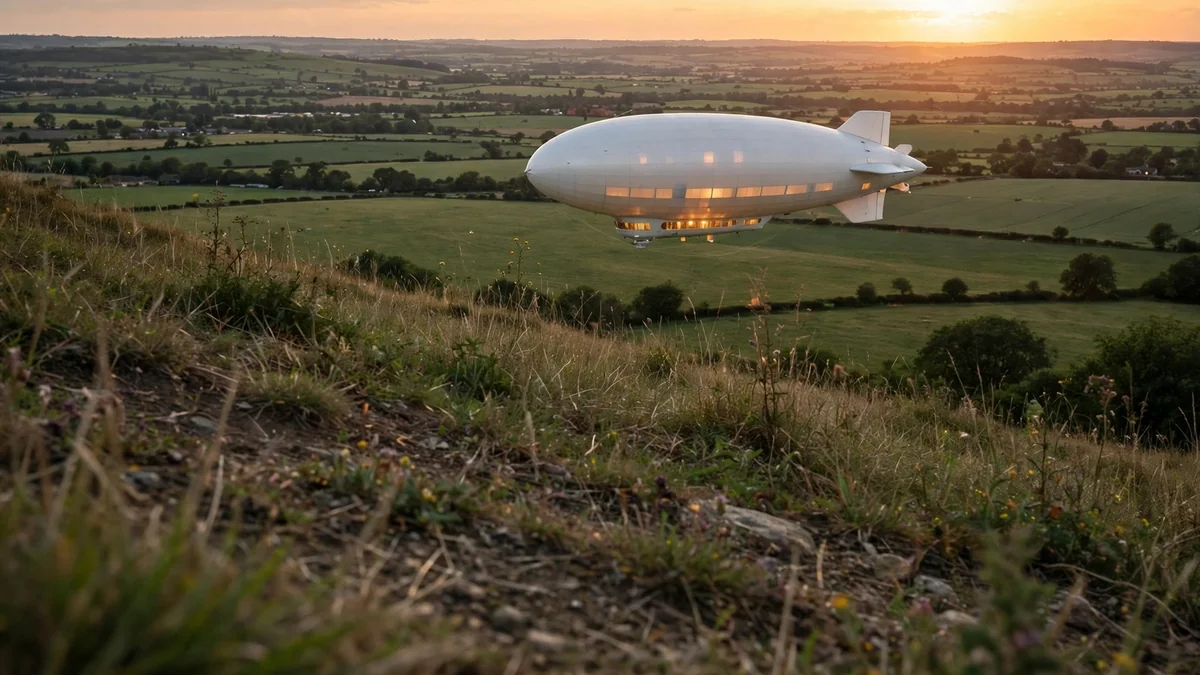
The airship came back quietly. There was no grand relaunch, only a slow accumulation of new envelopes, new materials and new money. A century after the great rigid airships burned and crashed out of fashion, the luxury airship is being rebuilt as something else: a slow, silent, panoramic way to travel, part hotel and part aircraft, with a lounge where the windows are the whole point. The new designs do not try to beat a jet on speed. They try to make the journey itself the luxury.
Why an airship, and why now
An airship flies for a simple reason: it is lighter than the air it displaces. Fill a large envelope with helium, and the lift is free, silent and constant, with no engine needed simply to stay in the sky. That changes the whole economics of luxury travel. A jet burns fuel every second it is airborne, and its cabin is a tube with small windows. An airship sips fuel, drifts at a walking pace by aviation standards, and can carry a lounge with floor-to-ceiling glass, a dining room and bedrooms, because weight is still a limit, but a gentler one than on a jet.
The reason it took a century to come back is that the old airships had three fatal weaknesses, and all three have only recently been fixed. The first was the lifting gas: hydrogen is cheap and powerful but flammable, and helium was once rare and expensive. The second was the envelope fabric: the old cotton and rubber skins leaked and rotted, while modern laminated fabrics hold gas for months. The third was control: a big airship in a crosswind was a handful for a crew with cables and muscle, while modern fly-by-wire controls and vectored thrust let a small crew hold the ship steady. Compare it with the private jet, whose engine is a masterpiece of heat and speed, as how a private jet engine is made shows. An airship engine is the opposite idea: small, quiet, and mostly there to push the ship gently forward.
How a luxury airship works
An airship is a balloon that can steer, but that undersells the engineering. Here is the sequence, from the ground up.
Step 1: Lift comes from the envelope
The envelope is a vast fabric bag, shaped like a teardrop, filled with helium. The lift is fixed by volume: roughly one kilogram of lift per cubic metre of helium. That single fact sizes everything else. A ship that must carry ten passengers, a crew, a lounge and its own structure needs tens of thousands of cubic metres of gas, which is why airships are so enormous next to the cabin they carry.
Step 2: Ballast and gas control the altitude
The ship rises by dropping water ballast and descends by venting a little helium or pulling air into internal bags called ballonets. The ballonets are the clever part: as the ship climbs and the outside air thins, they deflate to let the helium expand, and as it descends they inflate to keep the envelope taut.
Step 3: Propulsion pushes, it does not hold up
Engines on an airship are small turboprops or electric motors mounted on pods that can tilt. Because lift is free, the engines only need to overcome drag, so the power is a fraction of what a jet needs, often a few hundred kilowatts in total. The tilting pods double as the landing system: point them down and the ship can rise or sink vertically, point them back and it cruises forward.
Step 4: The gondola is the hotel
Under the envelope hangs the gondola, and on a luxury ship this is where the money goes. The structure is carbon fibre and aluminium, the windows are huge laminated panels, and the interior is laid out like a small boutique hotel: a lounge, a dining table, a handful of suites and an observation deck.
Step 5: Ground handling is the hard part
The newest electric aircraft face a similar puzzle about where they can actually operate, and how an eVTOL aircraft works shows how a new kind of flying machine has to solve the ground problem before it can sell the sky.
The spec sheet, decoded
An airship spec sheet is dominated by one number, volume, because volume is lift and lift is everything. The table below uses a modern hybrid luxury design, the class now being built for sightseeing and short luxury routes.
| Specification | Typical figure | What it tells you |
|---|---|---|
| Envelope volume | 30,000 to 40,000 cubic metres | Sets the total lift available |
| Length overall | 85 to 100 metres | Longer than a jumbo jet |
| Useful lift | 15,000 to 20,000 kilograms | Payload after structure and gas |
| Passengers | 12 to 20, plus crew of 4 | Hotel scale, not airline scale |
| Cruise speed | 60 to 90 km per hour | Slow, calm, and weather dependent |
| Range | 1,000 to 2,000 kilometres | Days of drifting, not hours of flying |
| Propulsion | 3 to 4 tilting engines, 300 to 800 kW total | Tiny power for an aircraft this size |
| Envelope material | Laminated polyester and film composite | Holds helium for months, resists weather |
| Ceiling | 2,000 to 3,000 metres | Low, scenic, and below the jet lanes |
The number to interrogate is useful lift, because it is the budget everything else spends. Structure, engines, fuel, crew, passengers and luggage all come out of it, and the interior fittings are weighed against it, kilogram by kilogram. Range is the second number to read sceptically: it assumes calm air, and a headwind can cut it sharply. The market for slow, spacious private flying is small but real, and the case for smaller private jets makes the same argument from the other end: for some travellers, the cabin matters more than the clock.

What a luxury airship costs
Prices here are estimates, because luxury airships are built in tiny numbers and almost always to order. A new luxury airship is estimated at roughly 30 to 80 million dollars, depending on size, interior and certification. A sightseeing seat on a shared flight is estimated at roughly 1,000 to 5,000 dollars, while a private charter for a day is estimated at roughly 50,000 to 150,000 dollars. The helium alone is a running cost other aircraft never face, and topping up a large envelope is estimated at tens of thousands of dollars a year. The envelope is the most expensive item to build and certify, the gondola interior is where the luxury money goes, and the ground infrastructure can cost almost as much as the aircraft itself. That is why the first luxury airships are not trying to be airlines. They sell a small number of very expensive experiences, where the slowness is the point.
A rare fact worth knowing
The fastest airships ever built were not the famous rigid giants of the 1930s. The record belongs to experimental hybrid ships that use aerodynamic lift from their shaped hulls on top of the helium, letting them cruise noticeably faster than a pure balloon shape. The airship was never really finished as a technology. It was abandoned, and the engineers who returned to it found ideas the first generation never got to try.

The verdict
Read an airship spec sheet the way you would read a yacht brochure, not an airline timetable. Volume is the budget, useful lift is the spending, and speed is the number that matters least. The ship that is honest about its weather limits and its helium costs is the one worth believing. For travellers who want to arrive quickly, the jet still wins. For travellers who want the journey to be the holiday, the airship is finally back.


