On an electric boat, the battery is not a component. It is the fuel tank, the engine room and most of the purchase price, all in one box. A petrol boat can carry a bigger tank for a few hundred pounds; an electric boat that needs more range needs a bigger battery, and a bigger battery changes the weight, the balance, the cost and the charging time. Pick the right chemistry and the boat runs all day on cheap overnight power.
Electric boats are a harder battery problem than electric cars. A car charges overnight and coasts downhill; a boat pushes water out of the way for every metre it moves and runs at high load for hours. The batteries below are ranked for a typical electric day boat or small cruiser used for leisure, fishing and short coastal trips.
How we ranked them
Five things decided the order. Cycle life comes first, because a boat battery is cycled hard and a replacement means lifting the boat and opening the hull. Safety is second: a thermal event on the water, far from a fire engine, is a different order of problem from one in a driveway. Energy density is third, since weight sits low in the hull but still costs speed and range. Charge rate is fourth, because most boats charge overnight.
10. Flooded lead-acid
Flooded lead-acid is the oldest battery on this list and it finishes last for reasons every boater already knows. It is cheap to buy and easy to find, but it is enormously heavy for the energy it stores, it must not be discharged deeply, and it needs topping up, ventilation and careful maintenance. As the main drive battery it turns a lively electric boat into a barge.
9. AGM lead-acid
AGM lead-acid is the sealed, maintenance-free version of the same old chemistry, and it is better in every practical way: no topping up, no spills, better vibration resistance, and it can be mounted in more positions. It still carries the core problem, which is weight. An AGM bank big enough to give a day boat useful range weighs hundreds of kilos. It works for short trips, but it is not a serious drive battery.
8. Nickel manganese cobalt (NMC)
NMC is the chemistry that powers most electric cars, and it brings excellent energy density to a boat: more range per kilo than anything below it on this list. The problem is the trade-off that comes with it. Cycle life is shorter than the phosphate chemistries, thermal stability is worse, and cobalt makes it expensive and awkward to source. On a boat, where the pack is hard to reach and harder to replace, the shorter life and higher fire risk outweigh the density.
7. Nickel cobalt aluminium (NCA)
NCA shares NMC’s strengths and most of its weaknesses. It is light, energy-dense, and well proven in cars, which is why it keeps appearing in marine conversions. But a boat cycles its battery differently from a car: long, sustained high loads rather than stop-start town driving, and that steady heat and deep discharge wear NCA out faster. Add the cobalt cost and the thermal management it demands, and it is a strong chemistry in the wrong job.

6. Lithium-ion polymer (LiPo)
Lithium polymer cells are light, flexible in shape, and deliver strong bursts of power, which makes them tempting for boats where the battery must fit an awkward hull space. Their weakness is durability and safety: LiPo is more sensitive to overcharging, physical damage and heat than the tougher chemistries, and it degrades faster under the deep, repeated cycling a boat demands. It suits a tender or a small auxiliary pack, but not the main drive battery of a boat you take offshore.
5. Lithium titanate (LTO)
LTO is the fastest-charging chemistry on this list and its cycle life is extraordinary, with tens of thousands of cycles possible. It also tolerates cold weather and abuse that would kill other cells. The reason it sits fifth is energy density: LTO stores far less energy per kilo, so a boat needs a much bigger and heavier pack to cover the same distance. On a short-hop boat that trade is worth making, but for a day boat the weight penalty is too large.
4. Sodium-ion
Sodium-ion is the newcomer, and it takes fourth on promise backed by early real-world results. Sodium is abundant and cheap, the cells are thermally stable, and they keep working in cold weather that slows lithium down, which matters for northern waters. Energy density is lower than the best lithium today and cycle life at marine scale is still being proven, but the cost per cycle is already competitive. The best electric ferry batteries ranked reaches a similar conclusion at larger scale, and the same logic holds here: for operators signing long contracts, sodium-ion deserves a serious look.
3. Lithium iron phosphate (LFP) standard
Standard LFP is the workhorse of electric boating and it earns third place on sheer dependability. It is thermally stable, which means a far lower fire risk than the cobalt chemistries, it tolerates thousands of deep cycles, and it uses no cobalt or nickel, which keeps costs down and supply simple. The best electric yacht batteries ranked shows the same chemistry winning on bigger vessels, and the reasons are identical: safety, life and cost per cycle beat raw density when the charger is never far away.
2. LFP with cell-to-pack design
Second place goes to LFP in its modern cell-to-pack form, where the cells are packed directly into the battery enclosure without intermediate modules. Removing the modules saves weight and volume, which recovers most of LFP’s density disadvantage, and the simpler structure is easier to cool and easier to monitor. That matters on a boat, where every kilo saved is speed and range gained, and where a simpler pack means fewer connections to corrode in a damp, salty environment.
1. LFP with liquid cooling and swappable modules
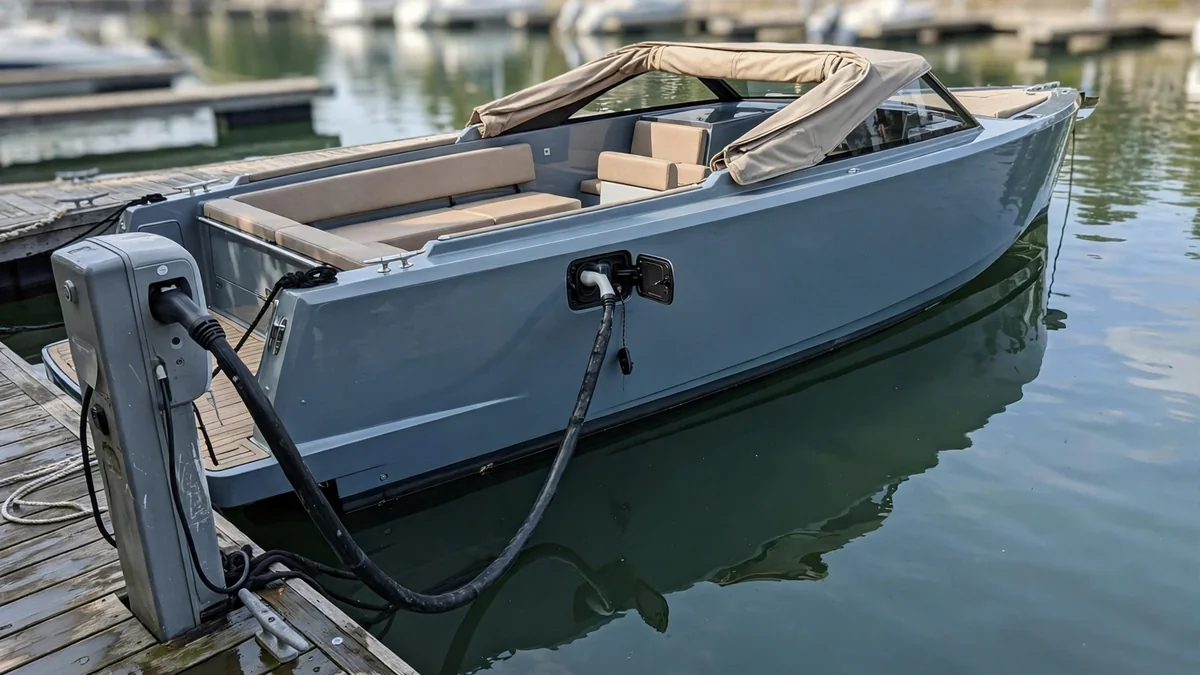
The best electric boat battery is LFP with liquid cooling and swappable modules, and it wins because it answers the boat’s real question: how long can you run, how fast can you recharge, and what happens when a module ages? Liquid cooling keeps the cells at a steady temperature through long, high-load runs, which is what makes fast charging safe and repeatable. The swappable modules mean a tired section can be lifted out and replaced without opening the whole pack. The way electric boat charging works makes the point from the other side: the charger is only as good as the battery behind it. This package is the battery that survives the daily routine for a decade, and it is the one boat buyers should specify.
The verdict
Specify LFP with liquid cooling and swappable modules for any new electric boat, and use the cell-to-pack version if weight or space is tight. Standard LFP is the safe, proven choice for a first electric boat, sodium-ion is worth watching for the next purchase, and LTO suits only the shortest hops. Avoid lead-acid for drive duty altogether.