Plug an electric car into a charger and the routine is familiar: pick a plug, wait, drive away. Plug an electric boat into a dock and it looks similar from a distance, but almost everything underneath is different. The water, the battery size and the age of the marina all change how long it takes and what it costs.
Charging an electric boat means moving energy from the shore into a battery bank on board. The battery stores direct current, known as DC, while the grid on land delivers alternating current, known as AC. Something must convert one into the other, and where that conversion happens decides how fast the boat charges. In slow charging it happens on board, in the onboard charger. In fast charging it happens on land, inside a cabinet on the dock.
Shore Power: The Overnight Workhorse
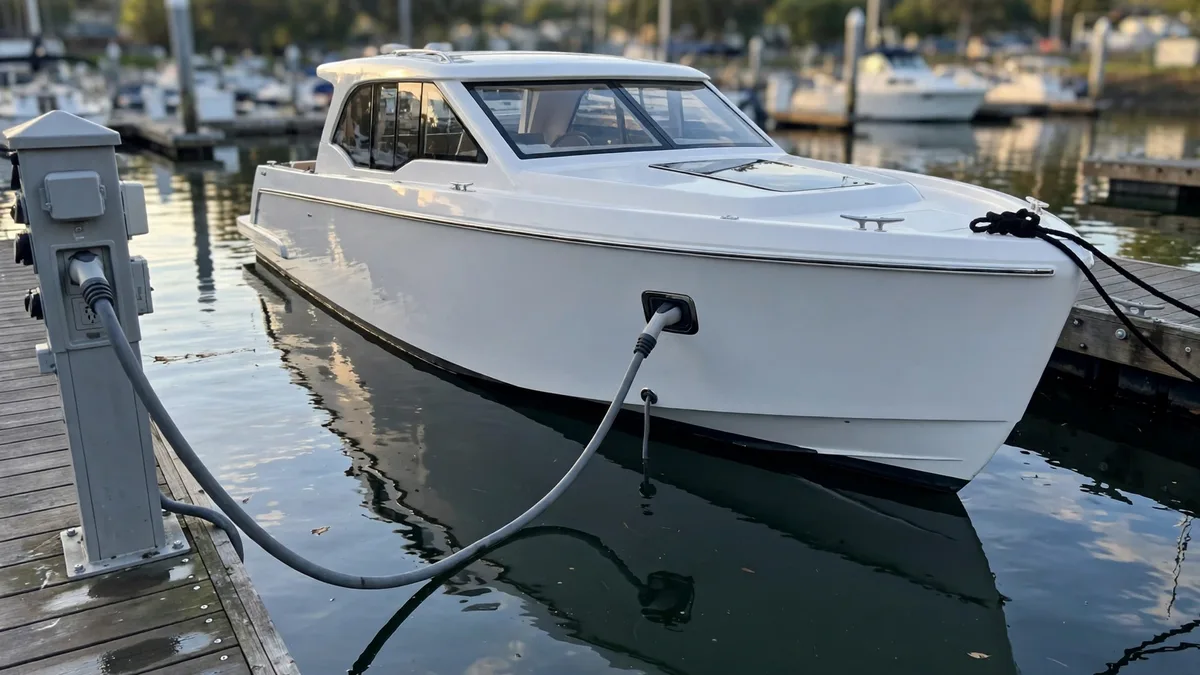
Almost every marina already has shore power. Walk along a pontoon and you will see the grey pedestals between the berths, each with sockets, a breaker and often a small meter. For decades they powered fridges and lights on diesel boats; now they also charge electric boats, and for most owners they are the main way charging happens.
A standard pedestal usually supplies 30 amps or 50 amps. At 120 volts, a 30-amp connection delivers roughly 3.6 kilowatts, barely more than a household kettle. At 240 volts, a 50-amp connection can deliver around 12 kilowatts, a serious step up. The pedestal is the tap, and its size limits how fast energy can flow. To use it, the crew runs a marine-grade cable from the pedestal to the boat’s inlet, switches on the breaker, and lets the onboard charger do its work. A full charge can take a whole night, which suits a boat that sits in its berth during the week and goes out at the weekend.
Level 2 AC Charging at the Dock
Level 2 charging means faster AC charging, usually at 240 volts and between about 7 and 19 kilowatts. It is the same idea as a home wall charger for an electric car, adapted for the water. Many marinas are upgrading selected berths with 240-volt pedestals, and owners with a private dock can have a dedicated circuit installed by a marine electrician, typically for 1,500 to 8,000 dollars.
Level 2 is the sweet spot for most electric boats. A small day boat with a battery of around 14 kilowatt-hours can recharge in about four hours. A 69 kilowatt-hour cruiser like the foiling Candela C-8 takes roughly twelve hours on a 5.5 kilowatt pedestal, or half that on a 12 kilowatt connection. The limit is always the onboard charger: no matter how powerful the pedestal is, the boat can only take what its own charger can convert.
DC Fast Charging: Rare, Fast and Growing
DC fast charging skips the onboard charger entirely. A large cabinet on the dock converts grid power to DC and pushes it straight into the battery, often through a CCS connector, the same system used by electric cars. Power levels typically run from 50 to 150 kilowatts, taking a large battery from 10 to 80 percent in roughly one to three hours.
For a big boat the difference is dramatic. A 126 kilowatt-hour boat like the X Shore Eelex 8000 takes around twelve hours on Level 2 but roughly two hours on a 40 kilowatt DC connection. A 226 kilowatt-hour Arc One needs eight to twelve hours on Level 2 and one to three hours on DC. That is slow next to a petrol fill-up, but it makes a day trip plannable. The catch is availability: only a handful of marinas in California, Florida and the Pacific Northwest have installed marine DC chargers, and a Mediterranean survey counted 642 charging locations but only 22 with DC fast charging.

How Long Does Charging Actually Take?
Charging time comes down to four things: the size of the battery, how much energy you need to add, how much power the dock can supply, and the maximum charging power the boat can accept. Divide the energy you need by the charging power and you get a rough answer; charging always slows above 80 percent to protect the battery.
A small electric outboard boat with a 14 kilowatt-hour battery charges in about four hours on Level 2 and in about an hour on DC fast charging, if one is available. A 69 kilowatt-hour foiling cruiser needs about twelve hours on a 5.5 kilowatt pedestal and around two and a half hours on DC. A 126 kilowatt-hour runabout needs about twelve hours on Level 2 and two hours on DC. Speed matters too: an electric boat cruising gently might cover 40 to 50 nautical miles on a charge, but push the throttle hard and that range can fall by half, because drag rises steeply with speed.
What Does It Cost?
Charging an electric boat is cheap compared with filling a petrol tank. Recharging a depleted battery costs roughly 8 to 25 dollars, against 60 to 120 dollars of petrol for a similar outing. Marinas charge for electricity in different ways: some include a shore power allowance in the berthing fee, some charge per kilowatt-hour, and some charge a flat nightly fee. The bigger cost is the marina’s: new cabling, switchgear and often a bigger grid connection.
Marina Infrastructure: What Is Changing
The marina of the near future looks different from the marina of ten years ago. A row of boats at 12 kilowatts each is a serious load, and one DC fast charger can draw as much as a small neighbourhood. Marinas are adding capacity, load management that shares power between berths, and sometimes solar panels. Payment is moving to apps and RFID cards, like public car charging. Standardisation is the slowest part: most modern electric boats support CCS, but some use proprietary connectors, so owners should check the connector on the boat against the marinas they plan to visit.
Safety: Water and Electricity Demand Respect
Mixing water and high-voltage electricity needs care. Only marine-grade cables and connectors should be used, since ordinary domestic extension leads corrode, overheat and fail in salt air. Every connection needs a ground fault breaker, which cuts power in a fraction of a second if current leaks. Check the cable and inlet for damage or corrosion before plugging in, keep connections out of standing water, and switch the pedestal breaker off before unplugging. If a breaker trips repeatedly or a connector feels hot, stop and get a marine electrician to look at it.

Is Electric Boat Charging Practical Yet?
For a day boat kept at a home dock with a 240-volt supply, the answer is already yes. The boat charges overnight, costs very little to run, and needs far less maintenance than a petrol engine. For a cruiser hopping between upgraded marinas, mostly yes, with planning. For a long-distance cruiser in remote waters, or a boat that must run all day at high speed, the honest answer is not yet, because the fast-charging network is too thin and the batteries too small.
Batteries are getting bigger and cheaper, more marinas are installing faster connections, and foiling hulls cut drag dramatically at cruising speed. The fastest electric yachts already show what is possible when a big battery meets a slippery hull, and the comparison with diesel propulsion keeps moving in electricity’s favour. The infrastructure is still catching up, but the answer is simple: plug in at the dock, and let the night do the work.


