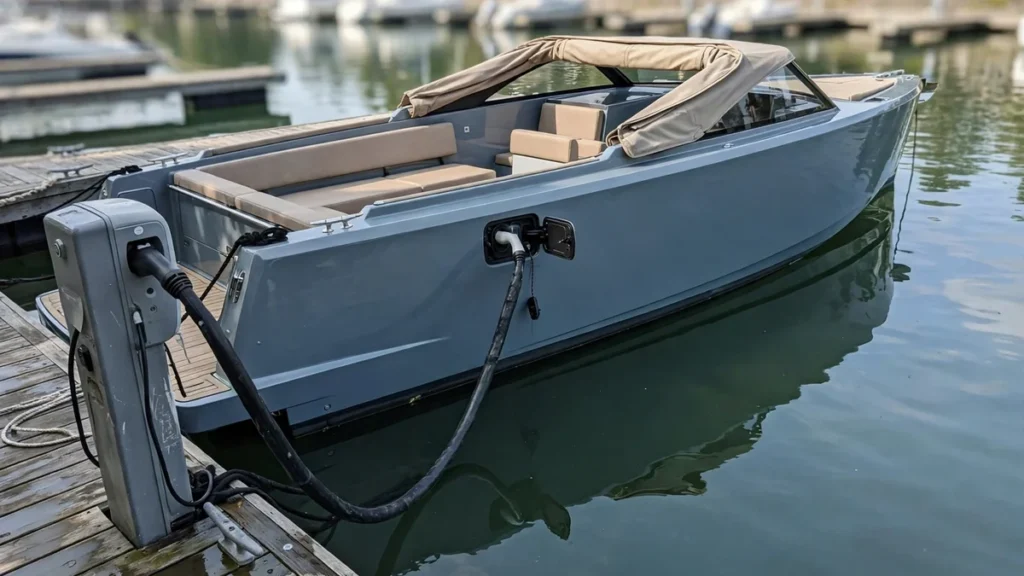
Charging an electric yacht is nothing like charging a car. A car plugs in for an hour and leaves. A yacht plugs in for a night, or a weekend, in salt air, in rain, on a pontoon that moves with the tide, and the charger has to keep working through all of it. The wrong charger is slow, fiddly and corroded within a season. The right one is boring in the best possible way: you plug in, walk away, and the boat is full when you come back.
Electric yachts are also getting bigger and hungrier. Battery banks that once measured in tens of kilowatt-hours now run into the hundreds, and a charger that was fine for a small day boat will take days to fill a cruising yacht. That is why the charger matters as much as the battery itself. The best electric yacht batteries ranked shows how far energy storage has come, but a great battery with a weak charger is a yacht that spends its life waiting at the dock.

How we ranked them
We ranked chargers on charging speed first, because time at the dock is the thing owners feel most. Then came weatherproofing and corrosion resistance, since a charger that cannot survive salt spray is a short-lived purchase. Ease of use mattered too: clear status lights, a cable that is long and flexible enough to reach the boat, and a plug that seats properly without a fight. We also weighed build quality, safety protection, and how each unit handles long overnight charges.
1. The dockside workhorse. The best all-round charger is a fixed dockside unit with serious output and a heavy, flexible cable. It delivers a strong, steady charge all night, shrugs off rain and spray, and its connectors are built to be plugged and unplugged hundreds of times a season. It tops this list for good reason.
2. The high-power marina pedestal. Close behind is the modern marina pedestal, which pairs high output with smart load sharing so several boats can charge at once without tripping the pontoon supply. Its metering is clear, its housing is sealed against the weather, and it talks to the boat so charging stops cleanly when the battery is full. The catch is that it belongs to the marina, not the owner, so you only benefit when your berth has one.
3. The portable shore charger. For owners who cruise between marinas, a portable charger that travels in a locker is the most useful thing on this list. It accepts whatever shore supply is available, adjusts its draw so it never trips a weak dock breaker, and packs away small. It charges slowly, but it charges everywhere.
4. The onboard fast charger. An onboard unit wired straight into the yacht’s electrical system is the neatest solution of all. There is nothing to carry, nothing to plug in on deck, and the boat charges the moment shore power is connected. It needs professional installation, but for owners who value a clean deck it is hard to beat.
5. The solar-assisted trickle charger. Not a main charger, but a brilliant second one. A solar-assisted unit keeps the battery topped up at anchor, runs the fridge and the instruments without touching the main bank, and means the boat is never flat when you arrive. It will not fill a big battery from empty, but as a companion to a shore charger it earns its place.

6. The compact travel charger. Smaller and lighter than the portable unit at number three, the travel charger is the one you take on a charter or a delivery trip. It charges slowly and gets warm, but it fits in a bag and has rescued more trips than any other charger here. Think of it as a spare tyre: you hope you never need it, and you are glad it is aboard.
7. The dual-voltage dock charger. Yachts that cross between regions face a dull but real problem: different shore voltages. A dual-voltage charger handles both without adapters or rewiring, which sounds minor until you have spent an afternoon hunting for a transformer in a foreign marina. It costs more than a single-voltage unit and its controls are more complex, but for a genuinely international yacht it removes a whole category of hassle.
8. The rugged weatherproof unit. Built for open pontoons and exposed berths, this charger is sealed, gasketed and armoured against everything the sea throws at it. It is heavy and its cable is stiff in the cold, but after three winters outside it will still be working. Owners with exposed berths should put this higher on their own list.
9. The smart connected charger. This one wins on information: an app shows charge state, power draw and time remaining, and it can schedule charging for cheap overnight electricity. The hardware underneath is solid but unremarkable. It ranks ninth because a charger should be judged on charging first and software second, however slick the graphs look.
10. The budget shore charger. The cheapest charger that is still safe to use rounds out the list. It charges slowly and its cable is short, but it is properly protected and does the job on a small boat. It is tenth because it is a starting point, not a destination, and most owners outgrow it within a season or two.
What to look for before you buy
Match the charger to the battery before anything else. A charger that is too small will take days to fill a large bank and will run hot doing it, while one that is far too large wastes money and can stress an older battery if it is not set up properly. Buy a cable long enough to reach from pedestal to inlet without strain. Salt air kills cheap metal, so look for marine-grade housings and sealed connectors rather than domestic parts dressed up for the dock. And remember that the charger is only half the system: the best electric ferry chargers ranked shows how the same ideas scale up for bigger vessels, and the lessons about weatherproofing and load management apply at yacht size too.
Installation matters as much as the unit itself. A fixed charger needs a proper breaker, a dry mounting spot and a cable run that does not chafe against the pontoon. A portable charger needs a locker that stays dry and a routine for coiling the cable properly. Get either wrong and even the best charger on this list will disappoint you, which is why a marine electrician is money well spent. The best electric yacht anchors ranked makes the same point about deck gear in general: the hardware is only as good as the way it is fitted and used.

Verdict
For most owners, the fixed dockside workhorse at number one is the right answer, with a portable charger in the locker for trips away from home. That pair covers the two ways yachts actually charge: long and slow at the home berth, and wherever you can find power on the move. Spend on weatherproofing and a proper installation, and the charger will disappear into the background, which is where it belongs.