An electric ferry is only as useful as the charger waiting for it at the dock. The boat gets the headlines — the silent crossing, the big battery, the clean harbour air — but the charging system decides whether the service runs on time. A ferry that cannot recharge between crossings cancels sailings, and no operator can afford that.
This ranking looks at the charging approaches that actually work for electric ferries in service today. We judged each one on charging power, turnaround speed, reliability in marine conditions, cost, and how well it fits the way ferries really operate — short stops, fixed routes, and long days. Anything that only exists as a prototype or a press release did not make the list.

How we ranked them
We gave the most weight to proven reliability in daily service, then to charging speed, then to cost and simplicity. Safety systems, standard connectors, and the ability to keep working in bad weather all counted. We also kept the ferry itself in mind: the battery on a modern electric ferry is a huge piece of engineering, and how it is charged shapes how long it lasts. How the electric ferry battery works explains the pack, the thermal management, and why charging curves matter more than headline power figures.
10. Overnight slow AC charging
The simplest option of all: plug the ferry in overnight and let it charge slowly on alternating current. It is cheap, gentle on the battery, and needs almost no special equipment beyond a sturdy shore connection. But it is last because it is so limited. A ferry that needs a top-up during the day gets nothing from an overnight charger, and any service with a tight timetable will outgrow it quickly. Slow AC charging is a starting point, not a strategy.
9. Portable containerised chargers
Containerised chargers pack the power electronics into a standard shipping container that can be dropped onto a quayside and wired up in days rather than months. They suit a trial service or a route that may move, and they let an operator start running electric ferries before committing to permanent infrastructure. The downside is that they are a compromise: limited power, limited weather protection, and a footprint that eats dock space.
8. Opportunity charging with pantograph arms
Pantograph charging uses a mechanical arm that drops from a dockside gantry onto the roof of the ferry, making the connection automatically in seconds. It borrows the idea from electric buses and trams, and it removes the need for a crew member to handle heavy cables in the rain. The connection is fast and the power can be substantial. The problem is mechanical complexity: moving parts, salt spray, and precise alignment with a vessel that never quite docks in the same place twice.
7. Plug-in DC fast charging
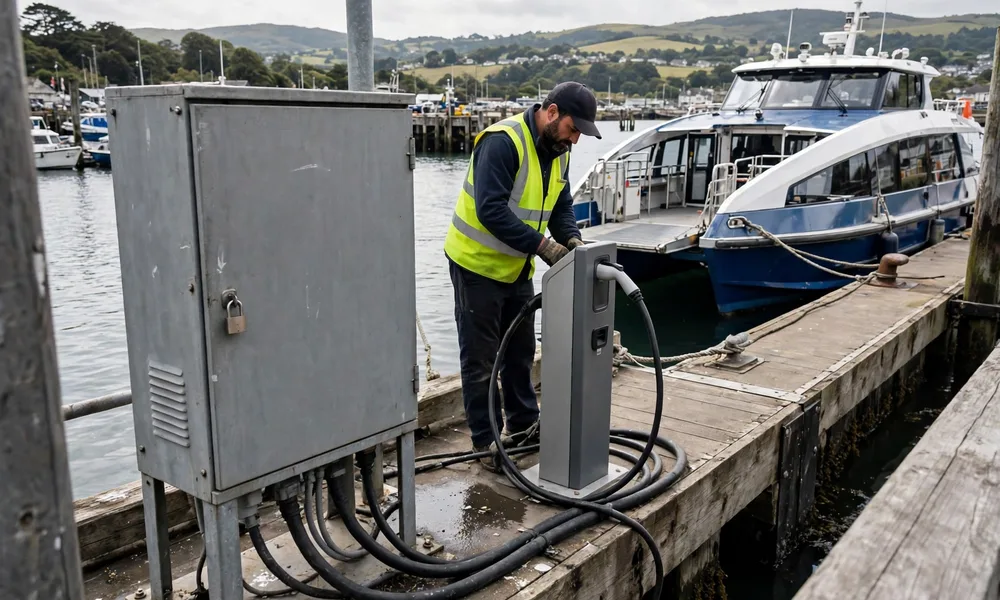
Plug-in DC chargers are the workhorses of the electric ferry world. A crew member connects a heavy cable, the charger delivers direct current at hundreds of kilowatts, and the ferry takes on a meaningful amount of energy in fifteen to thirty minutes. The equipment is proven, the connectors are standardising, and the costs are well understood. The weakness is the human element: handling thick cables in bad weather is slow and tiring, and every minute spent connecting is a minute not charging.

6. Automated cable connection systems
Automated connection keeps the familiar plug-in cable but removes the manual handling. A robotic arm or a guided cable carrier makes the connection as the ferry docks, cutting hook-up time to under a minute. That sounds like a small improvement, but on a route with a crossing every twenty minutes it adds up to hours of extra charging time per day. The systems cost more than a manual plug and need regular maintenance, but operators running intensive services increasingly consider them essential.
5. Shore power with battery buffering
Some ports cannot supply the peak power a fast ferry charger demands, because the local grid connection is too weak. Battery-buffered shore power solves this by charging a stationary battery slowly from the grid all day, then discharging it quickly into the ferry during a short stop. The catch is cost: you are buying two batteries, one on land and one on the boat. But where the grid is the bottleneck, buffering is often the only way to run a fast service at all.
4. High-power DC charging at 1 MW and above
Once charging power passes the megawatt mark, the whole operating model changes. A ferry can take on enough energy for its next crossing in the time it takes passengers to board, which turns charging from a scheduling problem into a non-issue. The engineering is demanding — liquid-cooled cables, careful thermal management, and serious grid connections — but the largest ferry operators are already installing megawatt chargers on their busiest routes.
3. Solar-assisted dockside charging
Solar-assisted charging pairs dockside chargers with solar panels on terminal roofs and canopies, cutting both the electricity bill and the carbon footprint of every crossing. On sunny routes the panels can supply a meaningful share of the energy, and the combination is popular with operators who want the ferry service to be genuinely clean rather than just clean at the tailpipe. What a solar electric ferry is explains how panels, batteries, and motors fit together on a real boat.
2. Megawatt charging with automated connection
Second place goes to the combination the busiest electric ferry routes are converging on: megawatt-scale power delivered through a fully automated connection. The ferry docks, the connection engages itself, and a megawatt or more flows for the few minutes the vessel is at the berth. There is no cable handling, no waiting, and no wasted time. The system is expensive and complex, and it needs a strong grid connection and a ferry designed to accept it, but for high-frequency urban routes it is the only charging approach that keeps pace with the timetable.
1. Integrated smart charging with grid management
The best electric ferry charging is not a single piece of hardware at all. It is a system that manages the whole picture: the ferry’s battery state, the timetable, the price of electricity, the capacity of the local grid, and the weather forecast. Smart charging decides when to charge fast and when to charge gently, when to draw from the grid and when to draw from a buffer battery, and how to spread the load so the port never trips its connection. The most powerful electric ferries for 2027 shows what the hardware at the top end can do when the charging keeps up.
The verdict
For most operators, the right answer is a mix: megawatt-capable automated charging at the busy berth, battery-buffered shore power where the grid is weak, and smart management tying it all together. Ferry charging is becoming faster, more automated, and more intelligent, and the operators who invest in the top of this ranking are the ones whose electric ferries will run on time, every time, for years. The best operators will keep testing, too: every year brings better connectors, better software, and better batteries, and the gap between the top and the bottom of this ranking will keep growing.


