Music on a yacht has to fight wind, water, and engine noise, and it has to do it from speakers that live in salt air, in the sun, and sometimes underwater. A good marine speaker sounds clear at anchor, stays clear at speed, and survives seasons of spray without corroding. A bad one distorts, rattles, and dies quietly over one summer.
This ranking rates the electric yacht speakers you will actually find aboard, from basic cockpit horns to full multi-zone systems. We judged each one on sound quality at volume, durability in salt and sun, how well it fits the space it serves, power efficiency, and how neatly it integrates with the yacht’s controls.
How we ranked them
Sound quality comes first, because a speaker exists to be heard clearly, and on a yacht that means cutting through wind without turning harsh. Durability comes next: a speaker that cannot survive salt, sun, and spray is a decoration, not equipment. Then fit, since a speaker that suits a salon will be lost in a cockpit, and power efficiency, since every watt comes from the batteries. The best electric yacht interiors, ranked covers the spaces these speakers live in, and this ranking is about the sound inside them.
10. The cockpit horn speaker
The cockpit horn speaker is loud, cheap, and almost indestructible, which is why it still appears on workboats and older yachts. It throws sound a long way and cuts through engine noise, and it will survive weather that kills finer speakers. The verdict is blunt: it is the worst speaker on this list to listen to, because the sound is thin, harsh, and tiring, with no bass and a tone that makes music sound like an announcement.
9. The basic flush-mount cockpit speaker
The basic flush-mount speaker sits flat in the cockpit coaming or the hardtop, out of the way and out of the weather, and it is the default speaker on most production yachts. It looks tidy, it is reasonably waterproof, and it is cheap to replace. The trouble is the sound: a small driver in a shallow mounting sounds thin, bass is almost absent, and at speed the wind simply takes the music away.
8. The portable deck speaker
The portable deck speaker is not fitted at all: it is a battery-powered box carried on deck, charged below, and taken ashore at the end of the day. It is the most flexible speaker on this list, and for a small yacht it is often the only speaker aboard. The verdict is mixed: the sound can be surprisingly good for its size, and it goes wherever the party goes, but it needs charging, it is not part of the yacht’s system, and it is one more thing to lose overboard.
7. The in-wall salon speaker
The in-wall salon speaker hides in the panelling of the main cabin, invisible until it plays, and in a quiet anchorage it sounds warm and full. It suits the salon because the enclosed space gives the bass somewhere to work, and the installation looks like it belongs to the yacht rather than being bolted on. The weakness is that it is a fair-weather speaker: it cannot be heard on deck, it struggles against any background noise, and a damp cabin will shorten its life.
6. The marine soundbar
The marine soundbar puts several drivers and a small amplifier into one long, weatherproof bar, usually mounted under a television or along the saloon bulkhead. It is the simplest upgrade on this list: one unit, one cable, and a large improvement over the television’s own speakers. It sounds clear for films and music, and it takes up no space. The best electric yacht kitchens, ranked shows how much of yacht life happens in one shared space, and the soundbar is built for exactly that kind of room.

5. The waterproof tower speaker
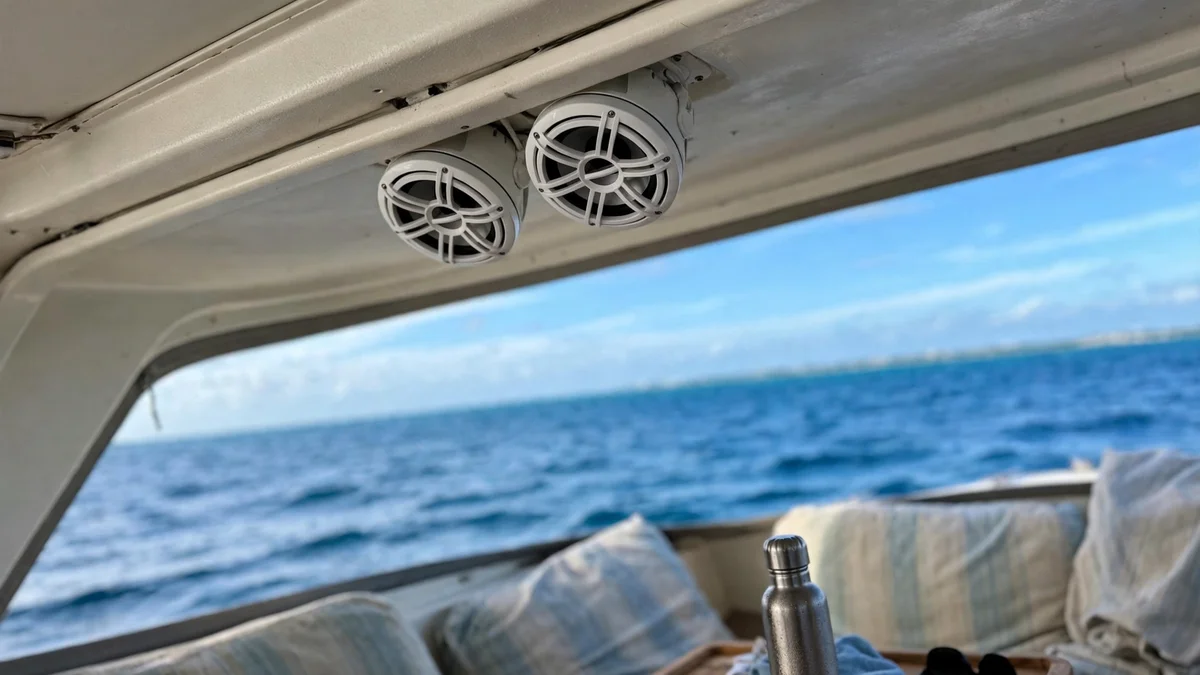
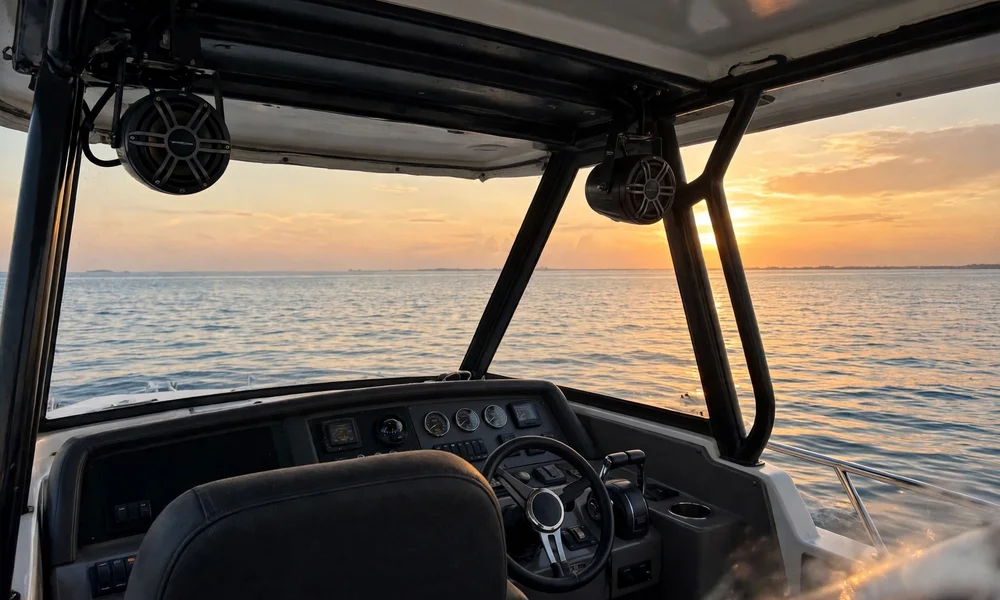
The tower speaker is the speaker of the flybridge and the sports yacht: a sealed canister on a wakeboard tower or a hardtop frame, aimed at the cockpit and the water behind. It is built to be hosed down, it plays loud without distorting, and it puts the sound where people actually sit when the yacht is moving. The verdict is that it is the best single-purpose speaker here, and its only weakness is that it is exactly that: a loud, outdoor speaker that is too much for a quiet evening and too exposed for a salon.
4. The marine subwoofer
The marine subwoofer does one job, which is bass, and it does it so well that it transforms every other speaker on the yacht. Add a proper subwoofer and the flush-mount speakers that sounded thin suddenly sound full, because they no longer have to pretend to make bass. A good marine subwoofer is sealed against moisture, mounted low where its weight helps stability, and tuned to the cabin rather than the street.
3. The premium tower speaker pair
The premium tower pair takes the tower speaker and finishes it properly: larger drivers, a dedicated amplifier channel each, and a horn design that throws clear sound a long way without harshness. On a yacht at speed, these are the speakers that still sound like music rather than noise, and at anchor they fill the cockpit and the swim platform with ease. The trade-off is cost and power: they are expensive, and they draw real current from the batteries. The best electric yacht batteries, ranked covers the power these speakers depend on, and a big tower system needs a big bank behind it. It takes third place on sound alone.
2. The multi-zone system
The multi-zone system is not one speaker but a design: separate zones for the salon, the cockpit, the flybridge, and the cabins, each with its own volume, its own source, and its own speakers. The owner can play jazz in the salon while the crew hears nothing, or the same playlist everywhere at once. It is the most practical way to sound good across a whole yacht, and it is what most good new builds now fit as standard. It misses first place only because its quality depends entirely on the speakers in each zone, and a multi-zone system with cheap speakers is still a cheap system.
1. The full distributed audio system
The full distributed system takes the multi-zone idea and completes it: premium speakers in every zone, a dedicated amplifier for each, a subwoofer where the bass needs help, and a single control that runs it all from a phone or a panel at the helm. Every space sounds right, because every space was designed for sound rather than fitted afterwards, and the system is efficient enough to run all evening on the yacht’s batteries. It is expensive, and it needs to be designed with the yacht rather than added later, but it is the only speaker setup on this list that sounds excellent everywhere aboard. That is why it wins.
The pattern in this ranking is that the best yacht sound is designed, not bought. A single expensive speaker in the wrong place will always lose to a modest system that puts the right speaker in every space, with the power and the protection to keep it playing.