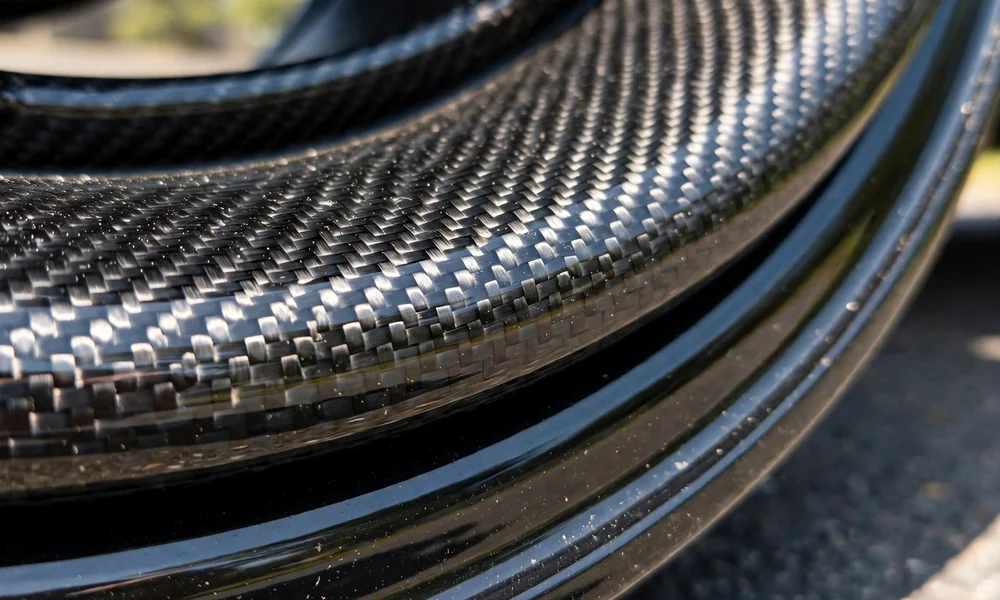
There is a moment, watching a hypercar pull away from a standstill, when the wheels seem to do something impossible. The car launches without a hint of hesitation, the suspension barely moves over the bumps, and the steering feels as if it is wired directly to the driver’s hands. Part of that magic is the engine. But a surprising amount of it is the wheels — or rather, what the wheels are not made of. They are not metal at all. They are carbon fibre.
A hypercar carbon wheel is a single piece of woven carbon, cured in an oven until it is stiffer than steel and lighter than aluminium. It has to carry a car that weighs over a tonne, survive potholes at 200 miles an hour, and shed the heat of brakes that glow. Here is how it does all of that, step by step.

How Hypercar Carbon Wheels Work
Step 1: The spokes carry the load
Everything starts with the spokes. When the car sits still, the weight of the car pushes down through the hub and out along the spokes to the rim. When it corners, the load swings sideways; when it brakes, it twists. The spokes are laid up from layers of carbon fibre cloth, each layer angled differently, so the wheel is strong in every direction at once. Carbon fibre is stiff along the thread and weak across it, so the lay-up is the engineering: fibres running along a spoke carry the load, while fibres crossing it hold the shape. Get the angles right and a wheel that weighs less than a bag of sugar can carry a quarter of a hypercar.
Step 2: The barrel holds the tyre
Wrapped around the spokes is the barrel, the rim that the tyre sits on. The barrel is a continuous ring of carbon, and its shape matters as much as its strength. Its outer edge forms the bead seat, the ledge the tyre seals against to hold its air, and its inner profile is sculpted to clear the brake disc and calliper with millimetres to spare. Because the barrel is one piece with the spokes, there are no bolts or welds to work loose — the whole wheel flexes as a single structure. The way that single piece is built is covered in how hypercar carbon wheels are made, from the laying of the cloth to the curing that locks it into shape.
Step 3: The centre lock holds it on
A hypercar wheel is not held on by five small nuts. It uses a single centre-lock nut, a large threaded fastener that screws the wheel onto the hub with one huge, precise torque. The nut is tightened to hundreds of newton-metres, and it is designed so that the rotation of the wheel itself keeps it tight rather than loosening it. A centre lock also lets a pit crew change a wheel in seconds, and it removes the bending loads that lug nuts put into a wheel. The trade-off is that the hub, the nut and the wheel must be machined to tolerances a human hair would fail, because any slack at the centre becomes a wobble at the rim.
Step 4: The wheel sheds brake heat
Behind every hypercar wheel sits a brake disc that can reach temperatures high enough to glow. Some of that heat soaks into the wheel, and carbon fibre handles it better than most people expect: it does not soften the way aluminium does, and it does not conduct heat quickly into the tyre. The spokes are shaped to act as fan blades, pulling cooling air through the wheel as it spins, and the gap between the disc and the rim is sized to let that air flow. The brake system itself is a story of its own, told in how carbon-ceramic brakes work, where the disc turns speed into heat and then gets rid of it lap after lap.
Step 5: Less weight changes everything
The real reason hypercars use carbon wheels is not strength — it is weight, and where that weight sits. A wheel is unsprung mass, weight the suspension must control without the help of the springs, so every kilogram saved at the wheel makes the suspension’s job easier and the tyre’s grip more consistent. A wheel is also spinning mass, so a lighter wheel takes less energy to speed up and slow down, and it resists changes of direction less. The result is a car that accelerates harder, brakes shorter, and turns in more crisply. A set of four carbon wheels can save 20 kilograms or more over aluminium — and on a hypercar, 20 kilograms at the wheels is worth far more than 20 kilograms anywhere else.
Step 6: Damage is inspected, not ignored
Carbon fibre has one weakness: it does not dent. Aluminium bends when it is hit, and a bent wheel is obvious. Carbon can look perfect on the outside while hiding a crack inside, so hypercar wheels are inspected with ultrasound or X-ray after any serious impact, and any wheel that fails is scrapped, never repaired. Owners are told to treat kerb strikes seriously, however small they look. The precise figures for these wheels are listed in the hypercar carbon wheels specifications explained, from their weight and size to the loads they are rated to carry.

Hypercar Carbon Wheels Specifications
| Specification | Typical figure |
|---|---|
| Construction | One-piece carbon fibre |
| Weight per wheel | Around 6–8 kg (19–20 inch) |
| Weight saving vs aluminium | Around 40–50% per wheel |
| Fixing | Single centre lock |
| Typical size | 19 inch front, 20 inch rear |
| Max operating temperature | Well above brake heat soak |
How Much Do Hypercar Carbon Wheels Cost?
A set of four carbon fibre wheels for a hypercar typically costs an estimated $15,000 to $40,000, depending on the maker, the size and whether they are a factory option or an aftermarket set — these are estimates, not list prices. A single replacement wheel can cost an estimated $4,000 to $10,000. That is roughly ten times the price of a good aluminium wheel, and it buys the lightest, stiffest wheels money can make — plus the knowledge that a kerb strike means a bill, not a repair.
A Rare Fact About Hypercar Carbon Wheels
Here is something few people realise: the first carbon fibre wheels were not made for road cars at all. They were developed for racing, where a wheel that saved a few kilograms was worth almost any price, and the technology only reached road hypercars after years of proving it could survive potholes, kerbs and everyday heat. Even today, a carbon wheel is checked far more carefully than a metal one, because carbon’s strength is absolute until the moment it is not — there is no bending, no warning, only a perfect wheel or a broken one.
So the next time a hypercar seems to change direction by thought alone, remember the quiet work of its wheels: spokes carrying a tonne, a barrel holding the tyre, a single nut holding it all on, brake heat flowing away, and twenty kilograms of spinning weight that simply is not there.


