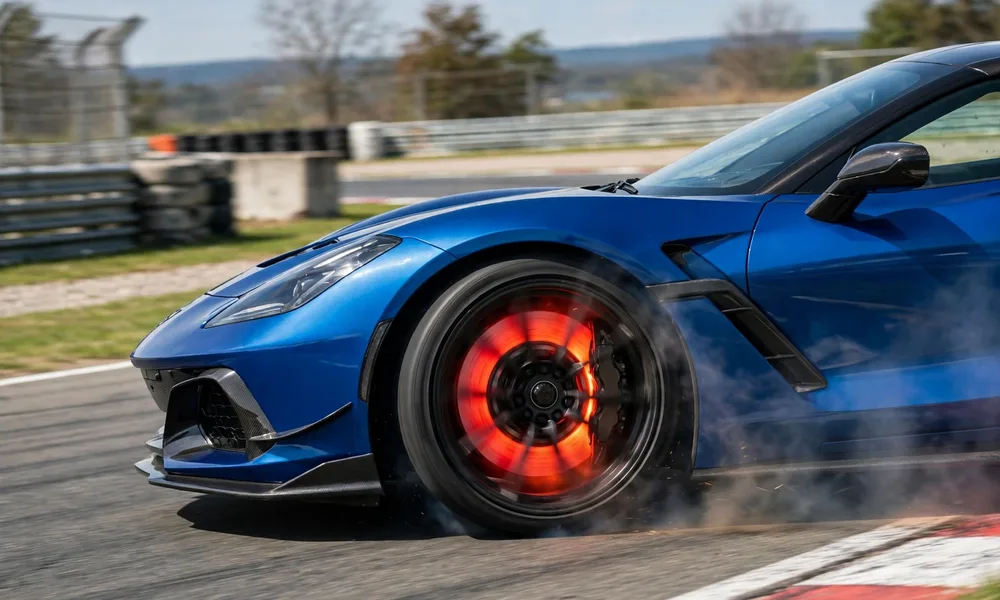
Imagine braking from motorway speed to a standstill, again and again, lap after lap, while the brakes glow orange and the air around them shimmers with heat. Carbon-ceramic brakes do not fade or give up. They are the brakes fitted to the fastest road cars on the planet, and they work by turning the violence of braking into something a ceramic can survive — a material that was born in rocket nozzles and space shuttle heat shields, and now lives behind the wheels of cars you can buy from a showroom.
A carbon-ceramic brake is not one material but a system of materials, each chosen for a different kind of punishment. The disc must survive temperatures above 1,000 degrees Celsius without cracking. The pads must grip that disc without tearing it apart. The caliper must squeeze with tonnes of force without flexing, and the fluid behind it must not boil. The engineering behind the system is a story of fibres, ceramics and furnaces — and of a material so expensive that for years only racing teams could afford it.

The Materials Behind Carbon-Ceramic Brakes
At the heart of the system is the disc: a carbon-fibre-reinforced silicon carbide composite, known as C/SiC. Its skeleton is woven carbon fibre, embedded in a matrix of silicon carbide — a ceramic so hard it is used as an abrasive. The carbon gives toughness and resistance to thermal shock; the ceramic gives hardness and wear resistance. Around the disc sit the pads, made from a sintered compound of metals and ceramics, the caliper, usually a forged aluminium monobloc, and the steel-braided brake lines that carry fluid that must never boil.
Step 1: Choosing a material that thrives on heat
Most brake materials get worse as they get hotter. Steel discs warp, and ordinary pads fade as their resins break down. Carbon-ceramic is chosen because it does the opposite: its friction stays stable at temperatures that would destroy steel, and it barely expands when hot, so the disc keeps its shape. Engineers accept the compromise because a brake that works best at racing temperature is exactly what a fast car needs.
Step 2: Weaving the carbon fibre preform
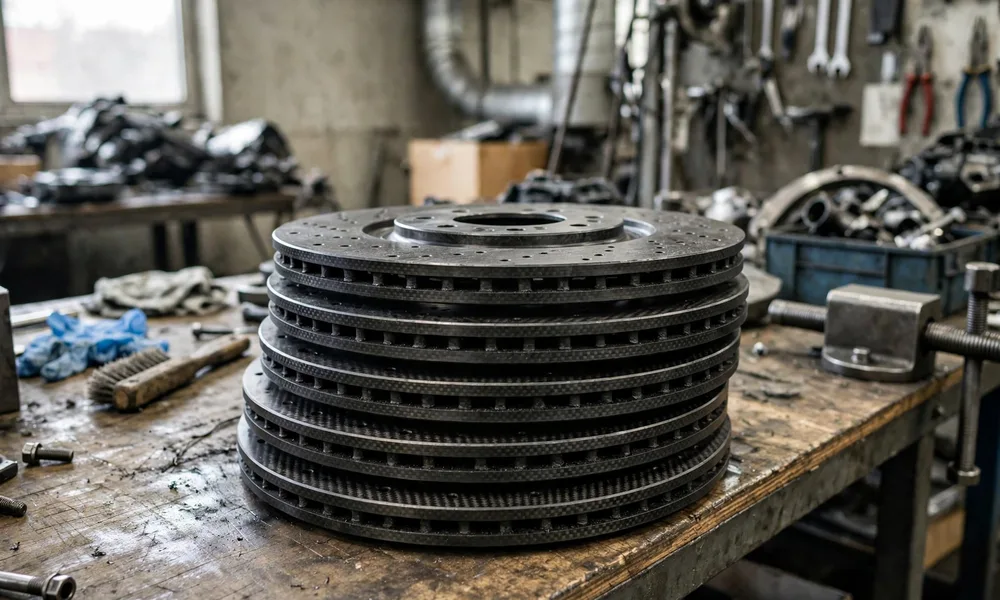
The disc begins as carbon fibre. Long tows of filament are woven into a disc-shaped preform, the fibres arranged in the directions the loads will run — mostly around the circumference, where the spinning forces are greatest. Layers are stacked and needled together so the preform holds its shape, like a thick, stiff pancake of black cloth. The quality of this layup decides everything that follows: a wrinkle or gap becomes a weak spot that heat and stress will find, and the work is slow and skilled — one reason a single disc costs as much as a used family car.
Step 3: Baking the preform into carbon-carbon
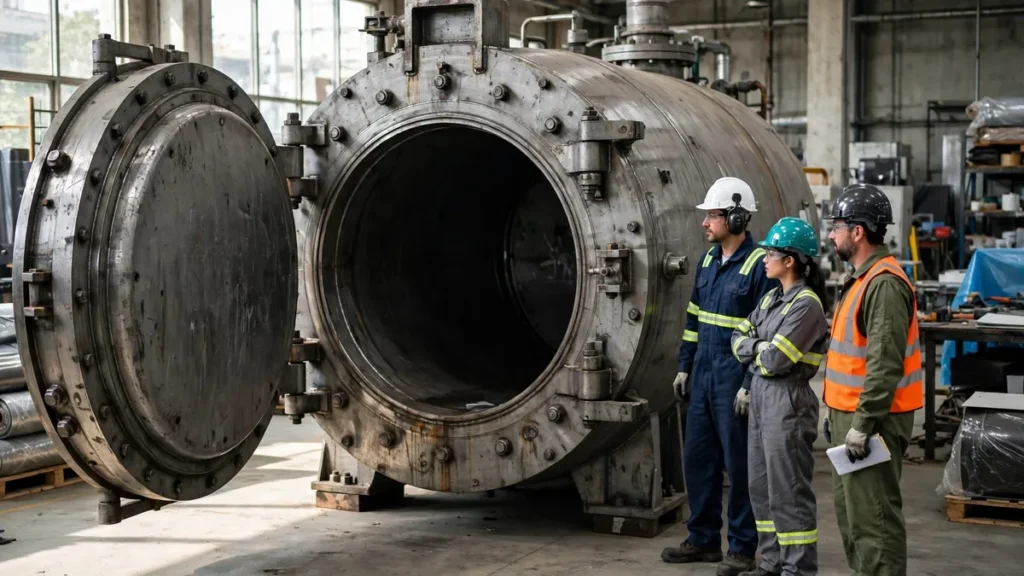
The preform is heated to around 1,000 degrees Celsius in an oxygen-free furnace, where the resin binding the fibres chars into pure carbon. What comes out is carbon-carbon: light and heat-resistant, but porous and fragile as charcoal. It is then densified — soaked in resin or exposed to carbon-rich gas and baked again, several times — until the pores fill with carbon and the disc gains strength.
Step 4: Silicon infiltration — turning carbon into ceramic
The decisive step is siliconisation: the carbon-carbon disc is packed with silicon powder and heated to around 1,700 degrees Celsius, where the silicon melts, wicks into the pores and reacts with the carbon to form silicon carbide. In that moment the disc becomes carbon-ceramic: the soft, porous skeleton gains a hard ceramic matrix that resists wear and grips the pads. The process is unforgiving — too little silicon leaves soft spots, too much leaves brittle silicon that can crack. The carbon-ceramic brakes system depends entirely on getting this one furnace run right.
Step 5: The pads that grip the ceramic
A carbon-ceramic disc needs a special pad. Ordinary pads would either tear the ceramic surface apart or glaze over and stop working. Carbon-ceramic pads are sintered compounds — metal and ceramic powders pressed and heated until they fuse — designed to transfer a thin, even layer of pad material onto the disc. That transfer layer is what the pads actually rub against, and it is why bedding in a new set of brakes matters so much: a badly bedded disc will judder for its whole life.
Step 6: Calipers, bells and the floating mount
The disc is bolted to its bell, usually machined from aluminium, through a floating mount — bobbins that let the disc expand as it heats without being constrained by the cooler bell. A disc can grow by more than a millimetre at full temperature; rigidly bolted, it would buckle or crack. The caliper that squeezes the disc is usually a forged aluminium monobloc, stiff enough not to flex under tonnes of hydraulic force, and the brake lines are steel-braided to stop them swelling under pressure. The hypercar brake disc assembly is only as good as this hardware, and each disc, bell and pad set is recorded as a matched set.
Step 7: Bedding in and proving the system
Before a carbon-ceramic brake ever sees a racetrack it is bedded in: controlled stops that build the transfer layer on the disc surface. The finished assembly is tested on a dynamometer, spun up and braked again and again while temperatures and torque are logged, and only when the friction curve is stable and thermal imaging shows no cracks is it signed off. The same discipline that keeps a hypercar brake disc alive at the limit keeps the whole system alive too — because a brake that fails at speed has no second chance.
Carbon-Ceramic Brakes at a Glance
| Specification | Detail |
|---|---|
| Disc material | Carbon-fibre-reinforced silicon carbide (C/SiC) |
| Typical disc diameter | Around 390–410 mm front, 360–390 mm rear |
| Weight vs steel | Roughly half the weight of a steel disc |
| Peak operating temperature | Above 1,000°C at the friction surface |
| Siliconisation temperature | Around 1,700°C |
| Pad material | Sintered metal-ceramic compound |
| Service life | Discs can last the life of the car on the road |
What Does It Cost?
A single carbon-ceramic brake disc typically costs several thousand dollars (estimate), and a full set of four with pads can run well into five figures (estimate) — which is why the option alone can cost as much as a small car. The price reflects weeks of furnace time, hand layup and precision machining, not the raw materials. Replacement is rare: under road use a disc can last the life of the car, and it is usually the pads that wear out, at a far more modest price (estimate) per axle.
A Rare Fact
Carbon-ceramic brakes have a quirk their makers rarely advertise: cold, they can squeal like a train braking into a station. The noise comes from the pads vibrating against the hard ceramic surface before the disc reaches working temperature, and owners of some high-performance cars are warned about it at handover. The same brakes that stop silently and fade-free from 200 mph can embarrass their driver at the first traffic lights on a cold morning — materials engineered for extremes rarely behave politely in ordinary life.