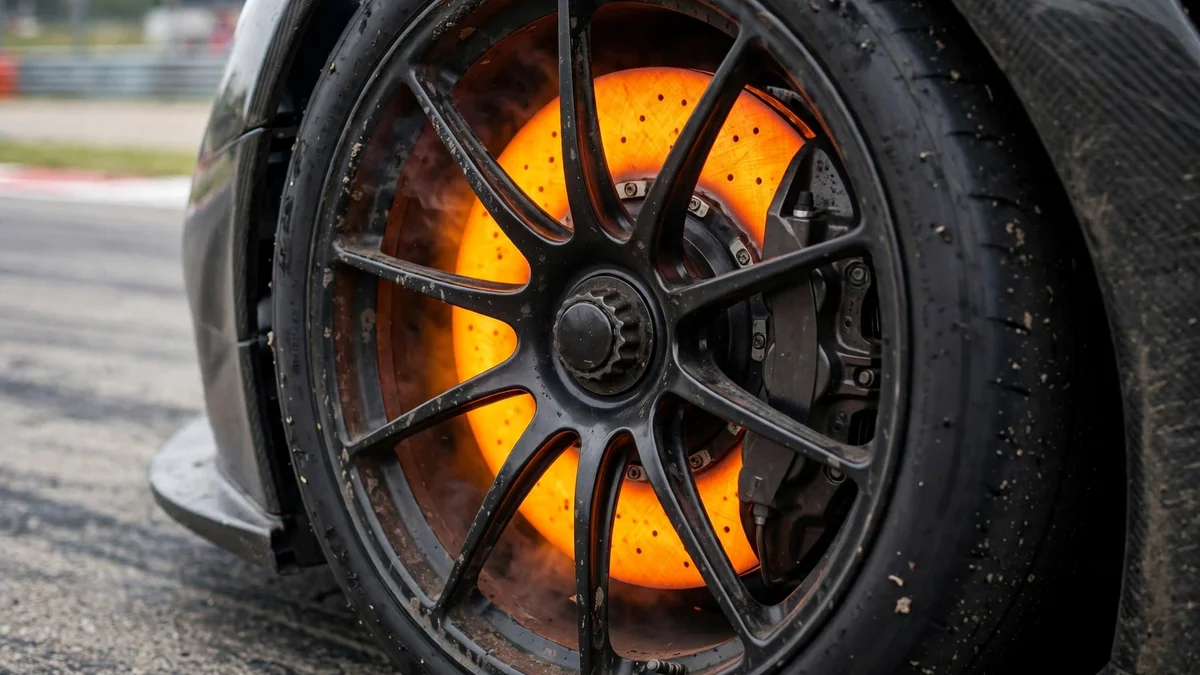
At the end of the longest straight, the speedometer reads well over two hundred miles an hour. The braking point rushes up, the driver stamps the pedal, and the car sheds a hundred miles an hour in a few seconds. There is no squeal, no shudder, no fade. Behind the wheel, hidden from view, a disc the size of a dinner plate is glowing orange-hot, turning all that speed into heat and throwing it away into the air. By the next corner it is already cool enough to do it all again. The driver never sees it happen. The disc does its work in the dark, lap after lap.
A hypercar brake disc is not a scaled-up version of the disc on a family car. It has to stop a car weighing well over a tonne from speeds that would get an ordinary car impounded, and it has to do it again and again without losing its bite. This is how the disc turns speed into heat — and heat into nothing.
How a Hypercar Brake Disc Works
Step 1: The pedal asks for stopping power
It starts with the driver’s foot. Pressing the brake pedal pushes fluid through the brake lines, and the harder the pedal is pressed, the higher the pressure in the system. In a hypercar the pedal feel is tuned to be firm and short, with very little travel, because at racing speeds the driver needs to feel exactly how much braking force is being applied. The request reaches the callipers in a fraction of a second, and the disc’s work begins.
Step 2: The pads clamp the disc
Inside each wheel, a calliper straddles the brake disc like a clamp. When hydraulic pressure arrives, pistons inside the calliper squeeze the brake pads against both faces of the spinning disc. The clamping force is enormous — several tonnes of pressure across the pad area — and the friction between pad and disc is what begins to slow the car.

Step 3: Friction turns speed into heat
This is the heart of the whole process, and it is pure physics. A car at speed carries kinetic energy, and the only way to get rid of it is to convert it into another form. The brake disc converts it into heat. The disc glows, the pads smoke slightly, and the air around the wheel shimmers.
Step 4: The carbon-ceramic material takes the punishment
Ordinary cast iron could not survive that cycle. It expands, warps, cracks and loses its friction when it gets too hot, which is the fade every driver dreads. A carbon-ceramic disc is different. Its friction ring is made from carbon fibres embedded in a silicon carbide matrix, a material that is enormously hard, very light and stable at temperatures beyond a thousand degrees. The ring is bolted to a lightweight aluminium centre bell, which lets the two parts expand at different rates without stressing each other. How that material is made is a story of its own, told in the guide to how carbon-ceramic brakes are made.
Step 5: Ventilation throws the heat away
Absorbing heat is only half the job; the disc must also shed it before the next corner. Hypercar discs are ventilated, with dozens of curved vanes cast or machined between their two friction faces. As the disc spins, those vanes act like the blades of a centrifugal fan, pulling cool air in from the centre and flinging hot air out at the rim. The engineering of the disc’s materials — why carbon-ceramic behaves the way it does — is covered in the guide to hypercar brake disc materials engineering.

Step 6: The electronics balance the braking
While the discs are doing the physical work, the car’s electronics are managing it. Stability control can brake individual wheels to keep the car pointing where the driver wants it. In hybrid hypercars, the system also decides how much braking should come from the discs and how much from the electric motors recovering energy, blending the two so smoothly that the driver feels only one pedal. The disc itself is dumb metal and ceramic; the intelligence sits around it, making sure its grip is used to the full.
Step 7: Cooling down between corners
When the driver lifts off the brake, the pads retract a fraction of a millimetre and the disc spins free, still hot but cooling fast in the slipstream. The suspension and chassis have to cope with the same repeated punishment, and the way they do is explained in the guide to how a hypercar suspension works.
Hypercar Brake Disc at a Glance
| Specification | Detail |
|---|---|
| Material | Carbon fibre in a silicon carbide ceramic matrix, aluminium centre bell |
| Typical diameter | 390 to 440 mm at the front, slightly smaller at the rear |
| Typical weight | Around 6 to 8 kg per disc, roughly half a cast-iron equivalent |
| Peak surface temperature | Over 1,000 degrees Celsius under hard track braking |
| Cooling | Internal ventilation vanes plus ducted airflow from the front of the car |
| Pad material | Sintered metal-ceramic compound, built for very high temperatures |
| Service life | Often the life of the car on the road; far longer than iron discs |
| Main uses | Flagship hypercars, track-focused supercars, top-end sports cars |
What Does It Cost?
Carbon-ceramic brakes are one of the most expensive options on any hypercar. As rough estimates, a full set of four carbon-ceramic discs for a flagship hypercar typically costs $15,000 to $30,000 for the discs alone, and a single front disc can be estimated at $4,000 to $8,000. Brake pads are cheaper but still dear, typically estimated at $1,000 to $2,500 per axle set. The saving grace is longevity: on road use a carbon-ceramic disc can last the life of the car, while an iron disc would need replacing several times. Those figures are estimates, not quotes — the real number depends on the model, the supplier and whether the work is done by a main dealer or a specialist.
A Rare Fact
A carbon-ceramic brake disc is so hard that it can only be machined with diamond tooling. Ordinary cutting tools simply wear away against the silicon carbide surface, and the disc is finished by grinding rather than cutting. Even more surprising, the disc actually works better when it is hot: its friction coefficient rises as the temperature climbs, which is the opposite of an iron disc, and it is the reason racing drivers warm their brakes with a few firm applications before they start pushing hard.
The hypercar brake disc is a quiet masterpiece of heat management. It takes the energy of a car travelling at twice motorway speed and throws it away in seconds, lap after lap, without complaint. The driver feels only the pedal and the deceleration. Everything else — the glowing ring, the rushing air, the thousand-degree surface cooling in the slipstream — happens out of sight, behind the wheel, exactly where it belongs.


