Carbon fibre and titanium are the two materials that define a modern hypercar. One is a woven composite, black, light and endlessly shapeable. The other is a metal, silver-grey, enormously strong and resistant to heat. Both are expensive, both are difficult to work with, and both appear in the most extreme road cars ever built — often in the same car, doing different jobs. The interesting question is not which material is better in general. It is which one is better for each specific job.
Carbon fibre is made of thin strands of carbon, woven into fabric, layered in a mould, and cured with resin until it becomes a rigid solid. Its strength comes from the fibres, and engineers control it by choosing the direction of each layer. Titanium is a metal element, light for a metal and exceptionally strong, with a natural resistance to corrosion and to high temperatures that few other metals can match.
This comparison looks at the two materials where they actually compete: weight and strength, stiffness, heat, cost and manufacturing, repairability, and where each one wins in a real hypercar.

Weight and strength
Carbon fibre’s headline advantage is its strength-to-weight ratio. For its weight, it is stronger than steel, and a carbon fibre structure can be far lighter than a metal one doing the same job. That is why the monocoque — the survival cell at the heart of a hypercar — is almost always carbon fibre today. Replacing metal with carbon fibre in the chassis saves weight where it matters most, low in the car, and that weight saving improves acceleration, braking and handling all at once. Our guide to the best materials for a hypercar chassis shows how carbon fibre took over the job that steel and aluminium used to do.
Titanium is also light for a metal, roughly half the weight of steel for similar strength, but it cannot match carbon fibre’s weight advantage. Where titanium wins is in absolute strength in a small space. A titanium bolt, bracket or suspension part can be tiny and still carry enormous loads, which matters in places where there is no room for a bulky composite part. It is the material of choice for fasteners and small, highly loaded components throughout a hypercar.
Stiffness and design freedom
Stiffness decides how a car feels. A stiff chassis lets the suspension do its work instead of the body flexing, which makes the handling sharper and more predictable. Carbon fibre is exceptionally stiff for its weight, and its stiffness can be tuned: engineers add layers in the directions that carry the most load, and leave other directions lighter. That directional control is something no metal can offer.
Carbon fibre also offers design freedom. It can be moulded into complex, hollow, curved shapes that would be impossible to machine or cast in metal — air channels, aerodynamic wings, and bodywork with curves that change in every direction. The weave itself matters, and our guide to carbon fibre weave specs explains how the direction of the fibres decides where a part is strong and where it is not.
Titanium is stiff and strong, but it is a metal, and it behaves like one. It can be machined, forged and welded, but it cannot be moulded into the hollow, organic shapes that carbon fibre allows, and it is notoriously difficult to machine, which limits how complex a titanium part can be.
Heat and durability
Heat is where titanium fights back. Carbon fibre composites are limited by their resin, which softens at high temperatures, and by the fibres themselves, which can be damaged by sustained heat. That is why carbon fibre is kept away from the hottest parts of a car, or protected with heat shielding, even though it appears throughout the body and chassis.
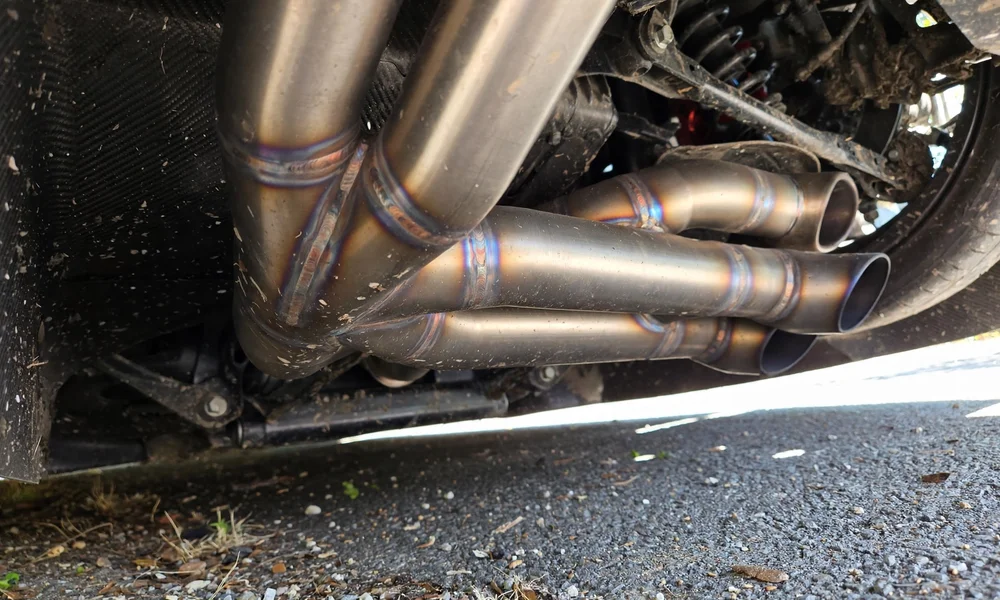
Titanium thrives in heat. It keeps its strength at temperatures that would destroy most metals, let alone composites, which is why it dominates the exhaust system of a hypercar, where gases leave the engine at extreme temperatures. It also resists corrosion, so it survives in places where steel would rust and aluminium would fatigue. Our guide to how titanium forging works explains how the metal is shaped under enormous pressure to make parts that survive those conditions.
Cost and manufacturing
Both materials are expensive, but for different reasons. Carbon fibre is expensive because it is labour-intensive: layers of fabric must be laid up by hand or by machine, placed in a mould, and cured in an autoclave under heat and pressure for hours. A single monocoque can take days to produce, and any flaw means starting again. The tooling is costly, the process is slow, and the skill required is rare. A replacement carbon fibre monocoque is one of the most expensive single parts on any road car.
Titanium is expensive because the raw material is costly to extract and refine, and because it is so hard to work with. It wears out cutting tools quickly, it must be machined slowly, and welding it requires an oxygen-free environment, because hot titanium reacts with air. Small titanium parts can cost many times more than the steel equivalent, which is why titanium is used sparingly, only where its properties justify the price.
Damage and repair
This is carbon fibre’s biggest weakness. A carbon fibre part that is hit hard can crack or delaminate — the layers separating inside — and the damage is often invisible from the outside. A cracked monocoque or wheel cannot simply be welded or hammered back into shape. Repair is possible, but it is specialist work, and in many cases the part must be replaced entirely.
Titanium is far more forgiving. It dents and bends rather than shattering, and it can often be repaired or reworked. In a crash structure or a part that might take a knock, that toughness matters, and it is one reason titanium still appears in places where carbon fibre would be too fragile.
Head-to-head
| Carbon fibre | Titanium | |
|---|---|---|
| Strength for weight | Outstanding, best available | Very good, but heavier |
| Stiffness | Excellent, and tuneable by direction | Excellent, but fixed |
| Heat resistance | Limited by the resin | Outstanding |
| Design freedom | Moulded into complex shapes | Machined and forged only |
| Cost | Very high, labour-intensive | Very high, hard to machine |
| Damage tolerance | Cracks, hard to repair | Bends, can be reworked |
| Best use | Chassis, bodywork, aero | Exhaust, fasteners, small parts |
The verdict
There is no overall winner, because the two materials do not really compete for the same jobs. Carbon fibre wins wherever weight and shape matter most: the chassis, the bodywork, the aerodynamic parts and the wheels. It is the material that made the modern hypercar possible, and no metal can replace it there.
Titanium wins wherever heat, toughness and tiny, highly loaded parts matter: the exhaust, the fasteners, and the components that must survive conditions no composite can handle. The best hypercars use both, each where it is strongest, and the engineering skill lies in knowing which one to choose for each part. That partnership, not a contest, is the real story.


