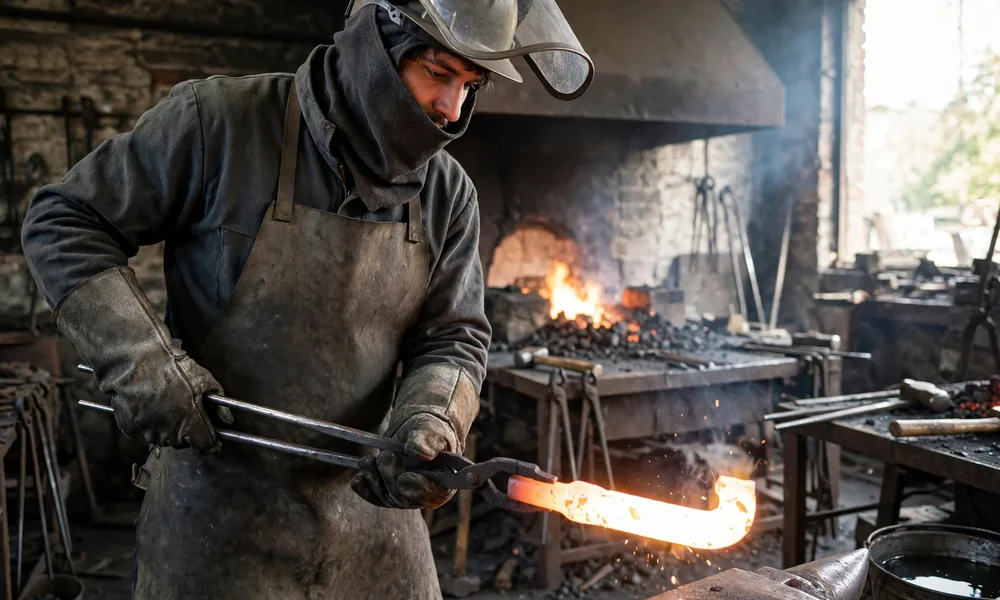
Inside a forge, the air shimmers. A billet of titanium, glowing orange-white at over a thousand degrees, sits between the dies of a press the size of a house. The press comes down, slowly and with impossible force, and the metal, which at room temperature is stubborn and springy, flows like warm clay. In a few seconds the billet is flatter, wider, and closer to its final shape. It will be heated and pressed again, and again, until it becomes a disc, a ring, or a fan blade for a jet engine.
Titanium forging is one of the hardest metalworking jobs in engineering, and one of the most important. Forged titanium is stronger, tougher, and more reliable than cast or machined titanium, which is why it holds together jet engines, submarines, spacecraft, and racing cars. Yet titanium is also a difficult metal to forge: it cools quickly, it reacts with air when hot, it sticks to the dies, and it demands huge presses and exact temperatures. Here is how titanium forging works, from the raw billet to the finished part.

How Titanium Forging Works
Step 1: The billet is cut and inspected
Everything starts with the billet, a round or square bar of titanium alloy, usually Ti-6Al-4V, the workhorse grade used in aerospace. The billet is cut to length, weighed, and inspected. Its chemistry is checked, its surface is examined for cracks, and its history is recorded, because a forged part for a jet engine must be traceable back to the exact melt it came from.
Step 2: The billet is heated in a controlled atmosphere
Titanium must be hot to forge, typically between 900 and 1,000 degrees Celsius, but hot titanium reacts with oxygen and nitrogen in the air, forming a hard, brittle skin called alpha case. To prevent this, the billet is heated in a furnace with a controlled atmosphere, or coated with a protective glassy layer, and the heating time is kept as short as possible. The billet is soaked at temperature until it is even all the way through, then moved to the press as fast as possible, because it begins cooling the moment it leaves the furnace.
Step 3: The press shapes the metal
The heart of the process is the press. Hydraulic presses for titanium forging range from a few thousand tonnes to the largest in the world, over 70,000 tonnes, and they close slowly, squeezing the metal rather than striking it. The billet sits between two dies, steel blocks machined to the rough shape of the part, and the press forces the glowing metal to fill the cavity. A single press stroke rarely finishes the part. The billet is pressed, reheated, turned, and pressed again, sometimes a dozen times, each stroke moving the metal a little closer to its shape.
The patience of this step is what separates forging from casting, and the earlier stages of the craft are covered in how titanium forging is made, which follows a billet from the furnace to the finished forging.
Step 4: The grain is refined by the work itself
Here is the secret of forging: the hammering does more than change the shape, it changes the metal itself. As the titanium is squeezed, its crystal grains are broken up and reformed into a finer, more uniform structure, and the flow lines of the metal follow the shape of the part. The result is a part that is stronger in exactly the directions it will be loaded, with no weak planes for a crack to follow.
Aluminium benefits from the same effect on a gentler scale, as shown in how aluminium forging works, which explains the process for the lighter metal used in wheels, pistons, and aircraft parts.
Step 5: The forging is trimmed and cooled
When the part has reached its shape, the excess metal that squeezed out between the dies, the flash, is trimmed off while the forging is still hot. The part is then cooled under control, sometimes in air, sometimes in a furnace, because the cooling rate sets the final microstructure. After cooling, the surface is cleaned. The brittle alpha-case skin is removed by machining, grinding, or chemical milling, and the part is inspected. Dye penetrant testing reveals surface cracks, ultrasound looks inside, and X-rays check the thickest sections.
Step 6: Heat treatment sets the final properties
Forging alone does not finish the metal. The part goes through heat treatment, a cycle of heating, holding, and cooling that sets its strength, toughness, and resistance to fatigue. For titanium, this often means heating to just below the temperature where its crystal structure changes, holding it there, and then cooling at a chosen rate, followed by ageing at a lower temperature to harden it.
Step 7: Machining finishes the part
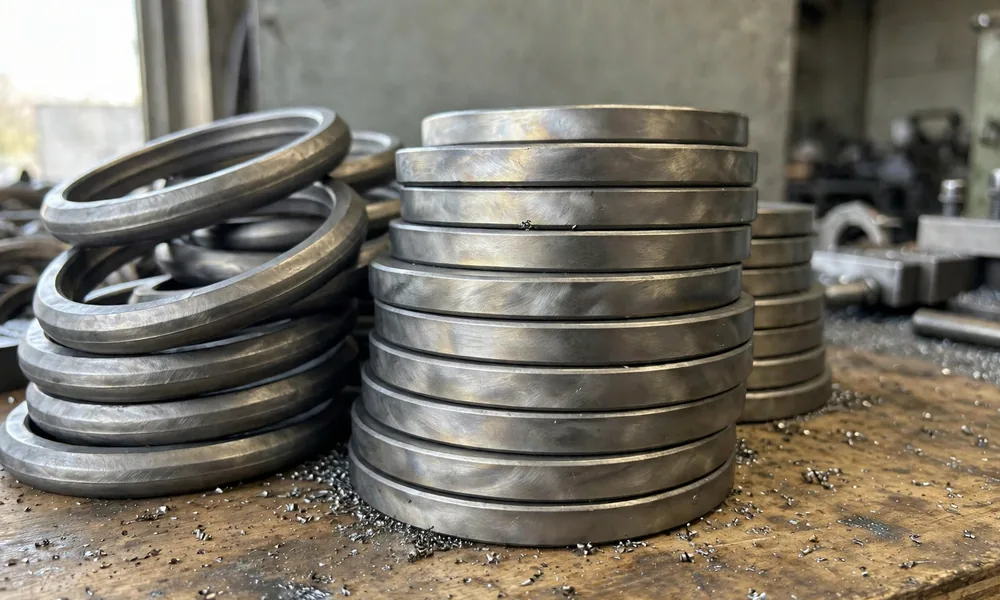
A forging is a near-net shape, close to the final part but not exact. The last step is machining, where computer-controlled mills and lathes cut the forging to its final dimensions, sometimes removing half its weight. Titanium is hard to machine: it work-hardens, it dulls tools, and it can catch fire in fine chips, so the cutting is slow, flooded with coolant, and done by specialists.
The metal’s journey does not stop at the forge, and the thin titanium shell on a modern phone shows how the same alloy is used at the other end of the scale, as explained in how a smartphone titanium frame works.
Titanium Forging Specifications
| Feature | Typical figure |
|---|---|
| Main alloy | Ti-6Al-4V, 6% aluminium, 4% vanadium |
| Forging temperature | 900–1,000 °C |
| Press force | 1,000–75,000 tonnes |
| Part weight | From grams to several tonnes |
| Strength gain | About 10–20% over cast titanium |
| Main uses | Jet engines, airframes, submarines, medical implants |
| Inspection | Ultrasound, dye penetrant, X-ray |
| Surface finish | Alpha case removed by machining or milling |
What Titanium Forging Costs
Forged titanium is one of the most expensive forms of metal, and its price comes from the material, the energy, and the press time. As an estimate, a small forged titanium part costs roughly $100 to $500, while a large jet engine disc can cost $20,000 to $100,000 or more, with the raw titanium billet often accounting for half the price.
A Rare Fact
The largest forging press in the world can press with a force of 75,000 tonnes, the weight of a small cruise ship, and it was built to forge titanium parts for aircraft and spacecraft. When it closes on a glowing billet, the whole building shakes, and the press is so big that its moving parts are lubricated with a river of oil and its dies are changed by crane.
Titanium forging is a craft of extremes: extreme heat, extreme force, and extreme care. The metal fights back at every step, cooling too fast, reacting with the air, and wearing out the tools that shape it. But the reward is a part that is lighter than steel, stronger than aluminium, and immune to rust, a part that can be trusted to spin inside a jet engine or dive beneath the sea. That trust is forged, quite literally, into the metal.