At a motor show, a crowd gathers around a hypercar the colour of liquid midnight, and a photographer crouches low to catch the wheel. It does not look like a wheel at all. There is no metal, no shine of polished alloy — just a deep, woven blackness, the faint pattern of carbon fibre visible under the lacquer, like the grain of some impossibly dark wood. A small placard beside the car gives the price of a single wheel, and someone in the crowd laughs out loud, certain it must be a misprint.
It is not a misprint. A single carbon fibre wheel for a modern hypercar can cost more than a respectable family car, and a set of four can cost as much as a house deposit. They are working components, not jewellery — spinning at hundreds of revolutions per minute, carrying tonnes of load, and surviving heat that would destroy lesser materials.
So why does a wheel — a thing humans have made from wood, steel, and aluminium for over a century — cost so much in carbon fibre? The answer runs through materials, labour, testing, and rarity.

The Material: Carbon Fibre, Woven for War
A carbon wheel begins as carbon fibre — threads of carbon atoms locked in a crystal structure that is stronger than steel and lighter than aluminium. But the fibre in a hypercar wheel is not the same as the fibre in a bicycle frame. It is aerospace-grade, made from a specialised precursor, woven into precise patterns, and impregnated with resins designed to survive the heat of a braking hypercar. The raw materials alone cost far more than aluminium, and the wheel uses a great deal of them: dozens of layers, each laid at a specific angle so the wheel is strong in exactly the directions the loads demand.
The weave matters. A wheel must resist forces from every direction — the weight of the car, the side loads of cornering, the torque of acceleration, and the shock of a pothole at speed. Engineers design the layup layer by layer. The material science behind that weave is covered in our guide to carbon fibre weave specs, and the same logic shapes the car in our guide to the best materials for hypercar chassis.
The Making: Weeks of Hand Labour
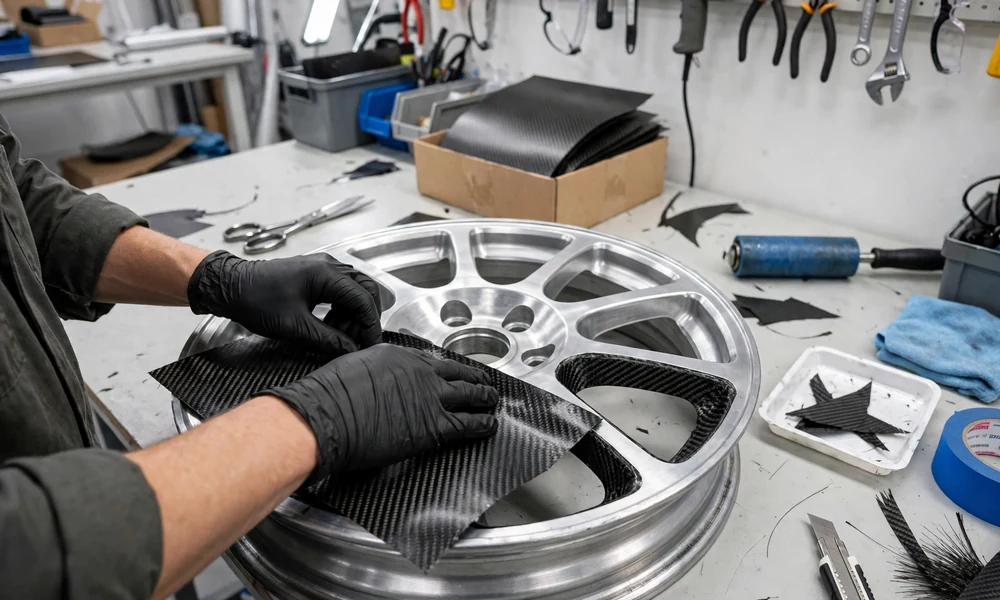
A forged aluminium wheel can be made in hours. A carbon wheel takes days or weeks. The fibre layers are laid by hand into a mould, a slow and exacting job where a single misplaced layer or a trapped bubble of air can scrap the whole wheel. The mould is then sealed, heated, and pressurised in an autoclave — a giant oven that cures the resin under heat and pressure — and the wheel is machined, balanced, and finished by hand. Each wheel is then inspected with ultrasound and X-ray, because a flaw hidden inside carbon fibre cannot be seen from the outside, and a failure at 350 kilometres per hour would be catastrophic.
That inspection is part of the cost, and so is the scrap rate. Carbon wheels have a far higher rejection rate than metal ones: a wheel that fails is destroyed, and its cost is spread across the wheels that pass. The labour is performed by specialists closer to aerospace technicians than factory workers, and there is no safe way to automate a process that depends on human judgement at every layer.
Why They Are Worth It: Unsprung Weight
There is a real engineering reason hypercar makers pay this price, and it is called unsprung weight — the mass of everything not supported by the suspension: wheels, tyres, and brakes. Reducing unsprung weight makes the suspension react faster, keeps the tyre in better contact with the road, and sharpens steering and braking. A carbon wheel can be 30 to 40 percent lighter than an equivalent forged aluminium wheel, saving several kilograms per corner. On a hypercar, where engineers fight for every gram, that saving is worth a fortune — it is weight removed exactly where it matters most.
The weight saving also helps the brakes: a lighter wheel is easier to slow down, and carbon’s heat resistance means it can sit beside glowing brake discs without warping. Those brakes are covered in our guide to carbon ceramic brake specs.
Testing: Proving a Wheel Will Not Fail
Before a carbon wheel is allowed on a road car, it must survive testing that would destroy an ordinary wheel: spun at speeds far beyond anything it will meet on the road, hammered with impact tests that simulate kerb strikes, and subjected to fatigue testing — millions of load cycles, simulating years of driving in weeks. It must also pass the carmaker’s own tests, often stricter than the legal minimum, because a reputation rests on a wheel never failing at speed.
Testing costs money and time: a new design can spend a year in testing before the first customer car is delivered, and the cost is spread across a tiny production run. It is the same economics that makes every hypercar part expensive.
Rarity: Built in Dozens, Not Thousands
Only a handful of companies in the world can make a carbon wheel to automotive standards, and they make them in small numbers. The moulds are expensive, the autoclaves enormous, and the skilled workforce small. A hypercar maker might order a few hundred wheels a year; a mainstream maker produces that many in a day. With no volume, there is no economy of scale — and the customer is buying a share of a tiny, specialised industry.
That rarity is part of the appeal: a carbon wheel is a visible statement that a car is built without compromise. But the price is not a fashion markup; it is the honest cost of making something extraordinary in very small numbers.
What Do Carbon Wheels Cost?
A single carbon fibre wheel for a hypercar is estimated at $10,000 to $15,000, and a set of four is estimated at $40,000 to $60,000 or more. Prices are estimates only and vary by manufacturer, size, and finish. For comparison, a set of high-quality forged aluminium wheels is estimated at $4,000 to $8,000. The carbon premium is roughly five to ten times the price, and it buys a 30 to 40 percent weight saving per wheel.
A Rare Fact
Carbon wheels were born on the racetrack, not the road. They were first developed for Formula 1, where a few kilograms of unsprung weight can decide a race, and only reached road cars in the 2010s, when a small Australian company proved they could be made strong enough for everyday use. The first production road car to offer them as standard was a limited-run American supercar. A decade later, they remain a rarity — fitted to a few hundred hypercars a year, out of tens of millions of cars built.

A carbon wheel is expensive because everything about it is hard: the material is costly, the making is slow and done by hand, the testing is relentless, and the market is tiny. It is also expensive because it works — removing weight exactly where a hypercar needs it removed. Whether it is worth the price is a question only a hypercar buyer can answer, but the price itself is no mystery.