A supercapacitor is one of the most misunderstood parts in modern engineering. It looks like a battery, it is wired up like a battery, and it stores energy like a battery, but it works on a completely different principle. Instead of storing energy in chemical reactions, it stores it as an electric field, with charged particles gathered on the surface of two electrodes. That single difference explains everything about it: the blistering charge speed, the enormous cycle life, and the stubbornly low energy density. A solid-state supercapacitor takes the same idea and replaces the liquid electrolyte inside with a solid one, which changes the safety, the packaging, and the places the device can go.
The idea matters because the machines Wilklit covers keep hitting the same wall. A hypercar needs a huge burst of power for a few seconds when it accelerates or recovers energy under braking, but it does not need to store that energy for hours. A battery can do the job, but it is heavy, it heats up, and it wears out after a few thousand cycles. A supercapacitor can absorb and release that burst almost instantly, and it can do it a million times. The question is whether the solid-state version can finally close the gap on energy density enough to matter beyond niche roles.

What a Supercapacitor Actually Is
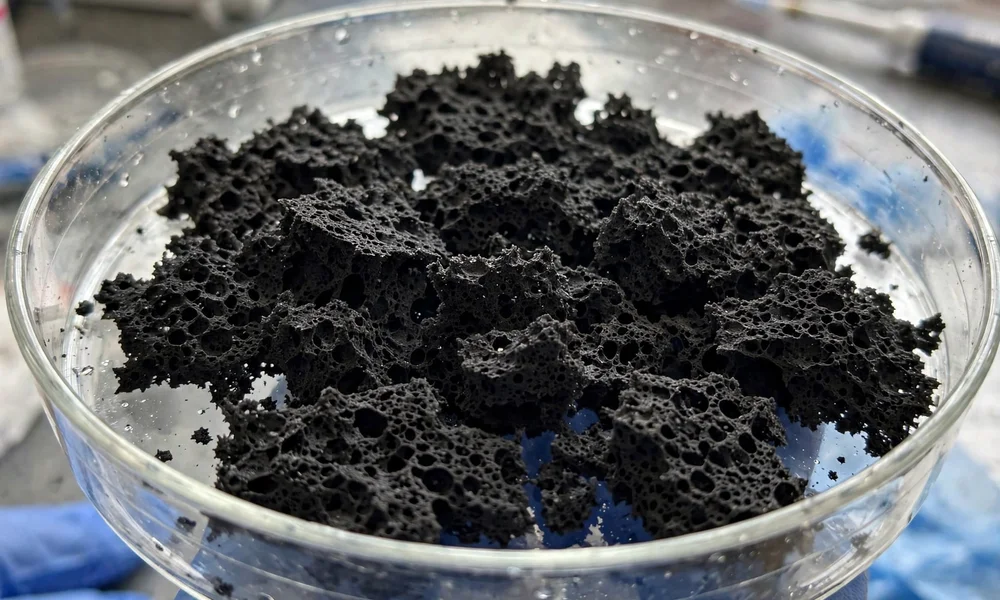
A conventional capacitor stores charge on two metal plates separated by an insulator. The plates hold opposite charges, and the energy sits in the electric field between them. A supercapacitor, also called an ultracapacitor, is the same idea scaled up by clever materials science. Its electrodes are made from porous activated carbon, a material whose internal surface area can exceed 1,000 square metres per gram. Ions from the electrolyte gather on that enormous surface, forming a layer only about a nanometre thick. Because capacitance grows with surface area and shrinks with separation distance, the result is a device that holds thousands of farads in a package the size of a soft-drink can.
The key point is that nothing reacts. In a lithium-ion battery, ions are driven into the electrode material itself, and the chemical change slowly degrades the structure. In a supercapacitor, the ions simply sit on the surface and leave again. There is no chemical transformation, so there is very little to wear out. That is why a supercapacitor can survive hundreds of thousands to millions of charge cycles, while a typical lithium cell is rated for roughly a thousand. It is also why a supercapacitor can charge in seconds: moving ions to a surface is far faster than forcing a chemical reaction through a solid.
The trade is energy density. A commercial supercapacitor holds roughly 5 to 10 watt-hours per kilogram, against 150 to 250 for a lithium-ion cell. Put simply, a supercapacitor that could run a laptop for a working day would be impractically large and heavy. What it can do is deliver its stored energy at enormous power: around ten times the power density of a battery, and in some designs roughly a hundred times. It is a sprinter, not a marathon runner.
What “Solid-State” Changes
In a standard supercapacitor the ions move through a liquid or gel electrolyte, usually an organic solvent. That liquid works well, but it brings the usual problems: it can leak, it can dry out, it limits the temperature range, and in some designs it is flammable. A solid-state supercapacitor replaces that liquid with a solid electrolyte, often a ceramic, a polymer, or a composite of the two. The ions still move, but through a solid material rather than a liquid bath.
The first benefit is safety. A solid electrolyte cannot leak, and it removes the flammable solvent that makes some energy-storage devices a fire risk. Supercapacitors were already far safer than lithium batteries, since they do not suffer thermal runaway, but the solid-state version goes further: it can be punctured, crushed, or overheated without catching fire. The second benefit is packaging. A solid electrolyte lets the device be built as a thin, flat, flexible sheet rather than a rigid canister, which opens up integration into body panels, structural parts, and wearable devices.
The third benefit is temperature. Liquid electrolytes freeze or boil at the extremes, while a well-chosen solid electrolyte keeps working across a much wider range. That matters in cars, where a device may sit in a freezing garage overnight and then run at high temperature under the bonnet, and in aerospace, where the same part must survive both. The price is conductivity: ions move more slowly through a solid than through a liquid, so solid-state designs have to work harder to keep their internal resistance low, and that is where much of the current research is focused.
Where They Are Already Used
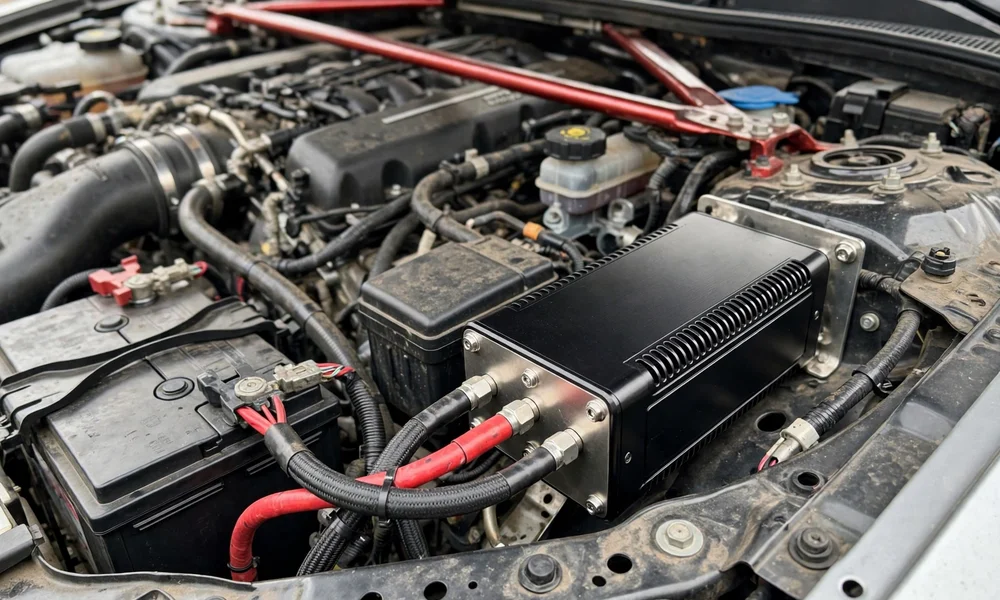
Supercapacitors already do serious work in places where bursts of power matter more than total energy. In motorsport, a supercapacitor system can absorb a huge braking-energy spike almost instantly and then blast it back out for acceleration, charging and discharging in about four and a half seconds. In buses and trams, they capture braking energy at every stop and release it at the next departure, saving fuel and sparing the battery from the hardest part of the duty cycle. In wind turbines, they provide the short burst of power that pitches the blades out of the wind when the grid fails.
In cars, the most famous use is regenerative braking, where the supercapacitor takes the energy spike that a battery cannot absorb fast enough. The Lamborghini Sian uses a supercapacitor instead of a battery for its hybrid system, saving weight and delivering its boost instantly, and Mazda’s i-ELOOP system uses a supercapacitor to capture braking energy and run the car’s electrics. Grid stabilisation is another growing role: a supercapacitor bank can inject or absorb power in milliseconds to smooth out fluctuations from wind and solar, a job batteries are too slow to do well.
The Limits, Honestly Stated
The hard limit is energy density, and it is set by physics rather than engineering. Storing charge on a surface will always hold less energy than storing it in chemical bonds, because only the surface participates. Even optimistic solid-state designs are unlikely to match lithium-ion on energy per kilogram. That means supercapacitors will not replace batteries in electric cars, phones, or anything that needs hours of stored energy. They are a complement, not a replacement, and anyone promising otherwise is selling a story, not a specification.
What Comes Next
Our guide to why solid-state batteries are overhyped covers the parallel story on the battery side, where the same solid-electrolyte idea faces its own timeline. The comparison with lithium iron phosphate EV batteries shows what the supercapacitor is up against on energy density, and the work on carbon nanotube composites is one of the routes to closing the gap. A solid-state supercapacitor will not power your next car on its own, but it may well be the part that makes the battery in that car last longer, charge harder, and work safer.


