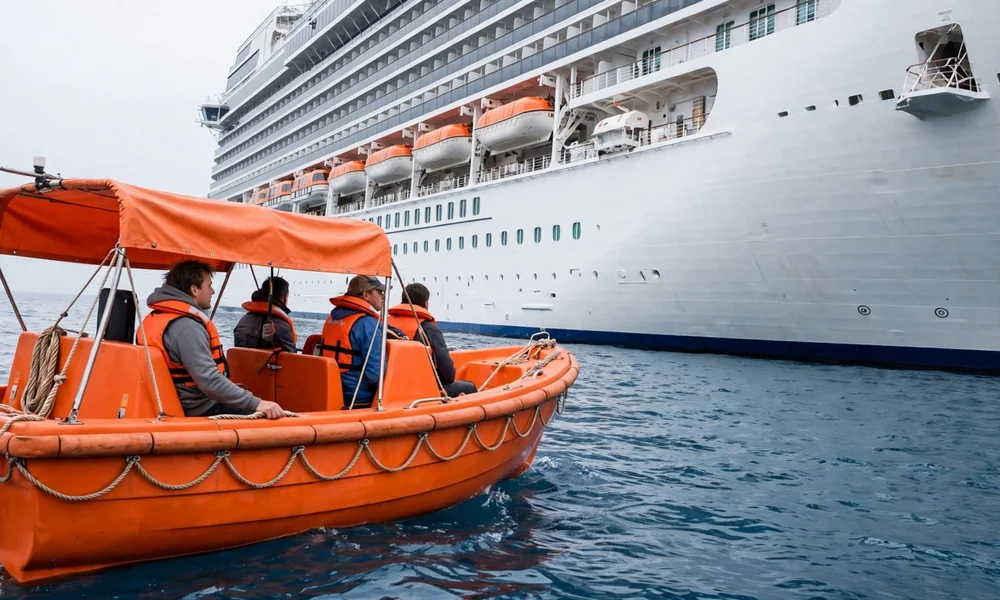
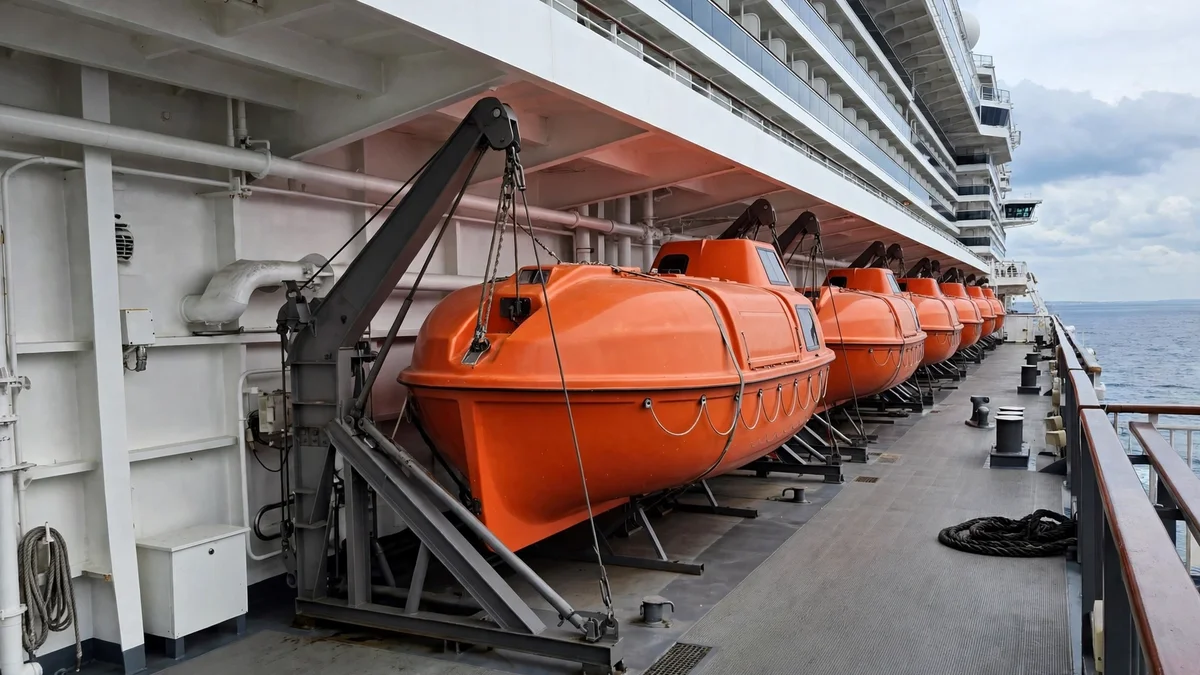
Every cruise ship carries a fleet of small boats that most passengers never look at twice. They sit in rows along the boat deck, orange or white, tucked into cradles under davits, and they are the last line of defence if the ship itself cannot be saved. A cruise ship lifeboat is not a dinghy with a coat of paint. It is a self-contained survival craft, built to a strict international standard, designed to be launched fully loaded in minutes, and equipped to keep more than a hundred people alive at sea until rescue arrives. Understanding how one works means understanding the davit that launches it, the release gear that lets it go, and the rules that decide how many the ship must carry.
The numbers explain the scale. Under the International Convention for the Safety of Life at Sea, known as SOLAS, a passenger ship must carry enough lifeboat space for at least 75 percent of everyone on board, with at least 37.5 percent of capacity on each side of the ship. The rest is covered by liferafts. On a ship carrying 6,000 passengers and crew, that means lifeboat space for at least 4,500 people, typically split across a dozen or more boats of 150 seats each. Every one of those boats must be launchable with its full complement aboard, in rough weather, with the ship listing up to 20 degrees.
The Boat Itself
A modern cruise ship lifeboat is a totally enclosed motor lifeboat, built from fire-retardant glass-reinforced plastic. The enclosed canopy protects the people inside from fire, smoke, and heavy weather, and the hull is designed to be self-righting: if a wave rolls it over, it comes back upright on its own. Inside, the seats face inward in rows, with seat belts, and the boat carries its own diesel engine, enough fuel for 24 hours at 6 knots, fresh water, food rations, first aid, signalling equipment, and a radio. Some boats also carry a water-spray system that keeps the hull cool while the boat motors away from a burning ship.
The Davit: How the Boat Gets to the Water
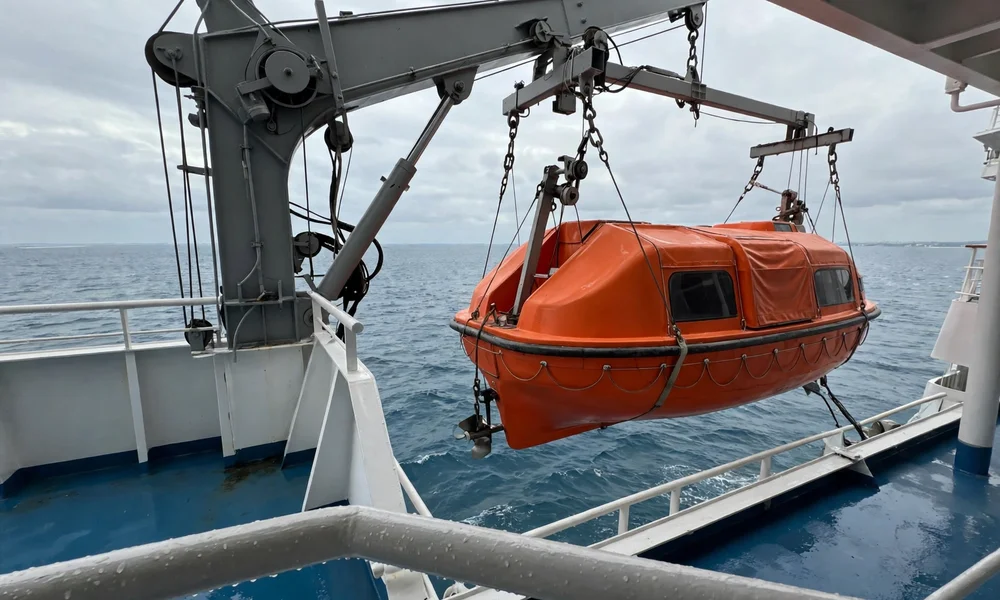
The davit is the crane-like arm that holds the boat and lowers it to the sea. Most cruise ship lifeboats hang in gravity davits. The principle is simple and deliberately power-free: when the brake is released, the boat’s own weight swings the davit arms out over the side and lowers it. Gravity does the work, which means the system still functions if the ship has lost all power. The lowering speed is controlled by a brake, and a centrifugal governor limits the speed automatically. The rules set the lowering speed at a minimum of 0.4 plus 0.02 times the height in metres per second, with a maximum of 1.3 metres per second unless the flag state approves otherwise.
The brake is a dead-man design: it applies automatically unless the operator holds the control in the lowering position. Let go, and the boat stops. One person can operate it from the deck, or from inside the boat using a remote control wire. Hoisting the boat back up is the powered part: an electric winch winds the falls, the steel wire ropes that carry the boat, back onto the drum, and hand gear provides a manual backup. Limit switches stop the powered hoist before the davit arms reach their stops.
Before any launch, the boat must be freed from its sea fastenings. At sea it sits in its cradle held by gripes, lashings with a quick-release slip, and harbour pins lock the davit arms against moving in port and during maintenance. The pins come out and the gripes are released as part of the launch drill, and forgetting either is one of the classic launch failures. For boats boarded at embarkation level, tricing pendants draw the boat in against the ship’s side as it lowers, and bowsing tackles hold it alongside, so passengers step across a small gap rather than a swinging void.
Release Gear: Letting Go at the Right Moment
Once the boat reaches the water, it has to be freed from the falls, and the release gear is the most safety-critical mechanism on the whole system. There are two main types. An on-load release can be operated while the boat is still hanging on the hooks, which allows a fast getaway but carries a real risk of accidental release. An off-load release only works once the boat’s weight is on the water, when a hydrostatic piston senses the water pressure and frees the hook. The off-load design is inherently safer against accidental release, but it requires the boat to be properly waterborne before it can let go.
The release is operated from inside the boat, so the crew does not have to stand on a deck in a storm to let it go. The operator pulls a single handle that releases both hooks at once. The two hooks must release together: if one lets go before the other, the boat drops at an angle and can capsize or slam into the ship’s side. That is why the gear is tested so carefully, and why a boat is not considered ready until its release mechanism has been proved under load.
Boarding and Launch, Step by Step
When the order to abandon ship is given, passengers gather at their assigned assembly points, put on lifejackets, and are directed to their lifeboat stations. The crew removes the harbour pins, releases the gripes, and boards the passengers. The boat is lowered by gravity, with the brake operator controlling the speed, until it reaches the water. The release gear is operated, the hooks let go, and the engine is started to motor clear of the ship. The whole sequence is drilled regularly: SOLAS requires weekly inspections, monthly operational tests, and a full abandon-ship drill with the boats lowered, though the boats are not always launched with passengers aboard.
What the Rules Demand
SOLAS Chapter III and the International Life-Saving Appliance Code set the standard for every part of the system: the boat’s construction, its capacity, its equipment, the davit’s strength, the release gear, the lowering speed, and the maintenance schedule. Davits must work at a list of up to 20 degrees and in winds up to 25 knots, and launching appliances must be type-approved by a classification society such as Lloyd’s Register, DNV, or ABS. The 2020 amendments added detailed requirements for the examination and overhaul of the whole system, after years of evidence that maintenance failures, not design failures, were behind most lifeboat accidents.
The lesson of the lifeboat’s history is that the engineering is only half the story. The other half is maintenance, training, and drills. A perfectly designed davit that has not been serviced will seize, and a release hook that has not been tested will jam. The boats hanging on the boat deck are a promise, and keeping that promise is a matter of weekly checks, monthly tests, and crews who have practised the launch until it is routine. Our look at how a cruise ship lifeboat is made covers the construction of the boat itself, while how cruise ship propulsion works explains the machinery that keeps the ship moving, and the cruise ship bridge is where the order to launch is given.