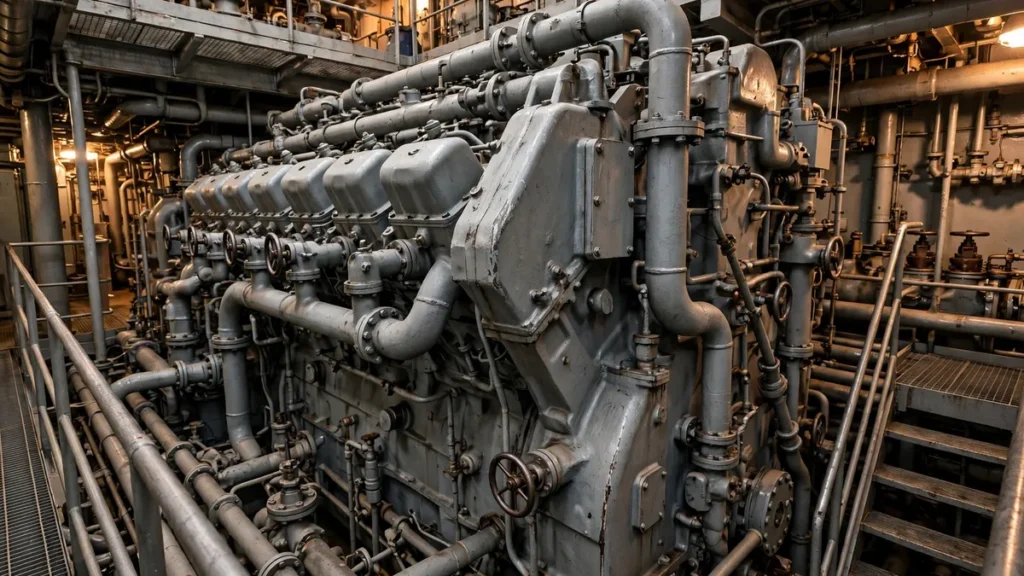
Deep below the waterline of a cruise ship, in a space the size of a cathedral, something the size of a house is turning. The engine room of a modern cruise ship holds several engines, each as tall as a three-storey building, each weighing hundreds of tonnes, each burning fuel by the tonne every hour. Together they make enough electricity to power a small town — and the ship itself, with its six thousand passengers, its theatres, its kitchens and its swimming pools, is entirely dependent on them.
A cruise ship engine is not one engine but a power station. Most modern cruise ships are diesel-electric: big diesel or gas engines turn generators, the generators make electricity, and electric motors turn the propellers. There is no direct mechanical link between the engine and the propeller, which means the engines can run at their most efficient speed whatever the ship is doing, and the ship can keep moving even if one engine is shut down for maintenance. It is a system built for a ship that can never afford to stop.
The numbers on a cruise ship engine are hard to grasp at first because they are so large — tens of megawatts, hundreds of tonnes, thousands of litres of fuel a day. The way those engines actually move a floating city is explained in how a cruise ship engine works, and the building of one is the subject of inside the giant engine of a cruise ship. The steel and scale of the whole machine are captured in a cruise ship engine as a floating steel city. Here is what the specifications mean.

The Specs, Explained
1. Installed power: megawatts, not horsepower
Cruise ship power is measured in megawatts, and the numbers are enormous. A large modern cruise ship has a total installed power of roughly 60 to 85 megawatts — enough electricity, in theory, to power a town of fifty thousand people. That power is split between propulsion, which takes about half, and the hotel load: air conditioning, lighting, kitchens, laundry, lifts and entertainment. Four to six main engines, each producing roughly 12 to 16 megawatts, generate it, so losing one engine is an inconvenience rather than an emergency. The redundancy is the point: a cruise ship cannot call a tow truck.
2. Engine type: diesel, gas and dual fuel
Most cruise ship engines are medium-speed four-stroke diesels, built by makers such as Wärtsilä and MAN, running at around 500 to 600 revolutions per minute. Newer ships increasingly use dual-fuel engines that can burn liquefied natural gas as well as diesel, cutting sulphur and soot emissions sharply. The newest large ships run primarily on LNG, stored in tanks kept at minus 162 degrees Celsius. The choice of engine type shapes the ship’s fuel system and exhaust treatment — and it is one of the most expensive decisions in the whole build.
3. Fuel consumption: tonnes per day
A large cruise ship at sea burns roughly 150 to 250 tonnes of fuel per day, depending on its speed, size and load. At around 20 knots, the fuel bill alone runs into tens of thousands of dollars a day. The fuel is heavy fuel oil or marine gas oil on older ships, and LNG on newer ones, stored in tanks holding thousands of tonnes. Fuel efficiency is measured in grams per kilowatt-hour, and the best modern marine engines burn about 170 to 180 grams per kilowatt-hour — a figure engine makers have spent decades shaving down, gram by gram.
4. Propulsion: pods and propellers
The power reaches the water through propulsion pods — Azipods — which hang beneath the hull and can rotate through 360 degrees. Each pod contains an electric motor of roughly 20 megawatts driving a propeller about 5 to 6 metres across. Because the pods steer as well as push, the ship needs no rudder, can turn in its own length, and can hold position in port without tugboats. The propellers are fixed-pitch, with five or six blades, turning slowly — around 130 to 150 revolutions per minute — because a big, slow propeller is far more efficient than a small, fast one.
5. Speed and range
A large cruise ship’s top speed is typically 22 to 24 knots, about 40 to 44 kilometres per hour, and its normal cruising speed is 18 to 21 knots. Range is rarely a limiting factor: with fuel tanks holding several thousand tonnes, a ship can cross an ocean and still have fuel to spare. What limits a cruise ship is not how far it can go but how much fuel it burns getting there — every extra knot of speed costs a disproportionate amount of fuel, which is why ships slow down when fuel is expensive and speed up only when the schedule demands it.
6. Emissions and exhaust treatment
Modern cruise ships carry exhaust treatment systems that would have been unimaginable a generation ago. Scrubbers wash sulphur out of the exhaust gas with seawater, selective catalytic reduction cuts nitrogen oxides by injecting urea into the exhaust, and particulate filters trap soot. LNG-fuelled ships cut sulphur almost entirely and reduce carbon dioxide by about a fifth compared with diesel. The systems add weight, cost and complexity, but they are now required in the emission control areas where most cruise ships spend their time.
Cruise Ship Engine Specs
| Specification | Typical range |
|---|---|
| Total installed power | About 60 to 85 megawatts |
| Number of main engines | About 4 to 6 |
| Power per main engine | About 12 to 16 megawatts each |
| Engine speed | About 500 to 600 revolutions per minute |
| Fuel consumption at sea | About 150 to 250 tonnes per day |
| Fuel efficiency | About 170 to 180 grams per kilowatt-hour |
| Propulsion pod power | About 20 megawatts per pod |
| Propeller diameter | About 5 to 6 metres |
| Top speed | About 22 to 24 knots |
| Cruising speed | About 18 to 21 knots |
| Main engine weight | About 200 to 300 tonnes each |
| Fuel type | Diesel, marine gas oil or LNG |
What Does a Cruise Ship Engine Cost?
A set of main engines for a large cruise ship is estimated to cost roughly $50 million to $100 million, each engine an estimated $8 million to $15 million depending on size and type. The full propulsion system — engines, generators, pods and propellers — is estimated at $150 million to $250 million, a substantial share of a ship costing well over $1 billion to build. Prices are estimates only: dual-fuel LNG engines cost more than conventional diesels, and the exhaust treatment systems are on top.
A Rare Fact
The cylinders of the largest marine diesel engines are so big that a person can stand up inside one. The biggest two-stroke marine engines have cylinder bores close to a metre across, with pistons as tall as a person and strokes of several metres. Engineers servicing these engines climb inside the cylinder liner to inspect it, working in a space that is, for a few hours, the inside of the largest engine in the world. It is a reminder of the scale involved: these are not engines you open with a spanner, they are engines you walk into.

Next time you stand on a cruise ship deck and feel the faint vibration under your feet, remember what is making it: several engines the size of houses, turning fuel into light, heat, air conditioning and twenty knots of steady progress across the sea.