For a century, the question of how to push a ship through the water had one answer: burn fuel in a big diesel engine and turn a propeller shaft. That answer still works, and it still powers most of the world’s fleet. But a second answer has moved from ferries and harbour craft into larger ships, and it is now a serious choice rather than an experiment. Hybrid propulsion — diesel generators plus batteries and electric motors — changes how a ship uses its power, and for many routes it changes the fuel bill, the noise, and the emissions with it. The two systems are not simply old versus new. They suit different kinds of work.
The confusion starts with the word hybrid, which covers several different arrangements. In a conventional diesel ship, the main engine is mechanically connected to the propeller, and its speed sets the ship’s speed. In a diesel-electric ship, diesel generators make electricity and electric motors turn the propeller, which lets the engines run at their best speed whatever the ship is doing. A hybrid adds batteries to that electric setup, so the ship can run on stored power alone, use the batteries to smooth out peaks, and shut the generators down entirely for stretches of the voyage. The choice is therefore not one change but a chain of them, and each step costs money, weight, and space.

How diesel propulsion works, and why it lasts
A marine diesel is a proven machine. Large two-stroke and four-stroke diesels are among the most efficient heat engines ever built, turning a high share of their fuel into useful work, and they run on fuel that is available in every port on earth. A direct-drive diesel is mechanically simple: engine, shaft, propeller. There is little to go wrong that a chief engineer has not seen before, and any port with a workshop can find the parts and the people. That reliability is why diesel still dominates deep-sea shipping, where a ship may be weeks from a specialist yard and the cost of a breakdown dwarfs any fuel saving.
The weakness of a straight diesel is that ships rarely need steady power. They need a burst to manoeuvre in port, almost nothing at anchor, and a long steady pull at sea — and a diesel running at a small fraction of its rated load is inefficient, dirty, and hard on the engine. Fuel consumption rises, exhaust temperatures fall, carbon deposits build up, and maintenance intervals shrink. The way a cruise ship engine is made shows how much engineering goes into making these giants reliable, but no amount of engineering changes the fact that a diesel wants to work hard or not at all, and a ship’s real life is mostly in between.
What hybrid adds
Hybrid propulsion solves that mismatch. Batteries absorb the peaks and troughs: they deliver power for manoeuvring and slow harbour work, they take the load while the generators rest, and they let the generators switch on, run at their efficient sweet spot, and switch off again. In port, a hybrid ship can sit silent on battery power, with no exhaust and no vibration, which matters more every year as ports tighten their rules on noise and emissions. With shore power, the batteries can recharge overnight and the ship can leave in the morning without starting an engine at all.
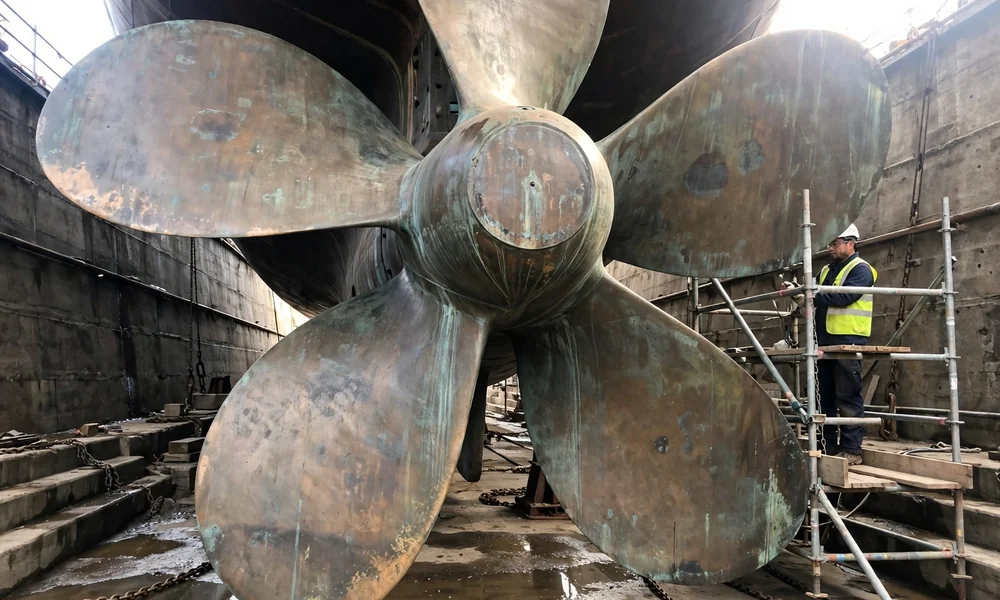
The fuel saving is real but it depends entirely on the route. On a ferry that crosses a short strait dozens of times a day, with constant speed changes and long waits at the dock, a hybrid can cut fuel use substantially, because so much of its life is spent at low load. On a container ship that steams at steady speed across an ocean for two weeks, the saving shrinks to almost nothing, because the diesel is already working in its sweet spot and the batteries are mostly dead weight. That is why the first battery-hybrid vessels were short-route ferries and harbour craft, and why deep-sea shipping has been slower to follow. The way a ship propeller is made matters to both systems equally, since the propeller is where all that power finally becomes thrust.
| Diesel | Hybrid | |
|---|---|---|
| Best for | Long steady ocean passages | Short routes, port work, variable loads |
| Fuel use | Efficient at steady high load | Saves fuel at low and changing loads |
| Emissions in port | Engines running, exhaust and noise | Silent battery running, zero local exhaust |
| Complexity | Simple, understood everywhere | Batteries, converters, software, integration |
| Cost | Lower to build, familiar to maintain | Higher upfront, batteries need replacing |
Cost, weight and the battery question
Hybrid is not cheap. Batteries, power converters, and electric motors add weight, volume, and cost, and the batteries will need replacing during the ship’s life at a price nobody enjoys quoting. The added weight cuts into cargo capacity or range, and the added complexity demands engineers who understand power electronics as well as diesel mechanics. A badly integrated hybrid — batteries crammed where they do not belong, cooling that was an afterthought, software from three suppliers that barely talks to itself — can be worse than the diesel it replaced. Owners should judge the yard and the integrator, not just the brochure.
Regulation is pushing the decision as much as economics. The International Maritime Organization has set the industry on a path to net-zero greenhouse gas emissions around 2050, with steep cuts along the way, and ports from Norway to California already restrict what ships may emit at the berth. A hybrid ship is a practical step toward those targets today, and it keeps a vessel welcome in the strictest ports. Diesel-only ships will keep trading for decades, but their owners will increasingly have to explain them, or avoid the places with the tightest rules. The case for hybrid power on yachts makes the same argument at a smaller scale, and the logic carries over: silence and clean air in port are becoming part of the price of access.
The verdict
Choose diesel if the ship works long, steady, ocean-going routes where the engine spends its life at efficient load and the nearest specialist is a long way away. Simplicity, fuel availability, and a century of know-how are worth more there than any battery can offer. Choose hybrid if the route is short, variable, and port-heavy — ferries, harbour craft, offshore support, and coastal shipping — where batteries can do the quiet work, the generators can run properly, and the fuel and emissions savings are large enough to pay for the system.
Most of the fleet will end up somewhere in between, and that is the honest answer. Diesel-electric without batteries suits ships that need flexibility but not silence. Full battery-electric suits the shortest crossings. Hybrid sits in the middle, and it is the right middle for a large and growing share of shipping. The question is not which system is better in the abstract. It is what the ship does all day, and whether its engines spend that day working properly or idling badly. Answer that, and the propulsion choice answers itself.


