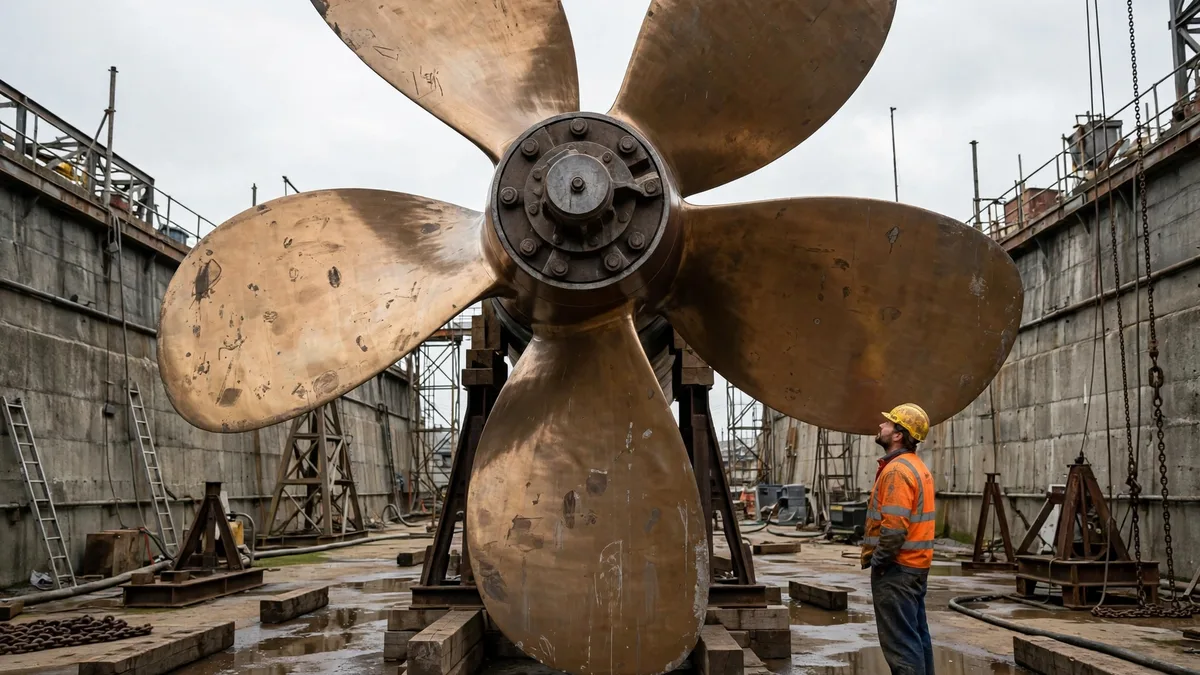
Stand at the stern of a ship in dry dock and look up, and the propeller is the first thing that makes you feel small. A single blade can be taller than a person, and the whole propeller can weigh more than a house, yet it has to spin for years without a wobble, pushing thousands of tonnes of steel through the sea. It is one of the oldest pieces of marine engineering still in use, and one of the most demanding to make, because a propeller that is even slightly out of balance will shake a ship apart from the inside.
Ship propellers are cast from bronze, machined to a mirror finish, and balanced to within grams, a combination of foundry work and precision engineering that has changed surprisingly little in a century, even as the ships around them have grown enormous. A modern container ship’s propeller can be ten metres across and weigh over a hundred tonnes. Making one is a months-long job for a specialist foundry. This is how a ship propeller is made.
How It’s Made
Step 1: Designing the blades
Every propeller begins as a calculation, not a casting. Naval architects work out the ship’s speed, the power of its engine, the shape of its hull and the wake the hull leaves behind, then design a propeller that turns that power into thrust as efficiently as possible. The number of blades, their pitch, their skew and their shape are all tuned to the ship: a fast ferry wants a different propeller from a slow bulk carrier. The design is tested in a computer and often in a towing tank with a scale model, because a propeller that cavitates, forming bubbles that collapse and eat away at the metal, will destroy itself in months.
Step 2: Making the mould
A ship propeller is far too large to cast in one piece in a normal foundry mould, so the mould is built in a pit in the foundry floor, layer by layer, from sand mixed with a binder that hardens into a rigid shape. Each blade has its own mould section, shaped from a wooden or foam pattern that was itself machined from the design data. The mould must capture the blade’s complex curved surface exactly, including the twist from root to tip that gives the propeller its pitch. Building the mould takes weeks, and it is used only once: after the casting it is broken apart to free the propeller inside. The same one-off mould-making craft shapes other great castings at sea, and our look inside ship propeller production follows the foundry work in more detail.
Step 3: Casting the bronze
The propeller is cast from a nickel-aluminium bronze, an alloy chosen because it is strong, resistant to seawater corrosion, and able to survive the hammering of cavitation better than steel. The metal is melted in a furnace, checked for composition, and then poured into the mould in a single continuous operation that can take hours. The pour’s temperature and speed are critical: too fast traps air, too slow and the metal cools before the mould is full. Once poured, the casting is left to cool slowly for days, because a hundred-tonne lump of bronze that cools unevenly will crack. When the mould is finally broken away, the propeller emerges rough, dark and covered in sand, recognisable but far from finished.

Step 4: Rough machining and grinding
The rough casting goes to a machining shop, where its blades are cut to shape on huge milling machines and then ground by hand. This is where the propeller’s performance is really made: the blade surfaces must be smooth to within a fraction of a millimetre, because any roughness creates drag and invites cavitation. Skilled grinders work over every square centimetre of every blade with hand tools, checking the shape against templates taken from the design. It is slow, physical work, and a large propeller can spend weeks in this stage. The leading and trailing edges are shaped to a fine, even profile, and the blade tips are finished with particular care, since the tips move fastest through the water and suffer most from cavitation.
Step 5: Balancing
A propeller that is out of balance will vibrate, and vibration at sea means cracked shafts, worn bearings and a miserable crew, so balancing is treated as sacred. The propeller is mounted on a balancing machine and spun slowly while sensors measure where it is heavy. Material is removed from the heavy blades, a little at a time, until all the blades weigh the same and the propeller spins true. The work is checked and rechecked, because removing too much cannot be undone. Submarine propellers are balanced to even tighter standards than surface ships, since silence matters as much as smoothness, as our guide to how a submarine propeller is made explains.
Step 6: Polishing, inspection and fitting
The final step is polishing, and it is not cosmetic. The blade surfaces are polished to a bright finish that lets water slide over them with minimum friction, and every surface is inspected, often with dye penetrant testing that reveals cracks invisible to the naked eye. The propeller’s hub is bored and keyed to fit the ship’s tail shaft exactly, and the whole assembly is weighed and documented. Then it is craned into place in the dry dock, bolted to the shaft, and the ship is floated again. The first time the engine turns it, the crew listen carefully for vibration, and if there is none, the propeller is done. The anchor gear in our guide to how a ship anchor chain works is part of the same running gear that keeps it that way.
Specs
| Specification | Detail (typical large container ship propeller) |
|---|---|
| Material | Nickel-aluminium bronze |
| Diameter | Approximately 8 to 10 metres |
| Weight | Approximately 80 to 130 tonnes |
| Blades | Typically 4 to 6 |
| Rotation speed | Approximately 60 to 100 rpm |
| Blade finish | Ground and polished to a mirror finish |
| Manufacture | Single sand-mould casting, then machining and balancing |
| Service life | Decades, with periodic polishing and repair |

Price
A large ship propeller is a major purchase in its own right. A propeller for a large container ship typically costs from around $1 million to $5 million (estimate, based on typical pricing of large marine propellers), depending on size, alloy and complexity, and that is before the cost of fitting it in dry dock. The price reflects the foundry work, the weeks of hand grinding and the precision balancing, none of which can be rushed or automated away. A cheap propeller is the most expensive mistake a shipowner can make, because a bad one costs far more in fuel and repairs than it saves.
Rare Fact
The largest ship propellers ever made are over eleven metres across, wider than a four-storey building is tall, and they turn at barely sixty revolutions per minute. At that slow speed, the tip of a blade still travels through the water at well over a hundred kilometres per hour, which is why cavitation, the bubbles that form and collapse on the blades, is such a threat.


