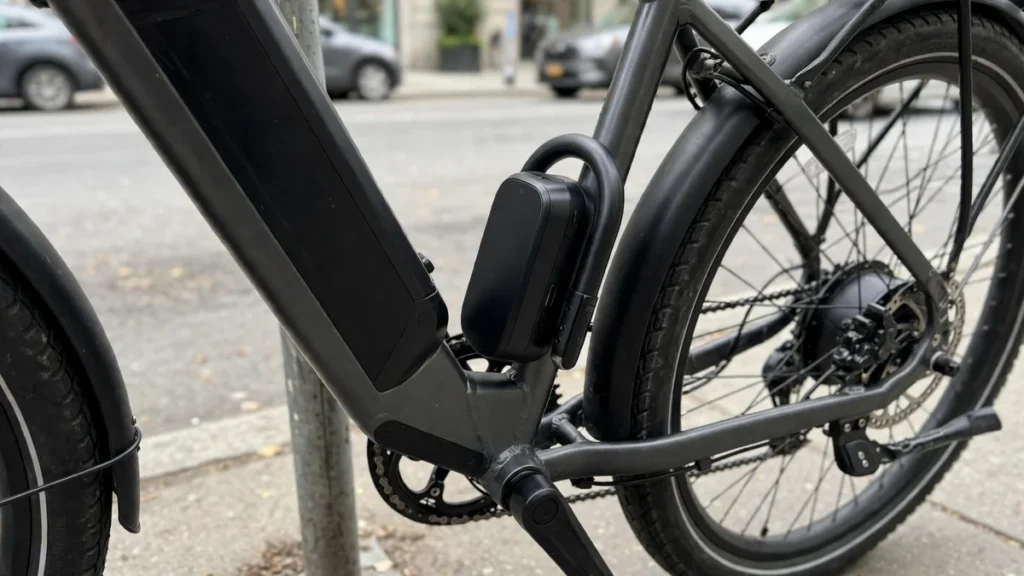
The hill does not get any easier, but the rider does not seem to notice. She is pedalling gently, almost lazily, and yet the electric bike is climbing steadily, past walkers, past a van that gave up halfway, past the point where her legs would normally have given out. There is no noise, no strain, no smell of hot metal. The push feels as though it is coming from the bike itself, as though the hill had quietly decided to help.
The push is coming from the hub motor, a small electric motor hidden inside the hub of the rear wheel.
Here is what is actually inside an e-bike hub motor, and why each material earned its place.

The Materials Behind the Machine
1. Copper windings and the stator
The heart of the motor is the stator, a ring of steel laminations wrapped with copper wire. The steel is made in thin sheets, each one coated with insulation, because a solid block of steel would waste energy as heat through eddy currents, while thin sheets keep the magnetic field where it belongs. The copper wire is wound into coils around the steel teeth, and when electricity flows through those coils they become electromagnets, switching on and off in sequence to pull the wheel around.
2. Neodymium magnets and the rotor
Around the stator sits the rotor, a steel ring lined with permanent magnets made from neodymium, iron and boron. Neodymium magnets are the strongest permanent magnets available, far stronger than the ferrite magnets used in ordinary motors, and that strength is what lets a hub motor be small and still powerful. The magnets are glued and held in place with steel, and they are coated to stop them rusting, because a rusted magnet loses its strength.
3. The steel shell and axle
All of those parts live inside a shell, usually made from cast aluminium or steel, which protects them from rain, dust and knocks. The shell has to be strong enough to take the weight of the rider and the torque of the motor, yet light enough not to make the wheel too heavy to ride. Through the middle runs the axle, a thick steel shaft that fixes the motor to the frame of the bike. The shell is sealed with rubber gaskets, because water inside a motor is a slow disaster, rusting the steel and shorting the windings. The shell is often painted black, which helps it radiate heat away from the motor inside. How the motor turns electricity into motion is covered in our guide to how an e-bike hub motor works.
4. Bearings and the freewheel
The motor spins on bearings, usually sealed ball bearings made from chromium steel, which keep the rotor turning smoothly and keep water out at the same time. A hub motor also needs a way to let the wheel spin freely when the motor is off, so that the rider can pedal without dragging the motor around, and that is the job of the freewheel or clutch inside the hub. It is a set of steel pawls and springs that engage when the motor drives the wheel and slip quietly when the rider pedals alone.

5. The controller and its electronics
The motor cannot run on its own. It needs a controller, a small box of electronics that switches the current through the windings in exactly the right order and at exactly the right time. The controller is built on a fibreglass circuit board, with copper traces and silicon chips, and its power switches are MOSFET transistors, which can switch large currents on and off thousands of times a second without wearing out. The numbers behind power, torque and range are explained in our guide to e-bike hub motor specs.
6. Heat, cooling and the cable
Every motor makes heat, and a hub motor makes it in a sealed metal shell with no fan and no airflow inside. The heat escapes through the shell itself, which is why the shell is often finned or made from aluminium, a good conductor of heat, and why the motor is most efficient when it is spinning fast rather than straining slowly up a steep hill. On a steep climb the motor works hardest and gets hottest, which is why hub motors are happiest on flat ground and gentle hills rather than long mountain passes. The cable that feeds the motor is a bundle of copper wires in a tough rubber sheath, and it has to survive being bent every time the wheel turns and flexed every time the bike is loaded. The cable is also the motor’s weakest point, because a cut or a corroded connector will stop the motor dead, even though everything inside is still perfect.
7. Spokes, rim and the wheel itself
The last part of the system is the wheel the motor is built into. The spokes are thicker than on an ordinary bike, usually stainless steel, because they have to carry the torque of the motor as well as the weight of the rider, and they are laced in a pattern that spreads the load evenly. The rim is aluminium, light and strong, and the tyre is the same as on any bike, though it wears faster on an e-bike because the motor adds both weight and speed. A hub motor is a quiet, simple design, and the mid-drive motor that sits at the pedals instead takes a different approach, as our guide to e-bike mid-drive motor materials explains.
Key Specs at a Glance
| Part | Typical material | Why it is used |
|---|---|---|
| Windings | Enamelled copper wire on laminated steel | Low loss, strong magnetic field |
| Magnets | Neodymium-iron-boron, coated steel | Strongest magnets, small and powerful |
| Shell and axle | Cast aluminium or steel, steel axle | Protects the motor, carries the load |
| Bearings | Sealed chromium steel ball bearings | Smooth spin, keeps water out |
| Controller | Fibreglass board, silicon chips, MOSFETs | Switches current exactly on time |
| Spokes | Thick stainless steel | Carries motor torque and rider weight |
| Typical power | 250 to 750 watts | Assisted speed up to 25 km/h in many regions |
What It Costs
A replacement e-bike hub motor typically costs $150 to $500 (estimate), depending on its power and whether it is a front or rear hub, and a complete wheel with the motor built in costs $250 to $700 (estimate). A controller costs $50 to $150 (estimate), and a new cable is usually $20 to $50 (estimate). An e-bike itself usually costs $1,500 to $3,500 (estimate), and the hub motor is one of the reasons e-bikes are so reliable, because there are so few moving parts to wear out.
A Rare Fact
Here is a fact that puts the engineering in perspective: the magnets inside an e-bike hub motor are so strong that a single one the size of a coin can hold up several kilograms, and the gap between those magnets and the copper windings is thinner than a sheet of paper. The next time your e-bike carries you up a hill without a sound, remember that the silence is not luck. It is copper, steel and a ring of the strongest magnets ever made, turning quietly inside your back wheel.