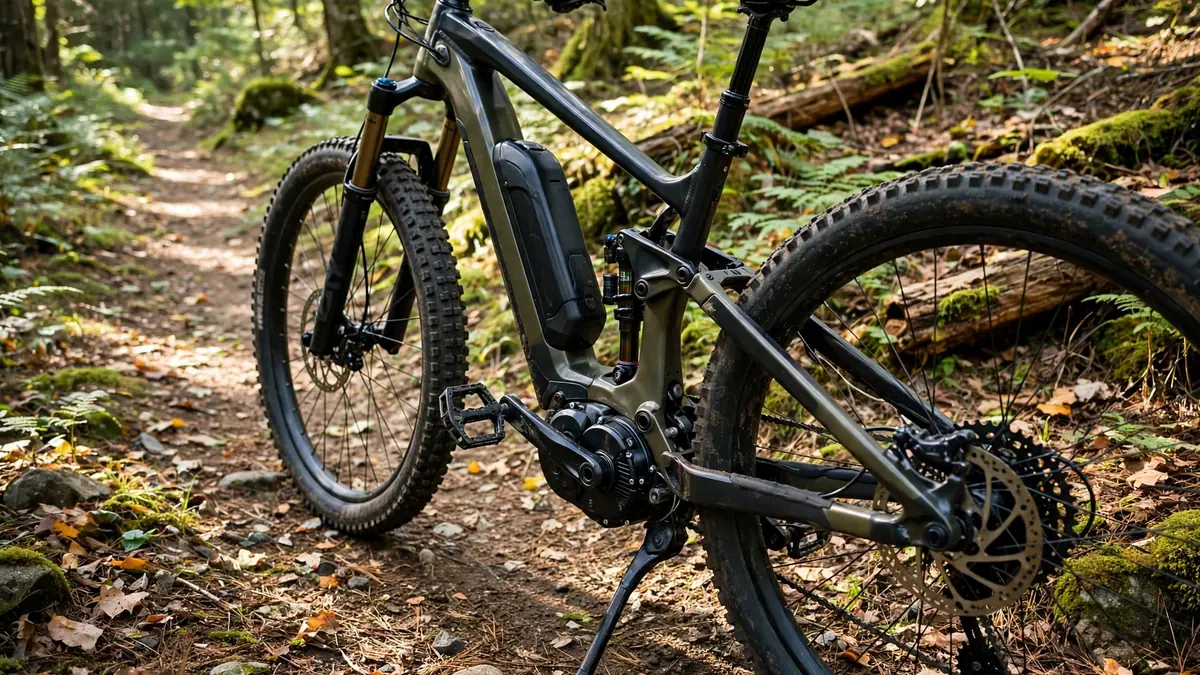
The hill does not get any shorter. It is steep, loose gravel under the tyres, and it goes on until the trees close over the track. You are not a professional cyclist. You are just a rider on an electric mountain bike, and yet you are climbing it at a steady pace, breathing hard but not beaten. The help is coming from a box the size of a lunchbox, bolted to the frame where the pedals meet.
That box is a mid-drive motor, and it is different from the hub motors that spin a wheel directly. It drives the cranks, which means it drives the chain, which means it can use the bike’s own gears. On a steep hill the motor spins fast through a low gear, the way you would, and on the flat it spins slower through a high one. Its materials are chosen to survive mud, rain, torque and years of it.
Here is what those materials are, and why each one earned its place.
The Materials Behind the E-Bike Mid-Drive Motor
1. Hardened steel gears, where the torque is multiplied
Inside the motor, a set of steel gears turns the fast spin of the electric motor into the slow, powerful turn of the cranks. The gears are usually a planetary set, small hardened steel pinions running inside a ring gear, and they carry the full torque of the motor plus the force of the rider’s legs. The steel is an alloy, heat-treated until its surface is hard enough to resist wear while its core stays tough enough not to crack. The gearbox build is shown step by step in how an e-bike mid-drive motor is made.
2. Copper windings and a silicon steel stator
The electric motor inside the unit is a compact brushless design, built around copper windings on a silicon steel stator, the same pairing found in drone and EV motors. The copper carries the current, the steel guides the magnetism, and the thin laminations of the stator keep wasteful eddy currents down. Because the motor is small and sealed inside the housing, it has very little air to cool it, so efficiency matters more than raw power: every watt lost as heat is a watt the housing has to shed through its own surface. The windings are enamel-coated and locked in place with epoxy, so trail vibration cannot rub them bare.
3. Neodymium magnets, small, strong and heat-sensitive
The rotor carries neodymium magnets, the same powerful alloy of neodymium, iron and boron used in drone motors, and they are what let such a small motor produce so much torque. The magnets are glued and clipped into the rotor, then coated to protect them from corrosion, because a magnet that rusts loses its grip on the steel beneath. Heat is their weakness: a long, steep climb on a hot day can push the motor’s temperature high enough to weaken the cheaper grades permanently. Better motors use high-temperature grades that cost more but survive the abuse.
4. Cast aluminium housing, the frame’s new bottom bracket
Everything sits inside a cast aluminium housing, which is also the structural heart of the bike: the cranks pass through it, the frame bolts to it, and the rider’s full weight pushes down on it. Aluminium is used because it is light, stiff, and easy to cast into the complex shape a motor unit needs, with ribs and fins that stiffen it and help it lose heat. It is machined at the bearing seats and frame mounts, and sealed with gaskets where the covers meet. The battery that feeds the motor is a system of its own, and the materials behind the e-bike battery show what sits inside the pack that powers all of this.
5. Bearings, seals and the bottom bracket shaft
The crank shaft runs through the middle of the motor on sealed ball bearings, and it takes a beating no ordinary bottom bracket ever sees: the rider’s weight, the motor’s torque, and the shock of every root and rock on the trail. The shaft is hardened steel, and the bearings are sealed against mud and water, packed with grease that stays put through winter. The seals are the weak point, and they are made from rubber and plastic composites chosen to stay flexible in the cold and keep grit out. The frame around it matters too, and how carbon fibre becomes an e-bike frame shows how it is built to take the same loads.
6. Torque sensor and controller, the parts that feel your legs
The last materials are in the sensor and the controller. A torque sensor, usually a steel shaft with strain gauges bonded to it, measures how hard the rider is pedalling, hundreds of times a second, and the controller uses that reading to decide how much help to give. The strain gauges are thin metal films whose electrical resistance changes as they stretch, and they are glued to the shaft with adhesives that must never creep or crack. The controller board itself is coated in a potting compound, a hard resin that seals the electronics against water and vibration.
E-Bike Mid-Drive Motor Materials
| Material | Where it is used | Why it is chosen |
|---|---|---|
| Heat-treated alloy steel | Planetary gears | Hard surface resists wear, tough core resists cracking |
| Enamelled copper and silicon steel | Motor windings and stator | Low resistance, guides magnetism, stays efficient |
| Neodymium-iron-boron magnets | Rotor | Strongest magnets available, huge torque from a small size |
| Cast aluminium alloy | Housing | Light, stiff, cast into complex shapes, sheds heat |
| Hardened steel shaft and sealed bearings | Bottom bracket | Takes rider weight and motor torque, keeps mud out |
| Strain gauges and potting resin | Torque sensor and controller | Measures pedal force, seals electronics from water |
What Does an E-Bike Mid-Drive Motor Cost?
A replacement mid-drive motor unit is estimated at roughly $400 to $1,200, depending on the brand, the power rating and whether it is a new or refurbished unit. Fitting adds to the bill, since the cranks, chainring and frame mounts all have to come off and go back on. A worn gear set or a failed bearing can be estimated at $100 to $300 to repair, which is why many owners service the motor before it fails rather than after.
A Rare Fact
A mid-drive motor can produce more torque at the rear wheel in first gear than many small motorcycles, yet it weighs less than a bag of flour. The trick is the gears: the motor spins fast, the gearbox slows it down, and the bike’s own gears slow it down again, multiplying the torque at each step. That is also why a mid-drive bike wears its chain and cassette faster than an ordinary bike. The motor is strong enough to stretch a chain designed for human legs alone, so full-power riders replace their drivetrain far more often than they expect.


An e-bike mid-drive motor looks like a plain metal box under the frame, but it is a gearbox, an electric motor, a sensor and a structural bracket in one housing. The steel takes the torque, the copper and magnets make it, the aluminium holds it together, and the sensor decides how much help you get.


